

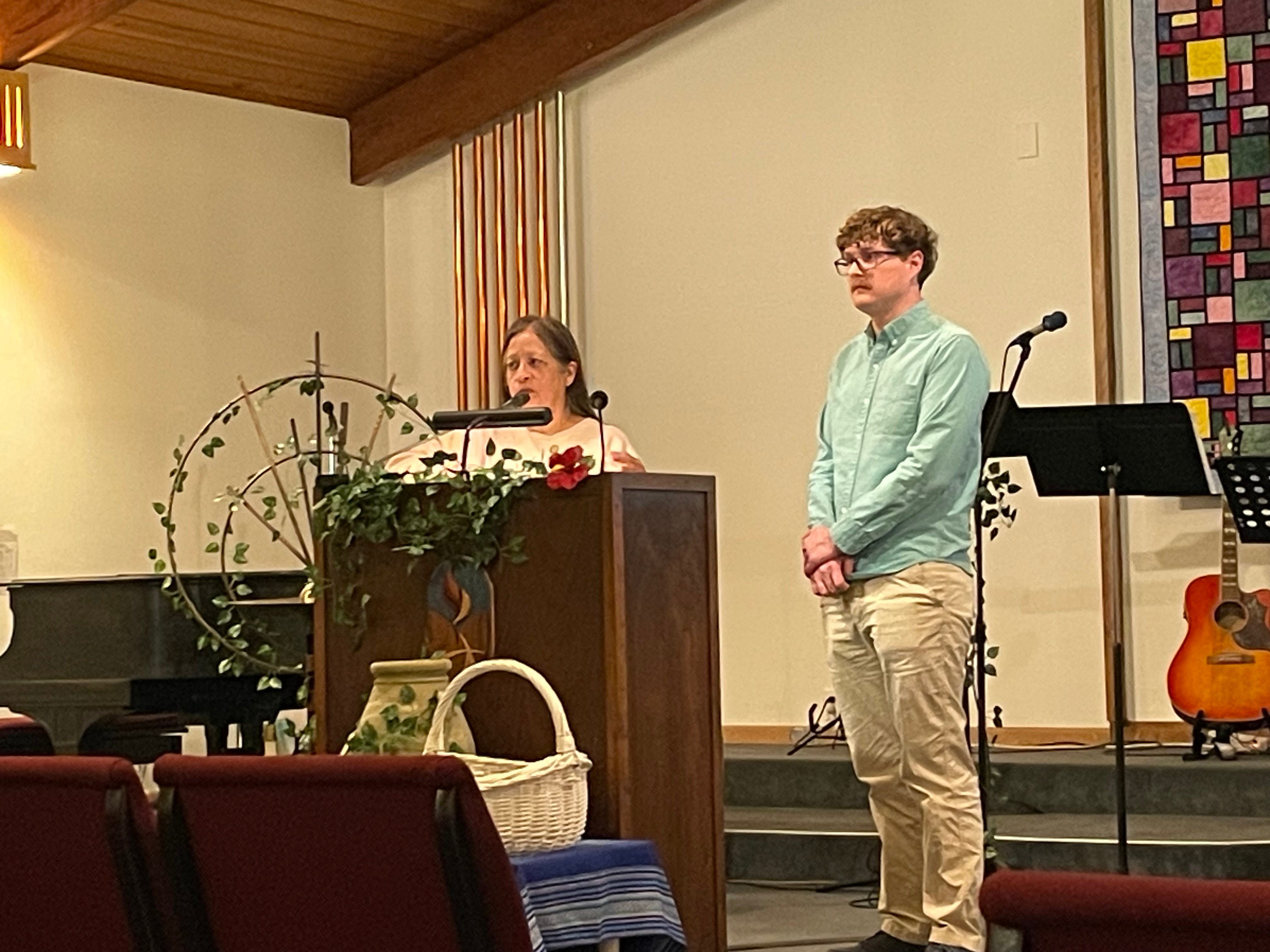
(Picture credit Lewis Thune)
OMAHA — State Senator Margo Juarez headlined an Omaha town hall on Tuesday with ProRail Nebraska, a 31-year-old rail lobbying organization currently focused on expanding passenger rail within the state.
The event, held at the Second Unitarian Church of Omaha, welcomed around 30 attendees for updates on the growing policy priority of Nebraska’s Democratic Socialists of America.
Richard Schmeling of ProRail Nebraska opened the meeting with an overview of current passenger rail capacity in the state, noting that Amtrak already exists within the state, operating a train between Omaha and Lincoln as part of its popular route between Denver and Chicago.
“It comes through once a day going in both directions, and currently it comes through about in the middle of the night,” he said.
The last notable addition to passenger rail in the state was an Amtrak station in Holdredge, a “one-off project” accomplished with funding from the 2022 Inflation Reduction Act. The biggest reason Schmeling observed for such sporadic development was a lack of central planning:
“Nebraska currently boasts the oldest state rail plan in the country, ours was last updated in 2003. South Dakota has a newer state rail plan than Nebraska and less rail service.”
In addition, he noted that Nebraska is not a part of any interstate rail commissions, an important factor in rail planning, as commissions provide access to increased federal funding due to the existence of multiple interstate economic regions.
Nebraska joining a commission remains among the group’s top priorities, Schmeling said, along with daylight Amtrak service and rail planning authority for Nebraska’s Department of Transportation and Public Service Commission.
He then welcomed State Senator Margo Juarez of District 5 to provide a legislative perspective on rail. Juarez has remained one of the foremost advocates for passenger rail in Nebraska. Among other things, she recounted attending a recent Midwest Interstate Passenger Rail Commission (MIPRC) meeting in Wisconsin and another rail-related conference in Boston.
“Since we’re in a budget deficit, we haven’t had any success in getting a bill passed at the state level to be part of the Commission… I will admit, it’s not cheap. It’s about $30,000 a year,” she said.
Her biggest priority, however, is updating the state rail plan.
“You definitely can’t go anywhere without having a state rail plan in place, now these are just some basic steps to try and get funding from the federal government.”
She asserted that she was open to different funding mechanisms, mentioning specifically dedicating a portion of the state’s gasoline tax, or perhaps taxes on recreational marijuana should senator Terrell McKinney’s recent bill pass.
One current rail project she mentioned Nebraska might be able to involve itself in would be MIPRC’s Midwest 40-Year Vision, which aims to develop 20 new routes across middle America. Toward that and similar goals, Juarez said she was going to “find out” if she could form a rail caucus.
“I’m just not real sure about the rules in Nebraska, because I know we don’t caucus but I didn’t know if that meant we didn’t do it for an interesting topic like rail.”
An extended time for audience questions raised some funding ideas, including one attendee who wondered if Nebraska could appropriate money to join the MIPRC via a ballot initiative. Schmeling indicated he was not certain on whether that was possible.
“I know there’s kind of a lot of legal wrangling around those usually, here with the single subject rules — but no, that’s a great suggestion,” he said.
“I’ll definitely look into that,” Juarez said.
In keeping with his frustrations expressed to The Plains Sentinel in July, Joyce Vondrasek, a democratic socialist running for Legislature in 2028, noted that previous efforts had stalled with seemingly little fight from Democrats, and asked Juarez whether she had an approximation of how many Democratic senators truly backed the passenger rail effort.
“It’s nice to think that the gains of the party in numbers is making mean something, but if the Democrats don’t actually support these things, we’ve got a long way to go,” he said.
“That is something that I will definitely need to have one-on-one interactions with them about. I think that, uh – I guess I don’t think that the current Democrats would be that much against it,” Juarez said.
Multiple attendees asked what positive messaging could help sell passenger rail between Omaha and Lincoln as a worthy cause. In response to one question, Schmeling recalled game-day trains from Omaha to Lincoln during the golden age of Husker football in 90’s.
“If you want to go to a football game, you’re right there in downtown just a couple of blocks away. We would love to see game-day trains come back.”
The questioner inquired whether a revival of passenger trains would revive Nebraska football’s national championship runs, drawing laughter from the crowd.
— Lewis Thune is a College Fix writing fellow with The Plains Sentinel.