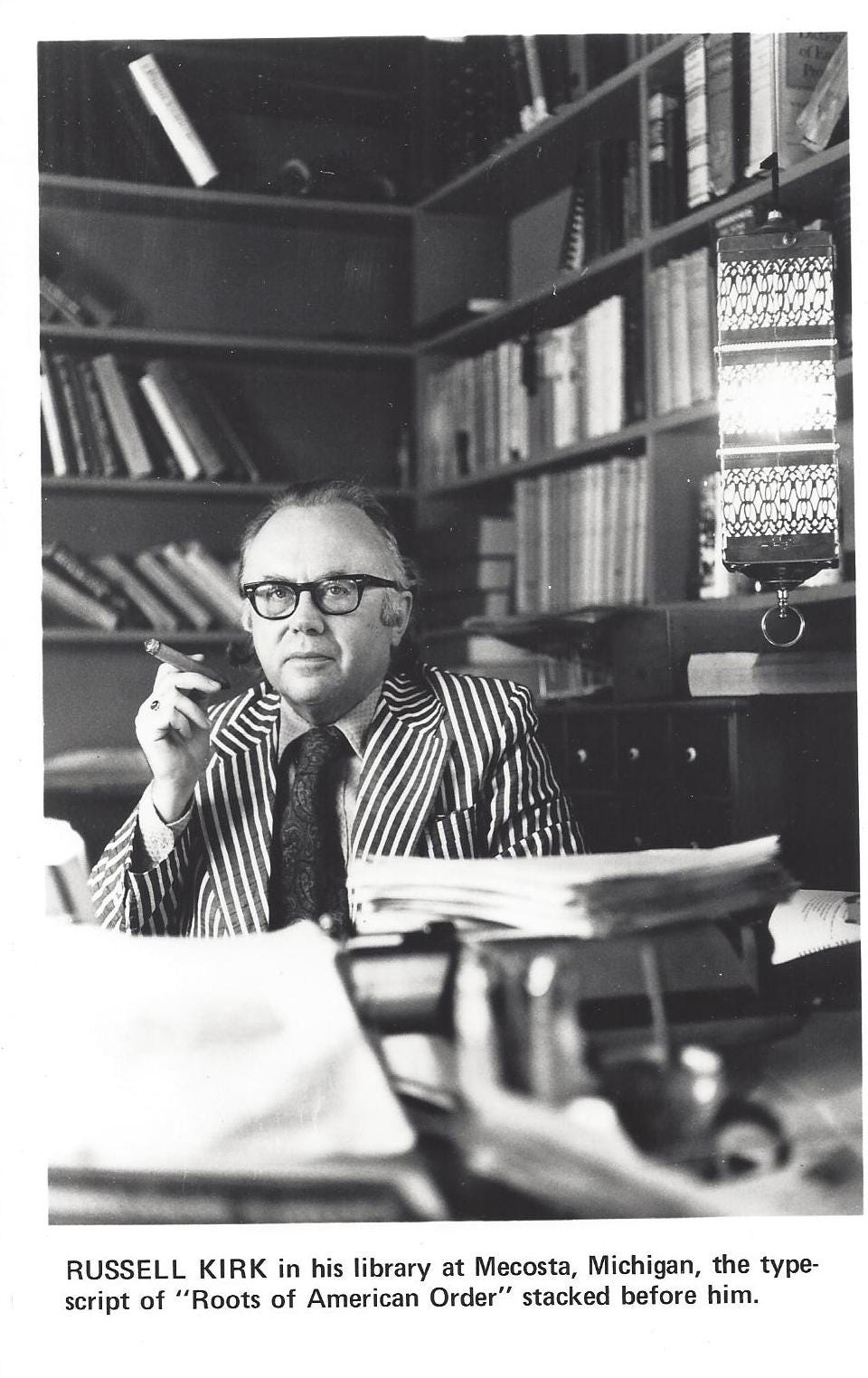
America 250 is a series by The Plains Sentinel celebrating our country’s 250th anniversary by highlighting the people, places, and events that have defined the Midwest and America.
Russell Kirk (1918-1994) is revered as the founder of modern American conservatism. He is perhaps best known for his 1953 book The Conservative Mind, which gave a name to the movement that culminated in Ronald Reagan’s election as president.
For Kirk, an authentic American conservatism was about more than preserving the economic or social privileges of a narrow class. He was concerned above all, rather, with understanding and protecting the ways that the American Founding manifested what he called the “Permanent Things” – those “those elements in the human condition that give us our nature” and that make life worth living.
For all its universality, there is nothing abstract about Kirk’s conservative vision. His defense of the Permanent Things was not a crusade to remake the world according to an “armed doctrine,” but instead a profound appreciation for the ways that particulars incarnate goodness, truth, and beauty.
Throughout Kirk’s life and work, this was evidenced by his intense loyalty to the region he called home: the Midwest. As we celebrate the 250th anniversary of our national independence amidst debates about the meaning and future of the conservative movement, there is much to learn from this local patriotism.
Kirk was born in Plymouth, Michigan, almost a month before the conclusion of World War I. The world in which Kirk was born was facing not just a political but also a technological revolution that was uprooting traditional ways of life.
And yet, as he lovingly recounts in his memoir The Sword of Imagination, family and place gave Kirk a perception of his place in a greater heritage. Spending time with his grandparents and reading old books, Kirk recounted, meant that “There entered into his head, early, something like T.S. Eliot’s awareness that the communication of the dead is tongued with fire.”
After service in World War II and studies at Duke University and the University of Saint Andrews in Scotland (where he was the first American to earn the prestigious Doctor of Letters), Kirk spent much of the 1950s trotting the globe. He lectured widely in the United States and also spent time in exotic locales, including Roman villas and the Sahara Desert.
Given all these global experiences, he sometimes referred to himself by the delightfully eccentric label “Bohemian Tory.” Writing as a new bohemianism was emerging, he reframed the wandering and cosmopolitan lifestyle through an attachment to “orthodoxy in church and state.” Instead of upending the commonsense lessons of his Midwestern childhood, Kirk’s travels taught him about their deeper truths.
After the smash success of The Conservative Mind in 1953, Kirk made a conscious decision to quit the academic rat race and move back to his family’s hometown of Mecosta, Michigan. With a population of just over 300, it was a far cry from the glitzy, jet-setting world of Kirk’s transatlantic peers such as William F. Buckley, Jr. His grandmother and great-aunts lived in Mecosta, on the property of an ancestral house known locally as Piety Hill.
To this day, the Russell Kirk Center for Cultural Renewal, an educational organization dedicated to promoting his legacy, is headquartered there.
In his memoir (written in the third-person), Kirk recounted how he found rural Michigan a respite. “Mecosta had good walking country still, along deer-hunters’ tracks, and an inveterate walker Kirk was. He was happy. He planted pines and spruces, thousands of them. Such was his life during the year after he had departed from Michigan State.”
He saw in the natural beauty of the world around him and the earthy manners of the community that inhabited it something worth defending – something worth conserving. Even as he threw himself into literary and political controversy and crossed rivers and oceans to lecture on conservatism, Kirk was always at heart a true patriot of the Midwest. Among his chief motivations was love of home.
Kirk reflected in his 1976 book The Roots of American Order on the unique constitutional character of the Old Northwest Territory, which would later become known as the Upper Midwest. Although the frontier was always marked by a sense of “rugged individualism,” those pioneers who expanded the American Republic did not live atomized lives. “It was America’s moral order, then, that sustained America’s social order,” Kirk wrote, drawing on the nineteenth-century observations of Alexis de Tocqueville.
The Midwestern pioneer “took for granted a moral order that was his custom and his habit. That is why the American frontiersman and backwoodsmen and entrepreneurs of the vast newly opened country were no men ‘in a state of nature.’ And that is why American democracy was not a democracy of degradation.”
The republican institutions founded in the Midwest, from schools to townships, were an expression of the long continuity of Western civilization. Like Aeneas bearing his father Anchises on his back, Kirk saw how his forefathers in Michigan bore a certain sense of human dignity Westward.
Kirk did not spend long alone in Mecosta as a bachelor. In the early 1960s he met and married Annette Courtemache, a native of Queens, New York. She moved to Mecosta, where she still lives, and together with Russell raised three daughters. Her description of his tenderness as a father is both moving and reveals how Kirk thought about home:
Russell’s emphasis on things of the heart and the hearth became more evident after we were married and began to have daughters. So mindful was he of pleasing children that when building an addition onto his ancestral home, he instructed the carpenters to place the windows closer to the floor so little ones could look out more easily. He also made sure there was a room in a tower that could be used as a clubhouse and a winding staircase to a cupola set atop the house allowing them to view village fireworks on the Fourth of July.
As a good Midwesterner, Kirk understood that home is not just a place we call our own – it must also be a place we invite others into. During the Cold War, the Kirk family often hosted refugees from totalitarianism at Piety Hill. Those seeking shelter from the gale of revolution could always find it in that old Italianate house in rural Michigan. People came from as far as Yugoslavia, Ethiopia, and Vietnam for sanctuary with the “Sage of Mecosta.”
Ultimately, what Russell Kirk’s Midwest localism demonstrates is the great lesson he always tried to teach: “The object of life is love.” True conservatism is the effort to defend a constitution ordered toward those loves, a constitution that shields our home from the threats she faces. Our lives are animated by universal principles, yes, but they are only incarnated in particular things. Armed with that insight from Dr. Kirk’s life and work, we might approach the question of patriotism with a truly renewed sense of moral imagination.
Michael Lucchese is the founder ofPipe Creek Consulting, an associate editor ofLaw & Liberty, and a contributing editor to Providence.He is also the editor of a forthcoming collection of Russell Kirk’s writings, On America: How to Understand the Legacy of 1776.