

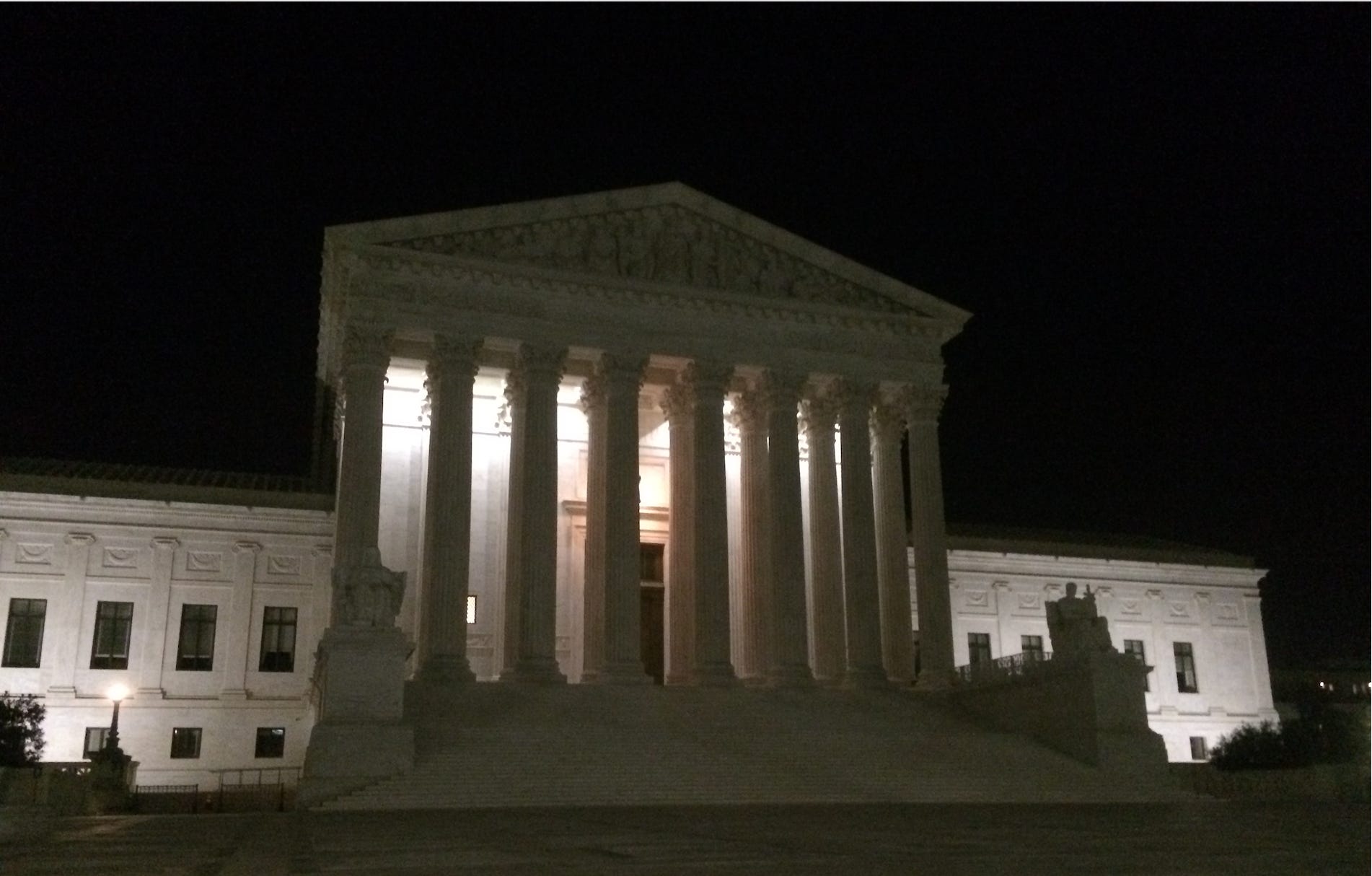
(Picture credit John Gage)
LINCOLN — The United States Supreme Court heard arguments last week in Trump v. Barbara over President Donald Trump’s executive order, which limited birthright citizenship to exclude children of illegal immigrants and temporary residents.
Before the attempted change by the Trump administration, the United States had been extending birthright citizenship to virtually anyone born in the U.S., regardless of their parents’ legal status. Birthright citizenship means hundreds of thousands of immigrants, legal and illegal, are giving birth to U.S. citizens each year.
The Pew Research Center released a research report last week, which showed that 9% of U.S. children were born to illegal immigrant mothers or mothers on temporary legal status. Pew estimated that 260,000 of the 3.6 million U.S. births would be affected by Trump’s birthright citizenship order if upheld.
The Plains Sentinel reached out to Jeff Passel, the researcher behind the report, to see if there was an estimate of how many Nebraskans would be affected if birthright citizenship were curtailed. Passel said that Pew did not break their report down by state, but he pointed to another report from Pew detailing a comparison of the number of illegal immigrants in the U.S. broken down by state.
“About 2.8% of Nebraska’s population consists of unauthorized immigrants according to our estimates,” he said. “The national share is 4.1%. States with lower shares of unauthorized immigrants probably have lower shares of births to unauthorized immigrant mothers.”
Pew estimates that Nebraska has 55,000 illegal immigrants residing in the state as of 2023 – a number that has risen sharply from just 45,000 in 2021. Pew’s state research goes back to 1990, when Nebraska only had an estimated 5,000 illegal immigrants.
While their analysis does not provide a state-by-state breakdown of births, a conservative estimate comparing Nebraska’s illegal immigrant population to the overall birthrate means that likely over 1,000 births annually in Nebraska would be affected by the Supreme Court birthright case.
Trump’s executive order was not retroactive, so any impact on temporary workers and illegal immigrants would only take effect moving forward, pending the outcome of the Supreme Court case.
Opponents, Proponents Argue For Rule of Law
Following Trump’s initial birthright order and a handful of additional immigration executive orders in January 2025, Governor Jim Pillen issued an executive order titled “Support for Federal Immigration Policy Implementation,” which sought to align the state of Nebraska’s policy on immigration with the Trump administration.
The order stated that “while the primary responsibility for enforcing immigration law rests with the federal government, states, counties, as well as cities and towns, have crucial roles in upholding America’s immigration laws, fighting illegal immigration, and protecting our citizens.”
In February 2025, Nebraska Attorney General Mike Hilgers joined a coalition of Republican attorneys general, who filed an amicus brief in favor of the Trump executive order. The amicus brief argued the Trump administration’s order stemmed from a “strong incentive for illegal immigration and birth tourism in hope of providing children with citizenship.”
The group argued that “increased illegal immigration has serious costs on the States.” “President Trump’s executive order will reduce harm to the States. Indeed, given the dangers of crossing illegally into the United States, stopping the incentive to try to cross the border will likely save many would-be border crossers’ lives,” the brief argued.
Proponents of birthright citizenship have argued that it is a guaranteed right under the 14th Amendment of the Constitution. Last week, following the hearing of arguments of Trump v. Barbara, the ACLU of Nebraska issued a statement slamming the Trump administration’s position on birthright citizenship.
“Birthright citizenship is a clear and longstanding constitutional principle,” Mindy Rush Chipman, the executive director of ACLU Nebraska, said in a statement. “President Trump wants to redefine who belongs in our country and what rights we are born with… The courts should focus on ensuring that constitutional protections are upheld fairly and consistently, to every person in this country.”
SCOTUS Appears Divided on Issue
Supreme Court justices appeared divided over the Trump order during oral arguments last week. Trump became the first sitting president to ever attend oral arguments at the Supreme Court — signaling how important the administration perceives the issue.
Chief Justice John Roberts called some of the arguments made by U.S. Solicitor General D. John Sauer, who was defending the Trump administration, “quirky” during the hearing. "I'm not quite sure how you can get to that big group from such tiny and sort of idiosyncratic examples," Roberts told Sauer after he had made the argument that birthright citizenship can be limited because children of ambassadors or enemies during a hostile invasion were exempt from it.
Conservative Justice Samuel Alito said that the Founding Fathers would not have recognized the type of illegal immigration issues the country is facing in modern America. “What we are dealing with here is something that was basically unknown at the time when the 14th Amendment was adopted, which was illegal immigration,” Alito said.
Following his attendance at oral arguments, Trump sent out a message on Truth Social saying America is “the only Country in the World STUPID enough to allow ‘Birthright’ Citizenship.”
John Gage is the executive editor of The Plains Sentinel.
READ MORE:
No 'Mississippi Miracle': Public School Coalition Gets Legislature to Kill 3rd Grade Literacy Bill

Lawmakers voted down a bill Wednesday aimed at improving literacy among Nebraska elementary students after a coalition of groups in support of public schools urged state senators to kill the measure.
‘Monitoring the Situation’: Free Speech Group Threatens High School Over Anti-ICE Cartoon

The Foundation for Individual Rights and Expression (FIRE), a nonprofit free speech organization, sent a letter to Gretna East High School after the school pulled a controversial anti-Immigration and Customs Enforcement (ICE) cartoon from the school newspaper.
‘Outrageous’: Nebraska Judges Receive Blowback Over Disparate Rape Rulings

OMAHA – A pair of judicial rulings is coming under scrutiny after two men who pleaded guilty to raping a 15-year-old boy got dramatically different sentences for the same charges. Last year, Judge Derek Vaughn sentenced Eric Bergstrom to 30 to 50 years in prison, while this month, Judge Rich McGowan sentenced co-defendant Bradley Perry to 3 years for 1s…
Nebraska AG Sues Gaming Giant Over Alleged ‘Pedophile Problem’

Nebraska Attorney General Mike Hilgers filed a lawsuit Wednesday against online gaming giant Roblox, alleging that the company has “created and maintained” an environment that gives rein to adult predators and the sexual exploitation of children.