

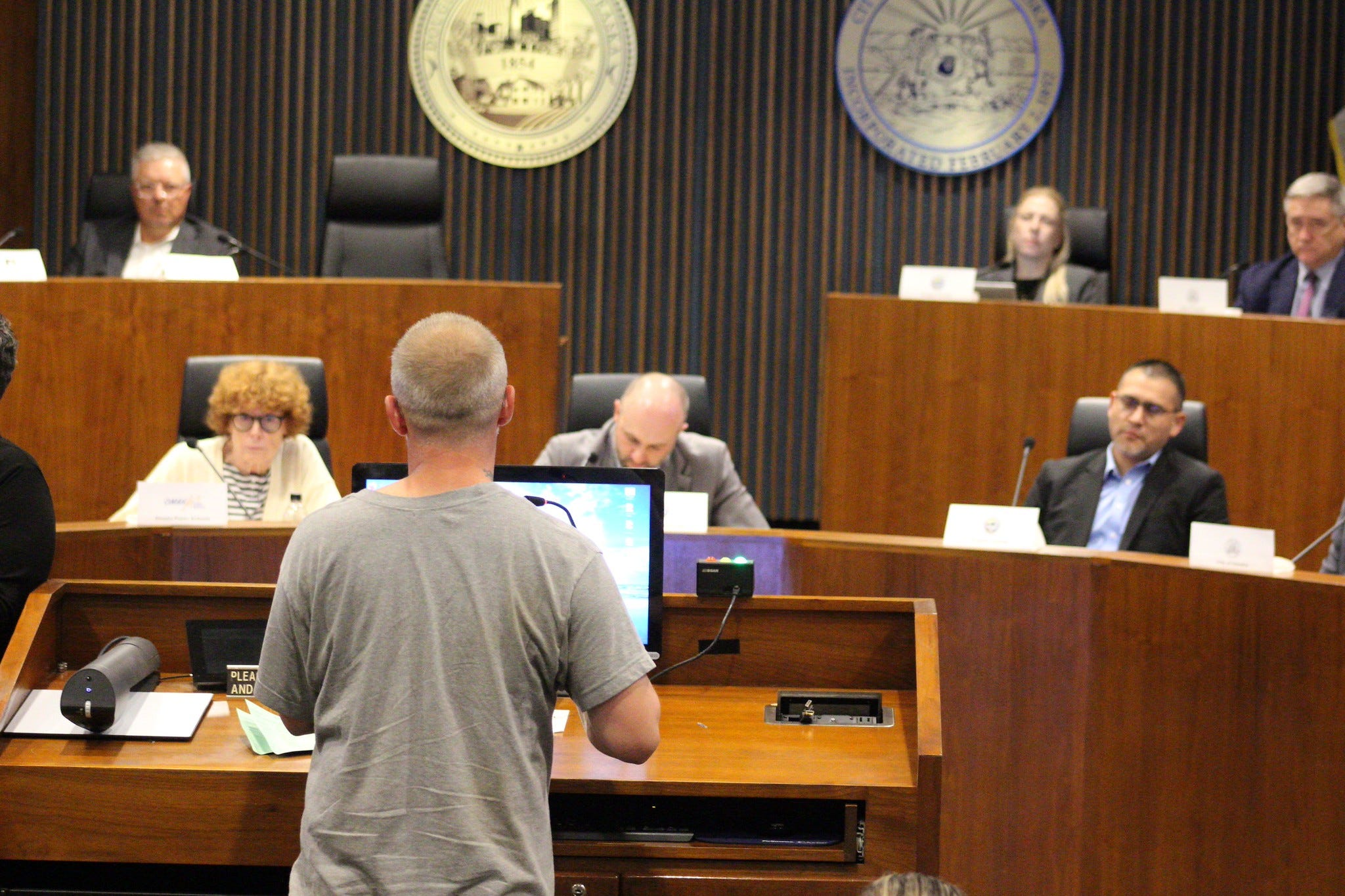
(Picture credit Matt Johnson)
Omaha taxpayers were given another chance Wednesday night to sound off on rising property taxes at a joint public hearing mandated by the Property Tax Request Act. The 2021 law also requires postcards notifying owners of a proposed tax increase to be mailed at least seven days before the hearing.
About 60 people attended, including Omaha City Council President Danny Begley. Douglas County Clerk/Comptroller Dan Esch led the meeting.
Presentations came first from Douglas County CFO Laurie Parrish, City of Omaha Finance Director Steve Curtis, Bennington Public Schools Superintendent Aaron Plas, Elkhorn Public Schools CFO Heather Shepherd, and Omaha Public Schools Chief Financial Officer Shane Rhian.
Also behind the dais were OPS Board President Jane Erdenberger, Douglas County Commissioner Roger Garcia, and Omaha Mayor John Ewing Jr.
Valuations Driving the Anger
With assessments rising so sharply, even a flat levy is still a tax increase. The chief complaint from many in the room was that the new values do not match the houses.
Erica Perez Morales, who lives on North 27th Street, said her assessed value jumped from $81,900 to $184,800.
“I live in a blighted neighborhood,” she said. “There’s gang violence. … We just had a flood two years ago that ruined all of our houses on my block. … A hundred thousand dollars of increase in the value of my house in the neighborhood that I live in is just outrageous.”
Tony Armendariz said 15 feet of his yard is sliding into a sinkhole beside a failing 40-foot wall the city has not fixed.
“My property value is going down into the ground, into a sinkhole, and there’s nothing I can do about it,” he said. “I can’t afford my taxes going up, because one day my house is gonna slide down into a sinkhole—and I might be with it.”
Yolanda Dorsey, who said she has lived in her house 58 years and has bullet holes in the walls, had a question for the assessor.
“Who does this property assessment? That’s what I wanna know,” she said. “Because if you look at my property, it’s not worth what they have on here.”
Esch anticipated that line of comment and opened by saying the deadline to protest 2026 valuations had already passed.
“Tonight’s public hearing is not an opportunity to officially contest your 2026 property valuation. Those deadlines for 2026 have already passed,” Esch said. “If someone is talking about their property valuation, I’m not gonna cut them off. But I just wanna make it clear that the window to officially contest your valuation for 2026 has already passed.”
Valuation-change notices are mailed on or before June 1. The levy-increase postcards that trigger this hearing go out much later—after the June 30 protest deadline.
One guest walked out at that news, saying, “Come on, people. It’s a joke!”
The Plains Sentinel spoke with the man, who did not want to be identified, before the hearing began.
“They’ve steadily come at me just every year, and I’ve come down here and protested my taxes, you know, three years in a row, and they’ve raised my taxes every year. So it doesn’t do any good to protest,” he said. “I’m not trying to sell my house. I’m trying to live in it until I die.”
OPS Driving a Large Share of the Tax Hike
Rhian said a state aid clawback is why OPS is asking for more property tax.
“Our state aid is being reduced by $50,618,295 for the upcoming school year due to an error in the calculation of state aid by the Nebraska Department of Education,” Rhian said. “Two years ago, when we received $60 million in additional state aid due to this calculation error and additional funding approved by the legislature, we reduced our levy by 10.9 cents. Now that we are losing that $50.6 million for the upcoming school year, we are proposing a total levy of $1.212, an increase of 8.2 cents, including the maximum general fund levy of $1.05.”
Some in the audience were not persuaded the increase was necessary.
“A budget crisis within OPS schools that we did not create is being dumped into our laps,” said Carla Okrina of North 42nd Street. “Negligence should not be rewarded with a blank check from the public. Many people in this room deeply support public schools. You cannot expect that support to be unconditional.”
Kara Feinhold said she drives 28 miles so her two children can attend school in Fort Calhoun rather than OPS.
“I was a graduate of OPS and felt like I floated through high school. I wanted better for my kids,” Feinhold said. “The OPS cohort dropout rate in 2021 was 10%. In 2025, 14.6. What are we doing?”
Corwin Keller, who is running for Learning Community Achievement Subcouncil 3, asked for more detail on spending cuts.
“Before asking taxpayers for additional revenue, I believe the public deserves a clear understanding of the steps already taken to reduce costs,” Keller said. “What specific administrative reduction costs have been made? What operational efficiencies have been implemented? What programs have been evaluated to ensure taxpayer dollars are producing measurable results? … When families face a budget shortfall, they look at efficiencies before asking someone else to pay their bills.”
Former Mayor Hal Daub challenged the city, the county, and OPS to form a public group to “scrub your budgets to look for savings.”
“The buck stops with the board that votes for the mill levy. That’s the tax,” Daub said. “And by looking for savings and actually making a project out of it, I’m proposing and challenging you to do that. Make a project that’s transparent with the right players around the table to look at how we can save, not how we can spend the automatic increase we know we’re gonna get.”
Where Taxpayers Go From Here
Each speaker had two minutes. The hearing was not a town hall, and no one on the dais answered the comments.
“There won’t be any back-and-forth discussion between those in the podium and the representatives of the dais,” Esch said. “This is just an opportunity to provide comments to the representatives here tonight.”
Taxpayers may have little choice in their local races in the near future with the Douglas County assessor-register of deeds and multiple of OPS board seats having no challenger.
For now, homeowners can wait and watch for next year’s postcards on the 2027 levies.
— Matt Johnson is a freelance reporter with The Plains Sentinel.