

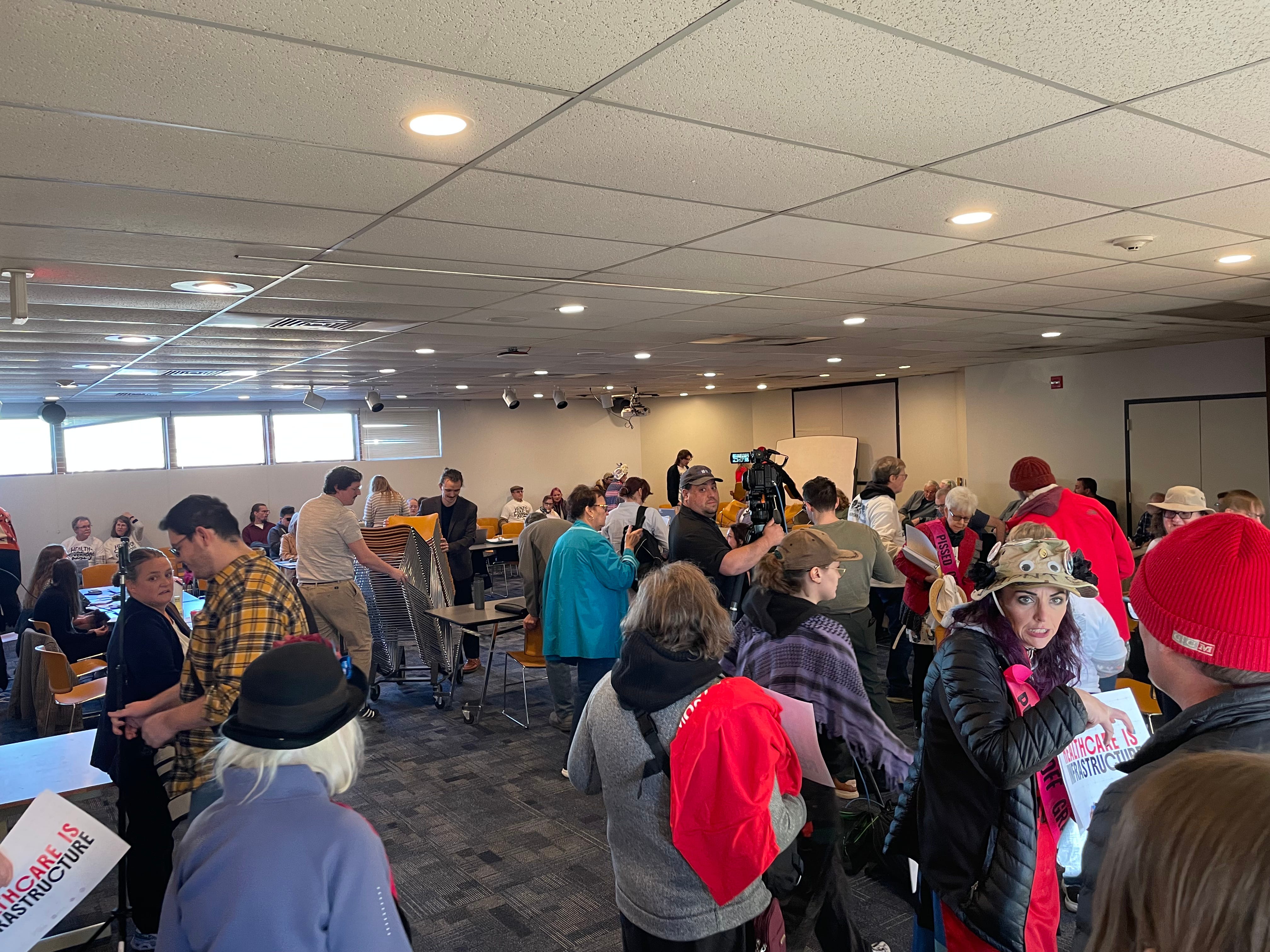
(Picture credit Lewis Thune)
LINCOLN — The Nebraska Medicaid Advisory Committee’s November meeting played host to about 80 members of Nebraska HealthWatch for a lengthy and occasionally contentious public comment period.
The purpose of the committee meeting was to discuss updates in its quality strategy and impending changes to Medicaid expansion recertification periods and retroactive coverage windows, as well as upcoming work requirement, verification, and attestation standards, a product of H.R.1, the “One Big Beautiful Bill.”
Exactly what those assembled sought from the committee was not entirely clear, with multiple HealthWatch attendees raising questions over the course of the meeting to ask what the committee’s actual makeup, function, and powers were.
Committee members answered questions in real time. The MAC is a federally mandated body composed of local providers, administrators, Medicaid recipients, and other Medicaid-connected personnel. According to its Nebraska government webpage, its purpose is “to make recommendations” for the Nebraska Medicaid program to the Nebraska Department of Health and Human Services.
Nebraska HealthWatch is a project of the Omaha and Lincoln Democratic Socialists of America which protests Nebraska’s implementation of Medicaid work requirements. That those assembled opposed work requirements; and the committee’s advisory-only role did not shield it from a spate of scoldings and accusations upon the opening of public comments.
“You said that you’re basing medial frailty on seeing whether they have a disability, which is really ableist,” the first commenter said regarding the medical frailty exception to work requirements.
“I can’t work 80 hours. I—like, impossible,” said the second commenter. “Like, the same people who need this extra help, obviously, like all this extra paperwork, all this extra shock. You guys can fight this. You could challenge this, but you’re doing it early instead.”
“All of our blood will be on your hands. I mean this with the utmost respect: you know better.”
“When you see me dead, you remember that you had the opportunity to fix this,” said the third commenter, a disabled senior. “I am dying because of your decisions.”
“Are you up to the task of actually standing up for these things and doing every single thing we can?” said another. “I want you to be on your best behavior whether or not you know we’re in the room… when you go home tonight, you go do me a favor and look at yourself and actually ask yourself if you’re doing the right thing.”
After two more commenters recounted navigating months’ worth of rabbit holes in getting their disabled child re-enrolled in Medicaid and directed questions at NHHS and Nebraska Medicaid, committee member Jacob Kawamoto had to again explain that MAC was a mixed advisory committee and not Nebraska Medicaid.
“So I myself, I’m representing Nebraska Medicaid,” he said. “But the committee is actually made up of providers, community service organizations, advocates, parents, members, so technically the committee are those members, right? That’s the Medicaid Advisory Committee.”
“That Medicaid Advisory Committee essentially works to, in this case, gather public input and determine if there’s something actual to follow up on… for future comments as well, just want to level set.”
This cleared the air somewhat, and other commenters addressed their frustration elsewhere. A slew of subsequent comments by additional HealthWatch members urged the advisory board that Medicaid should be funded more rather than less. Mike Gage of the Nebraska AFL-CIO also rose to briefly argue that cuts should be rejected.
“To even manage regular health care is already so difficult, and to add on more to that is to let people die,” said one woman. “It feels like you guys are going to be the scapegoats for our legislators and Jim Pillen and the Republicans up on Capitol Hill.”
Another woman, a psychiatric nurse, thanked the committee for being accommodating to the audience and asked that they consider advocating for a work requirement exemption for those actively seeking employment.
It was about this time that MAC’s status as an advisory committee began to click for the rest of those gathered.
“Like, is there, so does your recommendation from this committee have any guarantee of any kind of action from anybody in policy?” one woman asked.
“Our mandate is to make recommendations” one board member responded, “But the decisions are not ours, and the funding is not the department. The funding comes from the Legislature and from the federal government… we have no impact on either of those.”
He further reiterated that the committee had no authority to intervene on individual cases and the general purpose of the body was to find internal inefficiencies and negative impacts.
The commenter proceeded to call the committee toothless.
“I hope that all of you realize that you’re nothing more than a release valve… this is a way for the power that be to make all the rest of us be complacent. You are a stand-in for the people in power.”
She further chastised the board for not meeting in western Nebraska and mentioned Israel.
Mary Phillips, a board member who is herself of a publicly left-wing persuasion, did take minor offense at the insinuation that the committee was inconsequential.
“I’ve spent a lot of time working on these to be told I have no teeth and all my work was for nothing. This is not our first meeting,” she said. “We actually did just submit two reports on systematic concerns… we acted on the first one today that it will move forward to the leadership of DHHS, who by the way is in the room, sitting in front of you.”
Multiple board members chimed in to mention board applications were open, while some attendees argued the point, leading to Kawamoto attempting to quiet the room.
State senator-elect Christy Knorr then gave a public comment.
“No one should have to die because they do not have healthcare, I don’t know how much louder I can say that,” she said. “I know this is a state issue, but we also need to lean on our federal delegation. If we can spend $1 billion a day on a war that is needless, we can take care of our people.”
She concluded by calling work requirements “bunk” and saying the advisory committee “should have pushed back.”
The following commenter accused the committee of “bullshit” for saying they wanted to expand care, while the final one stated that he supported expanding Medicaid.
Despite some frustrations, the board members spoke highly of the gathered audience in closing, some joking they weren’t used to company. Janelle Miller of the Open Door Mission, a member of the committee, praised the group for showing up and asked that they remain hopeful and continue to engage with the committee.
“I’m here representing some of the most vulnerable people that we love, our neighbors,” she said, “the thing we can’t forget is hope… I was able to help – 12 years ago – get legislation started and it just passed this year. It took us 12 years to get legislation passed. It’s doable. You got to be persistent though. We all have to be persistent, ok? So want to inspire hope? Show up.”
— Lewis Thune is a College Fix writing fellow with The Plains Sentinel.
Anyone capable of working and refuses to do so, should not be entitled to free health care.
What a joke!! Not to mention the fact that it's EITHER work OR volunteer 80 hours a month. Some of those people act like the government is asking them to move the moon or something. But, I guess when you're a perpetual victim in life then that's the norm, not the exception