

(Picture credit Matt Johnson)
OMAHA — The race to replace Don Bacon has received national attention in this election. Democrats focus on the seat they see as one of the most flippable in the nation, and millions of dollars have been spent both in the primary and the general election.
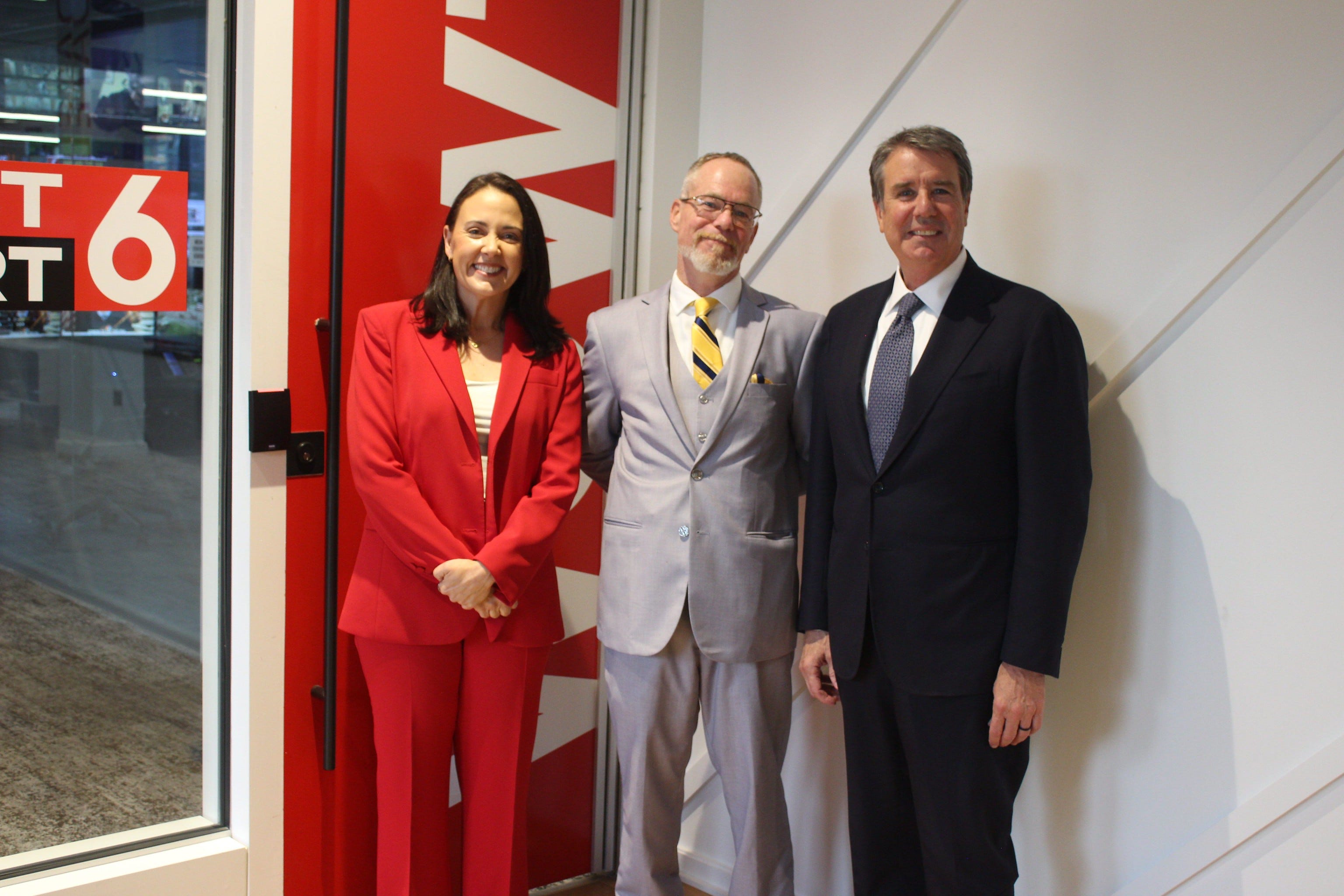
Three debates between the candidates were held this week, with the third and final coming Thursday afternoon. The Plains Sentinel got to speak with all three participants afterward: Democrat Denise Powell, Republican Brinker Harding, and Libertarian Eric Foreman.
Frontrunner Powell Makes Closing Argument
Don Bacon has managed to keep his seat for five terms while splitting with his party over various issues, gaining the support of Democrats who voted both for him and either Joe Biden or Kamala Harris.
The Plains Sentinel asked Powell if she would split on any issues with House Democrats as Bacon often did with Republicans.
“One of the things that I keep talking about is my frustration with the fact that we can’t pass a farm bill,” Powell said. “That’s really frustrating, and again, because I’m just hearing from so many farmers who are just drowning right now, and they need us to pass a farm bill, and I feel like in this moment we’re politicizing things.”
Powell has also been critical of actions by Immigration and Customs Enforcement under President Trump. The Plains Sentinel asked whether Powell felt the agency was run better under the Biden administration.
“No, I don’t. I don’t think either party has handled this well,” Powell said. “I mean, Obama didn’t do it well either. Obama was the deporter in chief. That was his nickname. Neither party has done right by this issue. Immigration policies haven’t been updated in 40 years. We need to take it seriously.”
The Plains Sentinel followed up, asking whether Powell was referring to the Immigration Reform and Control Act signed by President Reagan in 1986, which included both amnesty and a pathway to citizenship.
“That’s the last time there was any sort of substantive change to immigration policy, and we haven’t seen anything since, and the world has changed,” Powell said. “I recognize that this is a moment for a bipartisan coalition of people who want to work to make substantive change that keeps our country safe, but that also makes sure that we’re offering opportunities to folks who are going to be part of our communities.”
Powell cited her work on ballot initiatives to raise the minimum wage and establish paid sick leave as examples of building trust in the district. The Plains Sentinel brought up Ballot Initiative 442, a proposed constitutional amendment restricting participation in girls’ and women’s sports based on biological sex, and asked whether Powell supported the original language of Title IX prohibiting discrimination on the basis of sex.
Powell did not directly answer the question, instead turning to the issue of sexual assault.
“One of the reasons I think Title IX is so important is because it also protects survivors of sexual assault on college campuses, and unfortunately, that is something that we keep hearing about all the time,” Powell said. “I think those protections are incredibly important, so I think it’s important for us to keep Title IX and make sure that we are doing everything possible to protect our students on campus, all of them.”
Harding Holding On
Affordability has been a top issue of concern this year, as the conflict in Iran has been a key factor in rising prices at the pump. Rarely discussed, however, has been the possibility of increasing domestic oil production to reduce reliance on foreign countries for the United States’ energy needs.
Harding briefly brought the topic up in the second debate on Wednesday evening, and The Plains Sentinel asked him about it after Thursday’s debate.
“We absolutely need to make sure that we are energy independent. We had energy independence just not too long ago, but I think with the Biden administration coming in, the Green New Deal, we lost a lot of that,” Harding said. “We haven’t built a new refinery in the United States for over 40 years. If we are reliant on foreign energy, and foreign energy under despots, that’s not a good plan.”
Another hot topic for candidates on both sides has been congressional stock trading. During the debate, Foreman said that the U.S. had a law on it already, but that it had “no teeth.” Harding agreed.
“We’ve got members of Congress who have 240% increases on their portfolio year over year,” Harding said. “We want to make sure that it has teeth. We want to make sure it’s comprehensive. We want to make sure that it has the ability to be enforced, and not just another law on the book that isn’t.”
Questions on artificial intelligence came up in multiple debates. Powell said, “When you have all the major CEOs of every AI company basically going to the United Nations and asking for regulation, we should listen.”
The Plains Sentinel asked Harding whether he thought regulatory capture should instead be a concern, as the cost of independent AI platforms becomes more affordable and small start-ups may emerge to compete with tech giants.
“I think there’s a balancing act that needs to happen,” Harding said. “I mean, we want to make sure that there’s open opportunities for all to play in the arena, but we want to make sure that we don’t over regulate it to a point where they can’t have that competition.”
Harding also said that data centers did not need tax incentives and emphasized the importance of both competing with China and prioritizing concerns like the Ogallala Aquifer and local control.
The Libertarian Candidate Enters the Fray
Foreman shared the stage with Powell and Harding for the first time on Thursday. He told The Plains Sentinel that he had driven there in a truck “full of tree branches” that he spent the morning picking up.
“I’m just a nobody from Lincoln, Nebraska,” he said. “I saw more and more unaccountability, more and more corruption, and then when children started becoming a commodity of this corruption, I had to step up. No more sitting on the sidelines.”
Both Powell and Harding expressed appreciation for Foreman sharing the stage with them, and they both agreed on several issues with him throughout the debate.
Harding and Foreman agreed on issues of regulation when it came to health and vaccines, and they also agreed that data centers do not need tax incentives.
“I agree with Brinker,” Foreman said. “They don’t need the incentives. They’re a multi-billion-dollar company. They don’t need tax breaks.”
Powell, in kind, said that Foreman made “a lot of really great points” when he commented on immigration enforcement.
“We don’t need to run standing armies through our neighborhoods or have a terror campaign to scare people into deporting themselves,” Foreman said. “I think we can do it smart, we can do it with compassion, and we can do it by the letter of the law that’s already written.”
The Plains Sentinel asked Foreman why he ran as a third-party candidate in the general election rather than in a primary with one of the two major parties.
“I probably would’ve considered running for the Republicans, and I reached out to them at the very beginning, but it didn’t seem they were very welcoming to nobodies or to outsiders,” Foreman said. “And much like both parties, you see it’s a big club.”
Foreman pointed out the other new parties that have sprung up in this election, such as the America First Party and the Nebraska Working People Party, as a sign that voters want more choices. The Plains Sentinel asked if he thought they were created in good faith or as an attempt to split the vote.
“I think they were created in good faith. Whether they’ve been used in that manner is a different story,” Foreman said. “We want actual choices. Two of the same bird every single election year is not a choice for Americans. Having three, four, five different candidates on one stage, that’s the goal.”
Election Loams
With November 3 approaching fast, current polls and betting markets highly favor Powell to flip the seat. With the final debate now over, the candidates make their closing arguments ahead of Election Day.
“It has been honestly the honor of my life to have a shot at this seat,” Powell said. “I never, ever wanted to run for office, certainly not for Congress, but the fact that people share their stories and their hopes and their dreams, it’s a tremendous honor.”
And Harding, should he win, does not plan to have a long career in Congress.
“I’ve talked a lot about term limits. I want to be there long enough to be part of the solution, and not long enough to be part of the problem,” Harding said. “But here’s the other deal. When I’m done there, I’m going to come back to Omaha, and I’m going to live under the rules and the laws that I enact, and that’s exactly what a member of Congress should do.”
And Foreman was glad to have the platform to share his platform with a wider audience.
“It was a great opportunity for a third-party candidate to get out there and just speak in general,” Foreman said. “But for the message to resonate, people need to understand that we are all Americans. We’re united under the banner of that freedom, that liberty, and that justice will be served on everybody’s behalf.”
— Matt Johnson is a freelance reporter with The Plains Sentinel.