

(Picture credits Matt Johnson)
OMAHA — As Election Day approaches, and with early voting already underway in Nebraska, groups across the political spectrum are working to get out the vote. This week brought a sharp focus on faith communities in Omaha from both ends of that spectrum.
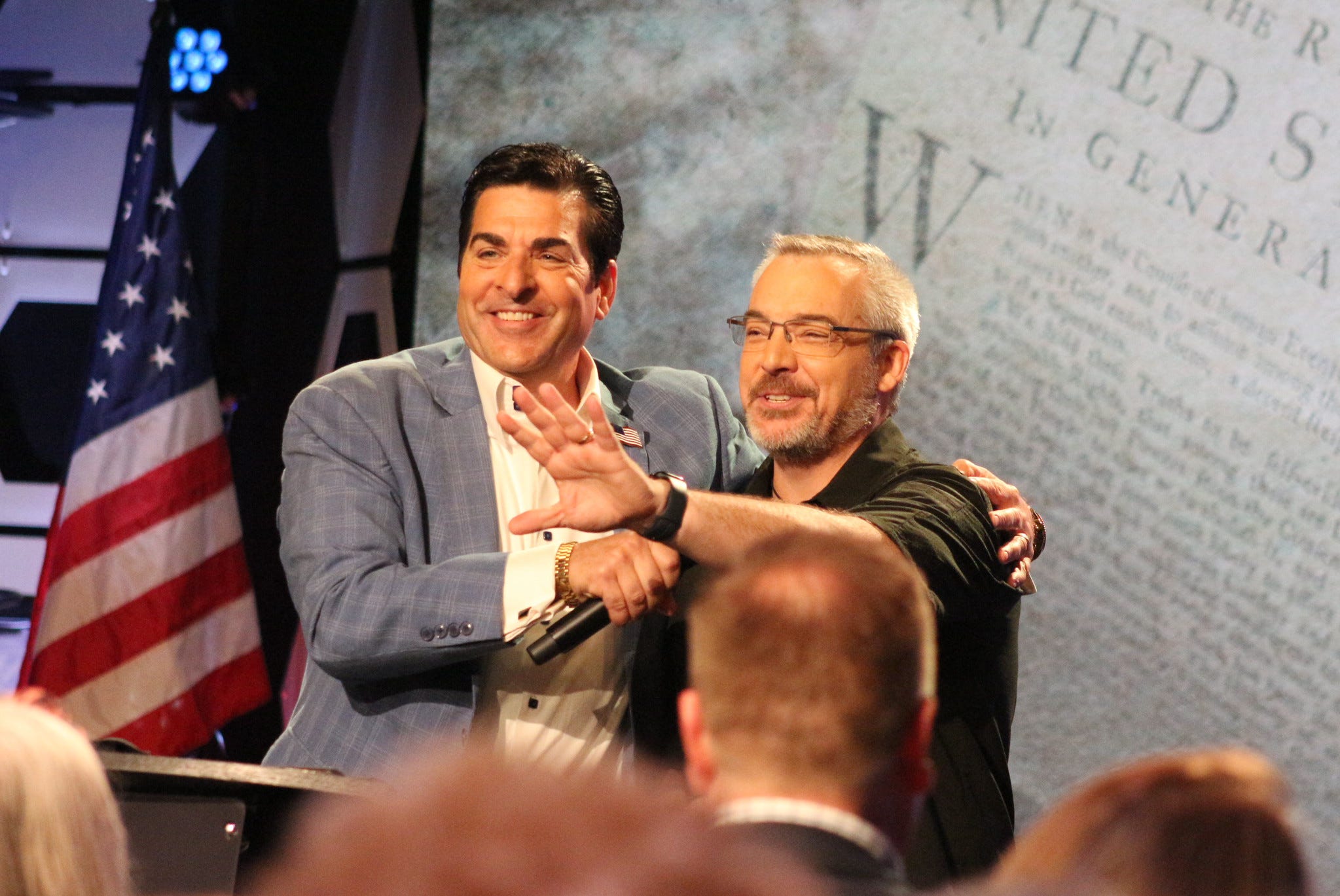
On Monday evening, Lord of Hosts, a conservative and politically engaged church in Millard, held a two-hour event titled “Vote Your Values,” featuring local candidates, voter guides, and speakers who cited Scripture to encourage attendees to show their faith at the ballot box.
Then on Tuesday morning, the Interfaith Alliance, a progressive group formed in 1994 to counter conservative groups such as the Christian Coalition, launched a cross-country bus tour titled “The Vote Is Sacred,” starting at the Tri-Faith Commons in Omaha.
Wielding Scripture in Political Battle
Lord of Hosts was started in 1997 by Hank Kunneman and his wife, Brenda, both of whom opened Monday night’s event. Hank Kunneman has been regularly featured and criticized by left-leaning watchdog groups such as Right Wing Watch for sermons that use Scripture to make political points.
Hank Kunneman’s opening remarks cited 1 Timothy 4:1–3, in which the Apostle Paul describes “doctrines of demons” spread through hypocritical human teachers whose consciences are “seared.” Kunneman related the verse to current culture-war issues.
“You talk to Christians today, and they will defend the right to kill a baby in the womb and argue whether it’s a child or not,” Kunneman said. “They will fight for the drag queen to keep reading to the kids in school, and pedophilia and pornography to be checked out by a seven-year-old.”
In turn, Brenda Kunneman cited Isaiah 5:20, which warns, “Woe to those who call evil good, and good evil.”
“Where good is evil, evil’s good, and killing murderers is wrong, but killing innocent babies is now somehow right,” she said. “Wake up, America. The great unsinkable ship Titanic has hit an iceberg, and taking on water and sinking fast.”
The keynote address was given by Rick Green, a former Texas state representative, co-host of The WallBuilders Show, and co-founder of Patriot Academy.
Green sees America’s 250th anniversary as an inflection point, and he argued that another stretch of liberty depends on George Mason’s “frequent recurrence to fundamental principles.”
“What he’s saying is, if we want that freedom, if we want to pass it to our children and our grandchildren, then we have to have a frequent recurrence to the principles that actually gave us that freedom in the first place,” Green said.
Green drew on quotations from Founding Fathers such as Benjamin Rush, who wrote in a letter to John Adams, “By renouncing the Bible, philosophers swing from their moorings upon all moral subjects. ... It is the only correct map of the human heart that ever has been published.”
“Now think about what that line means: when you renounce the Bible, you swing from your moorings,” Green said. “So now you’re not anchored to anything. You actually get so deceived, you don’t know what a woman is. You get so deceived you think men can have babies. Oh, yeah. I mean, we’re at that point.”
Green also cited the revivalist Charles Finney, a leading figure of the Second Great Awakening:
“If Satan rules in our halls of legislation, the pulpit is responsible for it. If our politics become so corrupt that the very foundations of our government are ready to fall away, the pulpit is responsible for it.”
Green applied the idea practically, invoking the Declaration of Independence’s call to “alter or abolish” any government that becomes destructive of the rights to life, liberty, and the pursuit of happiness.
“We don’t have to take up arms against our government or any of that,” Green said. “We don’t need bullets for a revolution—we need ballots. We need to be voting as the church, and we can ‘alter or abolish.’ So that’s what we’re going to do. That’s what the Declaration tells us to do.”
Green closed by addressing reasons Christians choose not to vote, first among them having to choose “the lesser of two evils.”
“Unless Jesus Christ is on the ballot, you will vote for the lesser of two evils,” Green said. “There is none righteous. No, not one. We are all flawed jars of clay. I have yet to find a candidate I agree with 100%.”
Terri Blackburn, political liaison for Lord of Hosts, later encouraged members not only to vote, but to attend public meetings, reach out to elected officials, and learn how to join local boards, task forces, and committees.
“‘Our Constitution was made for a moral and religious people. It is wholly inadequate to the government of any other,’” Blackburn said, quoting John Adams. “When I read that quote, to me, that says that our government, our Constitution, was made with the intent of Christians being involved and being a part of it. I think it’s time for the body of Christ to stop being reactive, to be proactive, and start taking our seat at the table.”
The Sanctity of the Right to Vote
“The Vote Is Sacred” bus tour the following morning was a dramatic contrast from the left to the conservative event at Lord of Hosts. It was held on the grounds of the Tri-Faith Commons, which include Countryside Community Church (United Church of Christ), Temple Israel, and the American Muslim Institute.
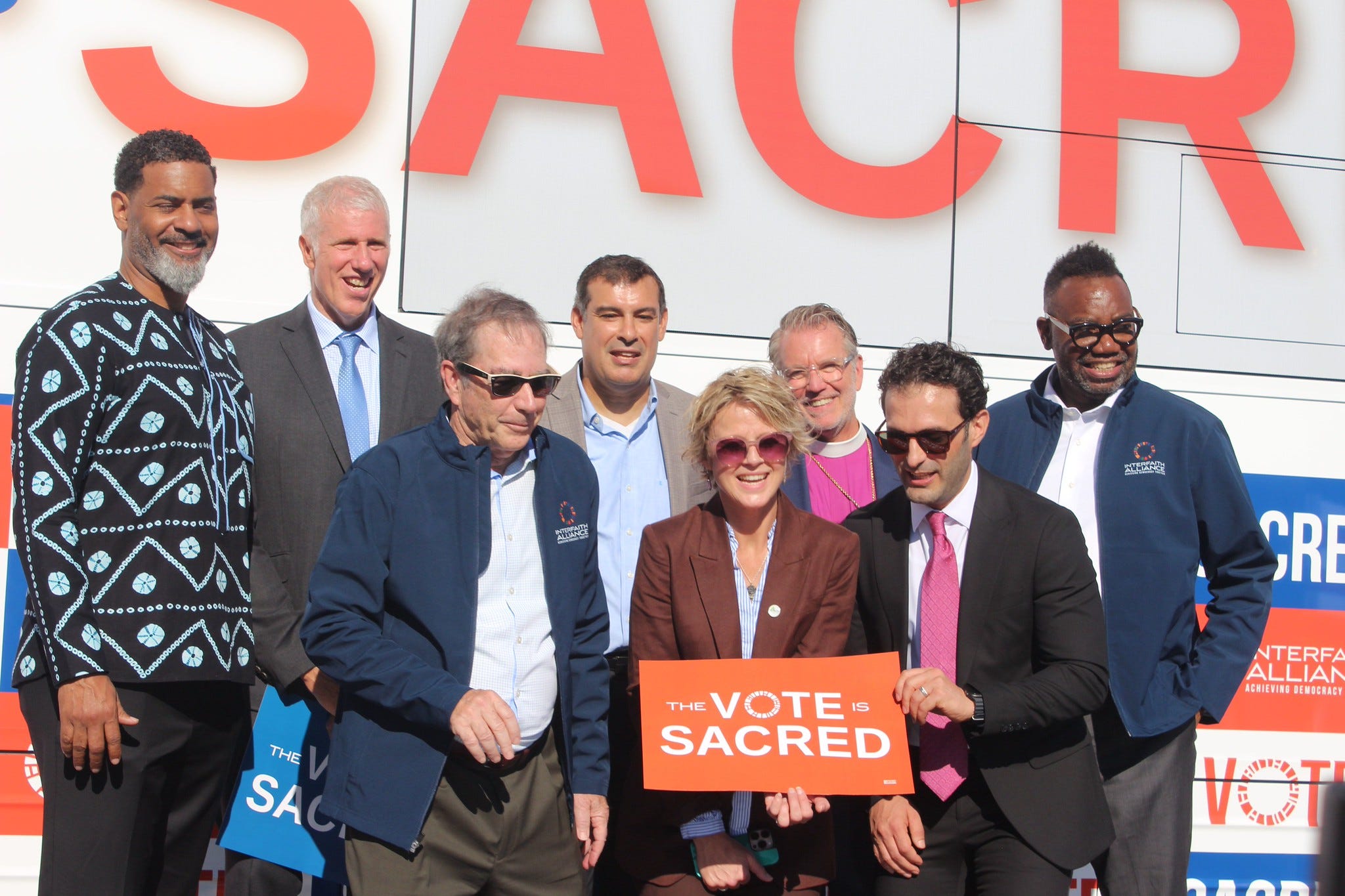
Rev. Dr. Jenny Shultz-Thomas, senior minister of Countryside Community Church, spoke about what she called the “miracle” of the location:
“We are standing on sacred ground. Indigenous peoples farmed this land, lived here, cultivated what we have now. It was a former Jewish golf course, because we know there’s been discrimination living in the bones of this country for too long. And so now we are gathered with a mosque, a synagogue, and a Christian church. Who thought this would happen?”
The event featured speakers from several faiths, all urging people to exercise the right to vote.
Unlike the Lord of Hosts event, there were no recitations of Scripture and no references to the Founding Fathers. Speakers instead invoked figures from the civil rights movement of the 1960s, including John Lewis and Dr. Martin Luther King, Jr.
“Our tour is ‘The Vote Is Sacred.’ It is rooted in the late Rep. John Lewis, who was one of the great saints of democracy in our country,” said Interfaith Alliance CEO Rev. Paul Brandeis Raushenbush. “Rep. John Lewis, who was also a Baptist minister, knew what it took to get votes for everyone, especially Black Americans. We’re in a moment when people are trying to take away the rights of people. They’re trying to intimidate us. They’re trying to gerrymander us. They’re trying to say that the vote doesn’t matter.”
The Plains Sentinel asked Raushenbush to elaborate on how the right to vote might be suppressed today.
“We’re listening to what is being said by the [Trump] administration,” Raushenbush said. “The President hasn’t ruled out sending—you know, all of this is illegal—but the president hasn’t ruled out sending armed guards. Kash Patel in a statement said he might send the FBI. There’s been talk of sending ICE. So we’re just listening to what they’re saying, and what we don’t want is people to feel intimidated.”
Intimidation at the polls was a recurring theme. Rev. Thomas L. Bowen, general secretary of the Progressive National Baptist Convention, told The Plains Sentinel some of his concerns.
“There are people who are scared to vote, particularly if they have injustice involved, particularly if their immigrant status has a question mark, or even if they’re wondering what would happen if they tried to go out to vote,” Bowen said. “I think that people are nervous that their mail-in ballots will not be accepted, but I think that’s having the opposite effect, as encouraging people to get out to vote early.”
Scott Barker, bishop of the Episcopal Diocese of Nebraska, said American voters were seeing something akin to the 1960s.
“Sixty years ago, in a moment of change and division every bit as great as this one, the Reverend Dr. Martin Luther King Jr. said, ‘So long as I do not firmly and irrevocably possess the right to vote, I do not possess myself. I cannot make up my mind. It is made up for me,’” Barker stated.
Rev. Shultz-Thomas described the right to vote as “our power” and “our fight to push back against empire, the resistance that is seeking to destroy and dehumanize the voter.”
The Plains Sentinel asked her to elaborate.
“Not only is the vote being suppressed, the voter, right, is being dehumanized. If you are registered to vote, there’s language that’s confusing. They’re mailing letters that tell you to vote in different places or using ambiguous language. They are checking IDs. They’re making people register off of an ICE detainee list, an immigrant list. They’re using those same lists to deny people the right to vote who are citizens of this country and who have every right to vote.”
Faith on the Campaign Trail
The injection of faith into politics is nothing new, but it does appear to be making a resurgence for both Democrats and Republicans as the midterm elections approach.
Lynne Walz, the Democratic candidate for governor of Nebraska, frequently mentions her faith on the stump.
“My parents were very, very faithful people,” Walz said at an Omaha event last week. “They taught me two things. Number one is to love and trust God—and I have to tell you guys, I have to do that a lot right now. The other thing is that I need to honor God by loving my neighbor.”
Speaking at an event in Fremont, Gov. Jim Pillen made a point of telling Christians to engage in the political process.
“Talk to people we go to church with,” Pillen said. “It is okay to talk about voting on the church steps. That is, we’ve been duped on this separation of church and state stuff. We have to make sure that we get out and vote.”
— Matt Johnson is a freelance reporter with The Plains Sentinel.