

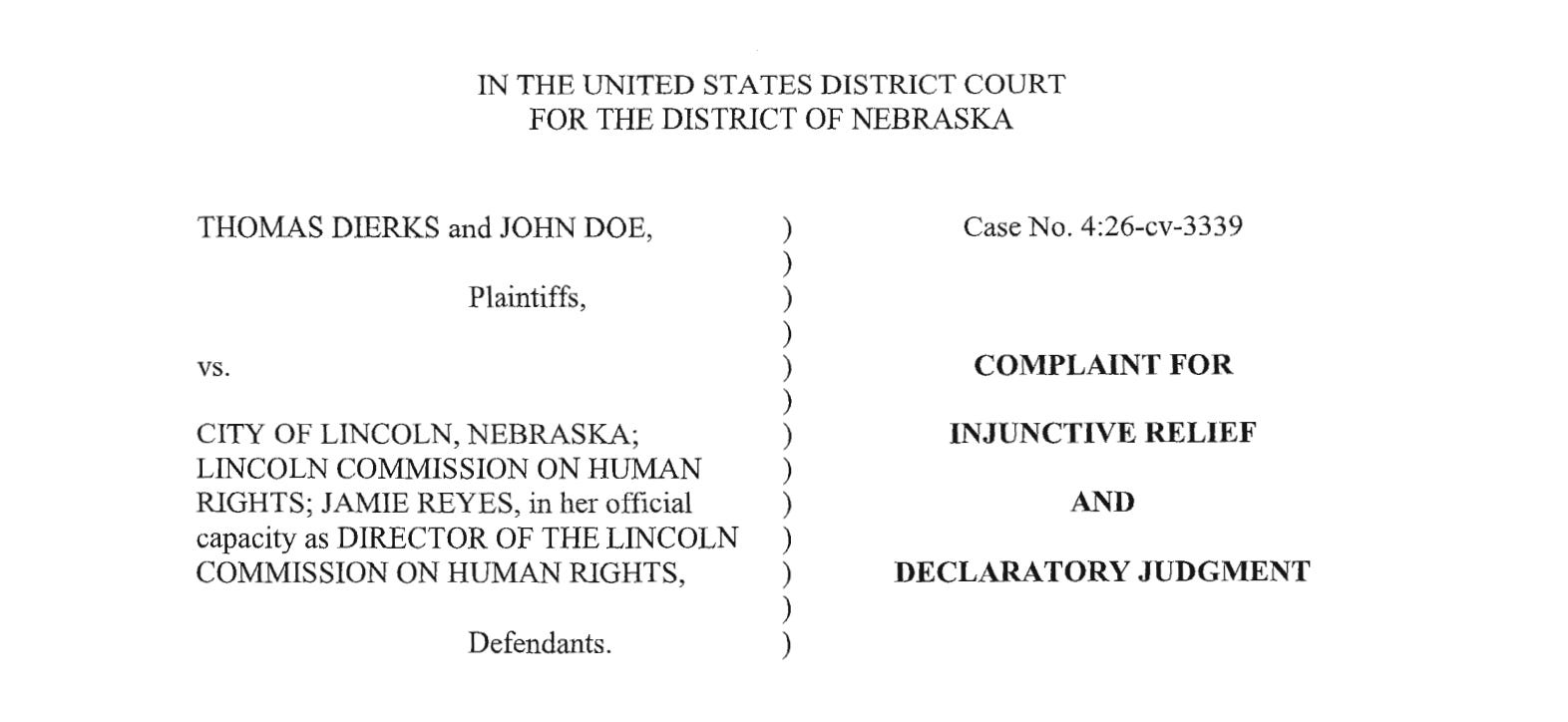
(Picture credit Tom Dierks)
The city of Lincoln and its Commission on Human Rights are being sued by two Christian counselors over its conversion therapy ban on minors.
Tom Dierks, a former candidate for state legislature, and a John Doe filed suit Tuesday that alleges the ban “violates their First Amendment rights to provide purely talk therapy desired by their clients to align their sexual orientation or gender identity with their faith-based or other personal goals.”
Violations of Lincoln’s conversion therapy ban incur $100 fines “for each act of unlawful sexual orientation or gender identity change effort.”
The Supreme Court has previously found a similar statute unconstitutional in Colorado, which has triggered questions about the validity of Lincoln’s ordinance. A city spokesperson told The Plains Sentinel last spring that it was weighing legal options.
“The City Attorney’s Office is aware of the Supreme Court ruling overturning a conversion therapy ban in Colorado, at this time the City Attorney’s Office is reviewing what that ruling means for the City of Lincoln’s Ordinance banning conversion therapy,” a spokesperson for the city said.
In April, The Plains Sentinel spoke with Matthew Heffron, a senior legal counsel with the Thomas More Society and the lawyer who filed the lawsuit on behalf of Dierks and Doe.
“It’s now dead in the water,” Heffron said. “To the extent that the Colorado law is unconstitutional, the Lincoln ordinance is unconstitutional as well.”
“When it’s unconstitutional, then there’s nothing they can do with that. If you try and enforce it against someone, then that person would challenge it based on this Chiles case,” he added.
Heffron said both the Colorado and Lincoln measures were “clearly” drafted off the same general template. “There’s very little difference between the two,” he said. “Just a few minor words.”
ACLU Nebraska, which supported the ordinance, said that Colorado’s ruling “could prevent the enforcement of any city or state prohibitions that mirror Colorado’s.”
Heffron said the lawsuit was necessary because the city of Lincoln continued to ignore requests for clarity about whether they planned to continue enforcing the ordinance.
— John Gage is the executive editor of The Plains Sentinel.