

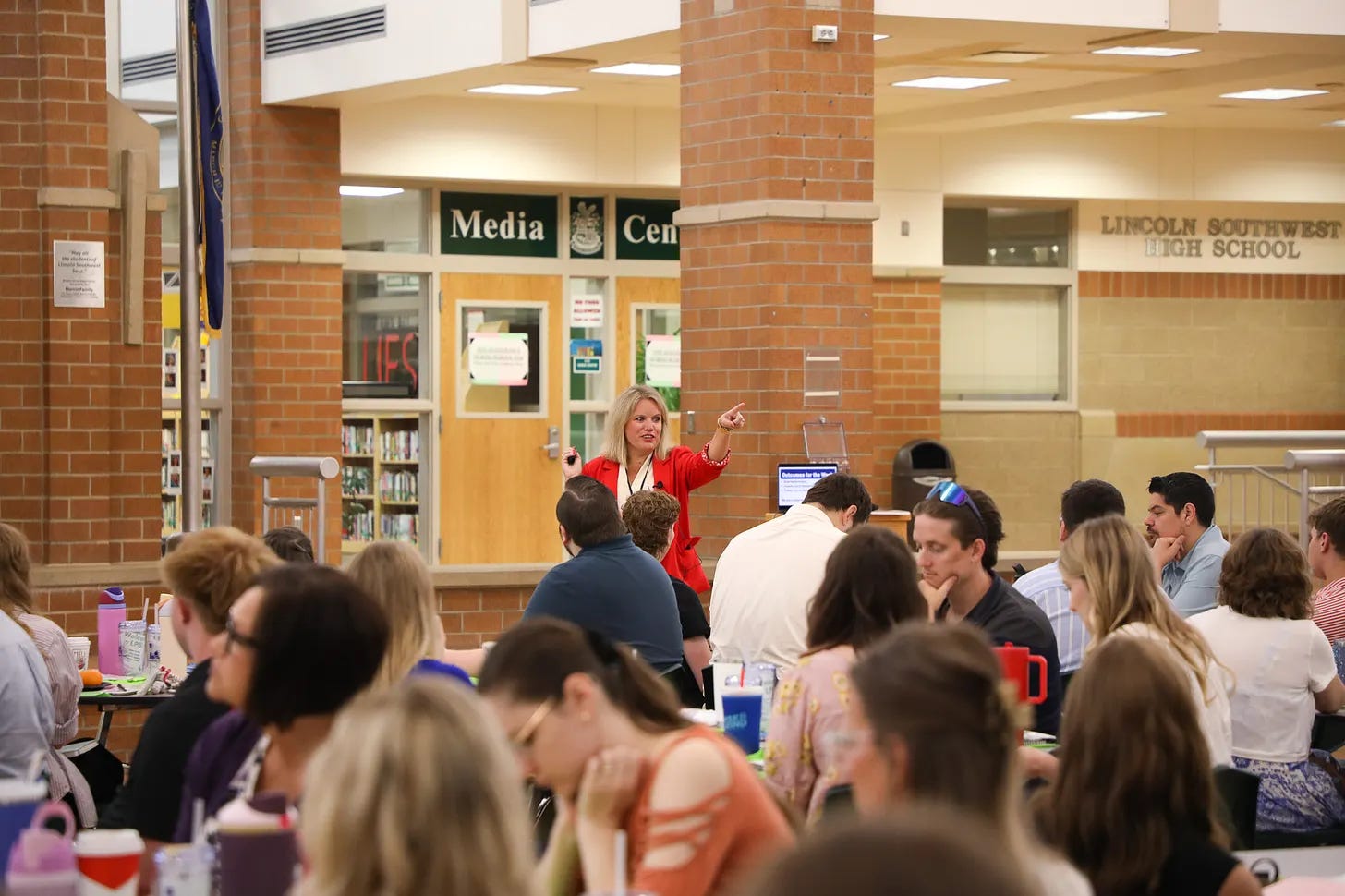
(Picture credit LPS)
Late October brought with it the first development in a first-of-its-kind lawsuit brought by the New Civil Liberties Alliance (NCLA) against Nebraska’s “educational regime.”
In August, the NCLA sued multiple Nebraska officials, Lancaster County, the City of Lincoln, and Lincoln Public Schools in Lancaster County District Court based on a recent legal theory that the current structure of free education violates parents’ First Amendment rights.
On October 27, the City of Lincoln, Lincoln Public Schools, and Nebraska Attorney General Mike Hilgers each moved to dismiss the case. On Tuesday, the NCLA issued its opposition to the motions.
“The arguments in the government motions essentially claim that they are immune from suit, that as the government they can do what they want, or that the court can’t make them fix the problem,” said Zhonette Brown, NCLA’s general and senior litigation counsel. “All of these arguments grossly oversimplify the issue and the possible solutions.”
The NCLA’s founder, Philip Hamburger, was among the first to float the case theory in 2023 for the Texas Review of Law. Former Nebraska law professor Rick Duncan also wrote on the matter in the Case Western Law Review that same year.
Although only sparingly mentioned in the suit, Duncan told The Plains Sentinel in August that the NCLA’s suit would effectively try the standard of the 2025 Supreme Court ruling Mahmoud v. Taylor, which he summarized as:
“Parents can’t be forced to choose between their constitutional right to control the upbringing and education of their children and governmental funding for education.”
The NCLA argues that Nebraska’s “education regime,” a web of state and municipal authorities, compels parents to educate their children and then conditions relief and significant financial assistance (free education) on those parents waiving their rights to free educational speech and excepting government-approved educational speech.
Dismissal will hinge on whether their claims are actionable in a court of law, which the defendants presently dispute.
The City of Lincoln predominately contends that NCLA’s observed “educational regime” is improperly detailed, failing to show any discriminatory city policies or customs with regard to nonpublic schooling, let alone harm to the two plaintiff families NCLA represents.
“The complaint does not allege facts sufficient to show City is part of an ‘educational regime’ even under their untested and unconvincing First Amendment theory,” the city’s filing reads.
NCLA argues that the City’s cited caselaw deliberately dodges the larger elements of the case, especially that educational speech is compulsory.
“The City acknowledges, in the same paragraph in which it argues the pleadings are inadequate, that Plaintiffs have pleaded that the State’s laws ‘consist of both a “mandate for education speech,” and “financial pressure,” which violates Plaintiffs’ free-speech rights,’” NCLA’s objection said.
Lincoln Public Schools asserted that it possesses sovereign immunity, while the Nebraska Attorney General’s Office calls the matter a political question and points out that NCLA did not sue all members of the Nebraska Board of Education, complicating their request for relief.
A Matter of Relief
The question of the plaintiff’s requested relief proves to be the largest issue throughout the motions. Though the initial suit was deliberately careful about what remedies it did and did not ask for, the theory tends toward the conclusion that if Nebraska cannot solely subsidize public education, it must subsidize both public and nonpublic education.
The defendants argued in their filings that was exactly what NCLA was trying to do.
“It appears that plaintiffs potentially want the Board of Education (via its president) to undertake an affirmative act, e.g. to alter aspects of the school district’s fiscal management,” said the filing by LPS. “Their argument is that, in the face of compulsory attendance laws and requirements, it is improper for Nebraska to limit public funding of education to public schools.”
NCLA said in its filings that the defendants were making “straw-man arguments” and that the state had more options in front of them.
“LPS’s attempt to torch its straw-man arguments fails because Plaintiffs’ actual claims demonstrate that LPS’s premises are flawed and thus, so too, are its conclusions” they said. “Money is not Plaintiffs’ first or only request for relief, nor is it the only practical remedy.”
“When a government imposes an unconstitutional condition on a benefit, there are two obvious remedies: the government can remove the unlawful condition or the government can stop offering the benefit. Reducing or eliminating the benefit does not mandate government funding.”
With the primary basis for dismissal now addressed at length, NCLA’s suit is poised to take the next step toward an eventual court date.
Though the firm did consent to the dismissal of one state constitutional claim within the case, the coming months may yield more official-capacity defendants as the plaintiffs peer into the exact makeup and activity of whatever “education regime” is claimed to exist.
— Lewis Thune is a College Fix writing fellow with The Plains Sentinel.
“The arguments in the government motions essentially claim that they are immune from suit, that as the government they can do what they want, or that the court can’t make them fix the problem,”
Nothing speaks louder than the truth. They are in a fairly direct what telling the court and us they own us. Its rather striking and upsetting if one stops to think about just what is being said.
They take what we think is our money ( its not their is no cap on what they can take they leave us some through the "goodness" of their heart but as we are seeing that is getting pretty thin) ) and then demand we use their defective product and we have no recourse. Just sit down shut up and accept the swill that they call education. Schools and the people in them suffer ZERO consequences for their failure. Nebraska has government schools churning out people that simply cannot read or write at anywhere near an adult level. Many schools are running schools at 20-30% proficiency in core subjects. Where else is 20-30% acceptable to anyone? Their consequences for failure is more money, so why should they strive to provide a acceptable product? Would any one accept a 25% box of fries? A tenth of an ounce of a 1/4 lb hamburger? Could the joint serving that claim they are immune, you have to eat here and no one can go elsewhere to eat? And no weights and measurement outfit can make us increase the portions to a full box of fries and bring that hamburger up to 1/4lb.