

If you ask people in Nebraska: “What is something that makes you proud of your community?” Many will tell you: Our local public schools.
Nebraska K-12 schools offer a glimpse into our future. Nebraska teachers, professional staff, administration, and their elected school boards clearly hold a special role in shaping the future of our state.
These public roles merit special scrutiny—particularly for those at the top. Nebraska superintendents are the chief executives of their school districts. Their power is immense—superintendents direct the locally-elected government entities with the greatest property taxation power.
This power comes with immense political responsibility. In many Nebraska communities, superintendents are the highest-paid public sector employee. It should come as no surprise that, like other public sector officials (including legislators, mayors, state governors), school superintendents are tight-knit, well-paid, and well-connected.
Here are a few examples showing just how well-paid they really are:
John Skretta, the Lincoln Public Schools Superintendent, has a base salary of $333,720, with an estimated retirement and benefits package bringing his total compensation to ~$379,321. (On June 9, 2026, the Lincoln Public School Board considered a $15,000 raise to Skretta’s salary).
Matthew Ray at Omaha Public Schools has a base salary of $344,071 with a large benefits package, bringing his estimated total to ~$451,152.
Mike Lucas at Westside Public Schools has a base salary of $270,233 with a benefits package bringing his estimated total to ~$325,895.
John Schwartz at Millard Public Schools has a base salary of $291,550 and a huge benefits and incentive package that brings his estimated total to ~$443,482.
Of course, these are just a select few examples from some of Nebraska’s larger school districts. But for reference, the President of the United States makes a salary of $400,000/year. All the above-mentioned superintendents are paid more in taxpayer-funded salary than the Vice President of the United States, members of the U.S. Cabinet, and United States Supreme Court Justices.
While these superintendents may well be worth the salaries they negotiated with their local school districts, there is no inherent reason for them to be struggling financially to the point where they need to pick up a second job.
What are these second jobs? Some in the Superintendent profession have sought to cash in on their position and influence through private-sector means. Take for example McPherson-Jacobson, a superintendent search-firm that operates in Nebraska. McPherson-Jacobson employs several current Nebraska school superintendents as “consultants,” a job in-addition to their work leading their respective public schools. McPherson-Jacobson consults school boards through the process of selecting a new superintendent when an opening occurs.
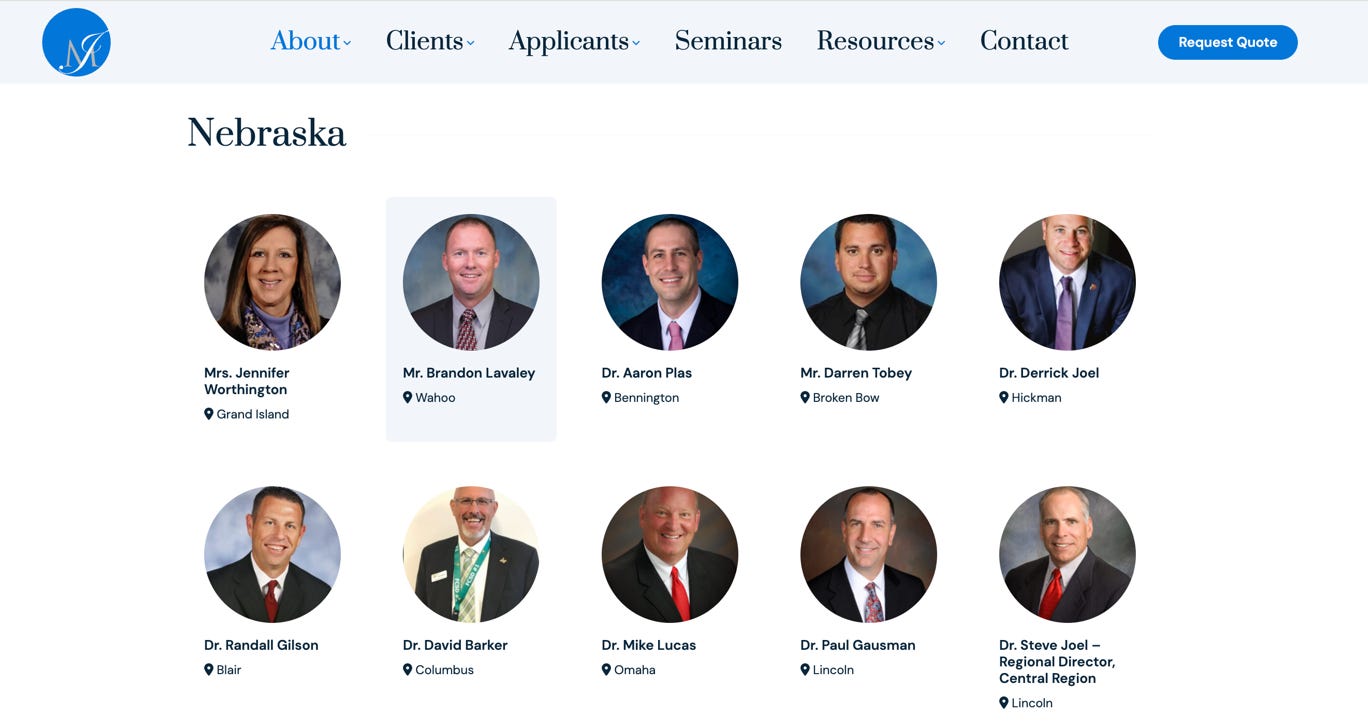
McPherson-Jacobson advertises their consulting firm as “ensur[ing] your search results in quality leadership for education excellence.” But as residents of Hastings Public Schools recently learned, McPherson-Jacobson’s search results are not always resulting in “quality leadership for education excellence.”
Some of the consultants employed by McPherson-Jacobson have quite the provocative record themselves. Paul Gausman was recently reported as having performed “no work” for Lincoln Public Schools despite collecting a ~$333,000 salary—a plainly offensive waste of taxpayer money.
Westside Superintendent Mike Lucas was filmed bragging about his control over the highest institutions of Nebraska State government—implying that things that are “harmful to Westside” won’t pass Nebraska’s Unicameral Legislature because of Lucas’s connections.
After all, who is footing the bill for McPherson-Jacobson’s searches? The property taxpayer. The school boards they contract with are paying these consultants money in addition to what they are making as employees of their own school district.
These superintendents are plainly commercializing their public-sector positions. It boggles the mind why public-sector officials paid as well as school superintendents would need to spend time away from their day job to act as consultants for a private-sector entity.
Their role as consultants seeks to both influence and profit off the decision-making of elected school boards through unacceptable means. It creates an impermissible incentive for those seeking to climb the ladder of leading a larger school as superintendent to “scratch the back” of current Nebraska Superintendents. It allows for—at the very least—the implicit creation of a good ole’ boys club, or at worst, the existence of an education swamp, dominating the top of an important public-sector profession.
It is time for the Nebraska Legislature to step in. That superintendents can profit off their well-paid public sector positions and influence school boards in their time of need is intolerable.
Many public sector roles in Nebraska already have existing conflict of interest regulations that at least provide transparency for similar types of dilemmas.
Here, Nebraska’s answer ought to be prohibiting current public-school superintendents from engaging in for-profit consulting and creating other necessary regulations that provide for transparency about the incomes of current Nebraska school superintendents.
This solution would go a long way to restoring confidence in the leaders of one of our most proud local institutions: our public schools. This solution empowers school boards to act in the interests of their constituents—helping to drain the morass of the education swamp, rather than serving the good ole’ boys club entrenched in the top levels of the superintendent profession.
Blake Aspen is a recent graduate of the University of Nebraska College of Law. Aspen previously served as a legislative aide to State Sen. Dave Murman and as a law clerk for the Office of the Nebraska Attorney General.
You mention our state's largest districts. I live in one of the smallest...less than 120 students, K-12. Super gets a salary of 115-120k, retirement, health insurance, cell phone, a vehicle to drive for school business, and a house to live in, for which he pays utilities only.
And you are right...they are tight knit.
And it gets worse. The six figure salaries allows these people to give thousands of dollars to political candidates to gain favor. Each of the people named could easily have their salaries cut by 20 percent and live comfortably. The high salaries merely empower them to control politicians and the school unions know this.