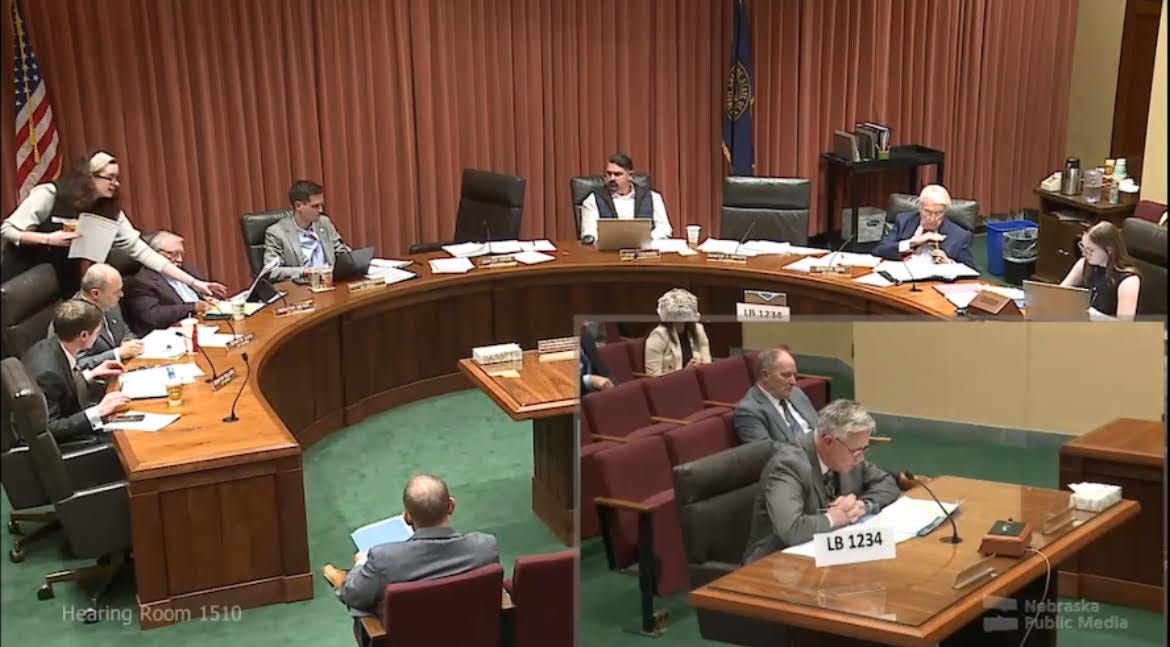
LINCOLN – Birthworkers and parents across the state are rallying behind a bill that will grant Nebraska the ability to have freestanding birth centers and more birthing options. Senator Ben Hansen introduced the bill on Thursday afternoon to the Health and Human Services Committee.
If passed, LB1234 will allow for birth centers that are not physically or financially connected to a hospital and will not be required to follow the restrictions that the hospitals set in place. Hansen has added an amendment AM2051 for the bill that would add licensure for Certified Professional Midwives (CPM), remove the practice agreement requirement for Certified Nurse Midwives (CNM), and add Medicaid reimbursement for doulas – adding numerous birthing options for the women of Nebraska.
The hearing for the bill lasted three hours, with a number of families and birthworkers speaking as proponents, followed by opponents, including hospitals and medical associations, speaking against the bill.
Hansen introduced the bill and amendment, stating that licensure for the freestanding birth centers would align with the Health Care Facility Licensure Act. The bill seeks to address staffing shortages by recognizing not just CNMs but also CPMs through the amendment. The bill requires the birth centers to be accredited by the Commission for the Accreditation of Birth Centers (CABC) and have transfer protocols. Hansen aims to improve birth options, reduce C-sections, and address rural healthcare needs.
“Women choosing births outside of the hospital setting and celebrating physiological birth increased significantly between the years 2004 and 2019, with a 130 percent increase in women having birth center births,” Hansen said. “During that time, Nebraska remained stagnant, while other states made movement towards providing midwifery care for the women.”
With the requirement to be accredited by the CABC, Hansen said the birth centers will have to meet a standard that requires excellence.
“These standards focus on safety and consistency in practice in the unlikely event of an emergency and the need for a higher level of care,” Hansen said. “This is modeled differently in each state. For instance, a birth center in Iowa partners with local EMS and the university for joint training to provide for more familiarity and smoother transitions.”
Hansen said it is the practice of birth centers to assess risk and do so continuously throughout the entire process from prenatal care to labor. When there are indications of a potential risk, birth centers transfer to a higher level of care at the hospital.
Opponents Cite Safety Concerns
The safety of birth centers was one of the recurring themes brought up by opponents of the bill, such as Dr. Robert Wergin, a family physician and current president of the Nebraska Medical Association (NMA). He believes the bill will create a significant risk for Nebraska mothers and infants.
“The NMA is not opposed to freestanding birth centers, which can already operate under Nebraska law, but we are opposed to LB1234,” Wergin said. “LB1234 recognizes CPMs, and the Legislature rejected this approach last year. CPMs have no formal medical training, and their standards fall far short of what is required to provide safe maternity care. Introducing CPMs into a birth center model does not mitigate the underlying safety concerns.”
Dr. Timothy Tesmer, the Chief Medical Officer of the Division of Public Health in the Department of Health and Human Services (DHHS), said he was concerned by the licensure of the birth centers.
“The CABC is not an entity DHHS has previously worked with for accreditation, and DHHS has no control over its accreditation requirements,” Tesmer said. The department regulates health care facilities under the Health Care Licensure Act.
He stated that while birth centers are intended for low-risk women, transfer may still occur, and protocol needs to be in place for this. He said when asked that while transfers occur from non-emergent things such as maternal exhaustion, pain management, or failure to progress, only about two percent of transfers are due to true emergency situations.
Midwives Say They are Misunderstood
Chandra Stewart, who is a CPM and Licensed Midwife in the State of Iowa and has been heading up the Nebraska lobbying efforts for CPM licensure, said she has been seeing a lot of misunderstanding of the training and education of CPMs.
“As part of their training and education, CPMs must prove competency in over 800 skills and pass a 300-question board exam,” Stewart said. “They have to spend at least two years apprenticing with a nationally-approved preceptor, they are the only maternity care providers who must attend out-of-hospital births as part of their training, and they must re-certify every 3 years, which includes continuing education requirements and peer review.”
Staffing shortages are one of the leading causes for birth centers closing in Nebraska, according to Hansen. Under the current law, birth centers must be affiliated with an overseeing physician or hospital, and CNMs aren’t allowed to operate them on their own.
“Nebraska will need to recognize CNMs, CPMs, and doulas as people capable of working at our centers,” Hansen said. “Sixty-one percent of birth centers are owned partially or in full by CPMs, 73 percent have CPMs on staff, and 39 other states license CPMs.”
Stewart said this bill will give Nebraska families more choice in where and with whom they give birth.
“Currently, the only legally recognized options for birth in Nebraska are hospital birth and unassisted birth,” Stewart said. “This bill would add a third option, birth in a freestanding birth center, where women can have more control over their birth experience. It would also give them legal access to CPM-led care.”
Julia Cherry is a mother who chose the out-of-hospital route for birthing her child. She said she was vaguely aware of the laws surrounding who can assist mothers while birthing in Nebraska, but looked further into it when she became pregnant. She was surprised to find that, in her opinion, women do not have a lot of say.
“Women’s choice is good’ but a woman choosing to have a CPM at her birth isn’t okay,” Cherry said. “Where is our choice there?”
A specific date for the executive session to vote on the bill has not been finalized at this time.
— Olivia White is a freelance reporter with The Plains Sentinel. She previously was a staff writer for The Northside Sun.