

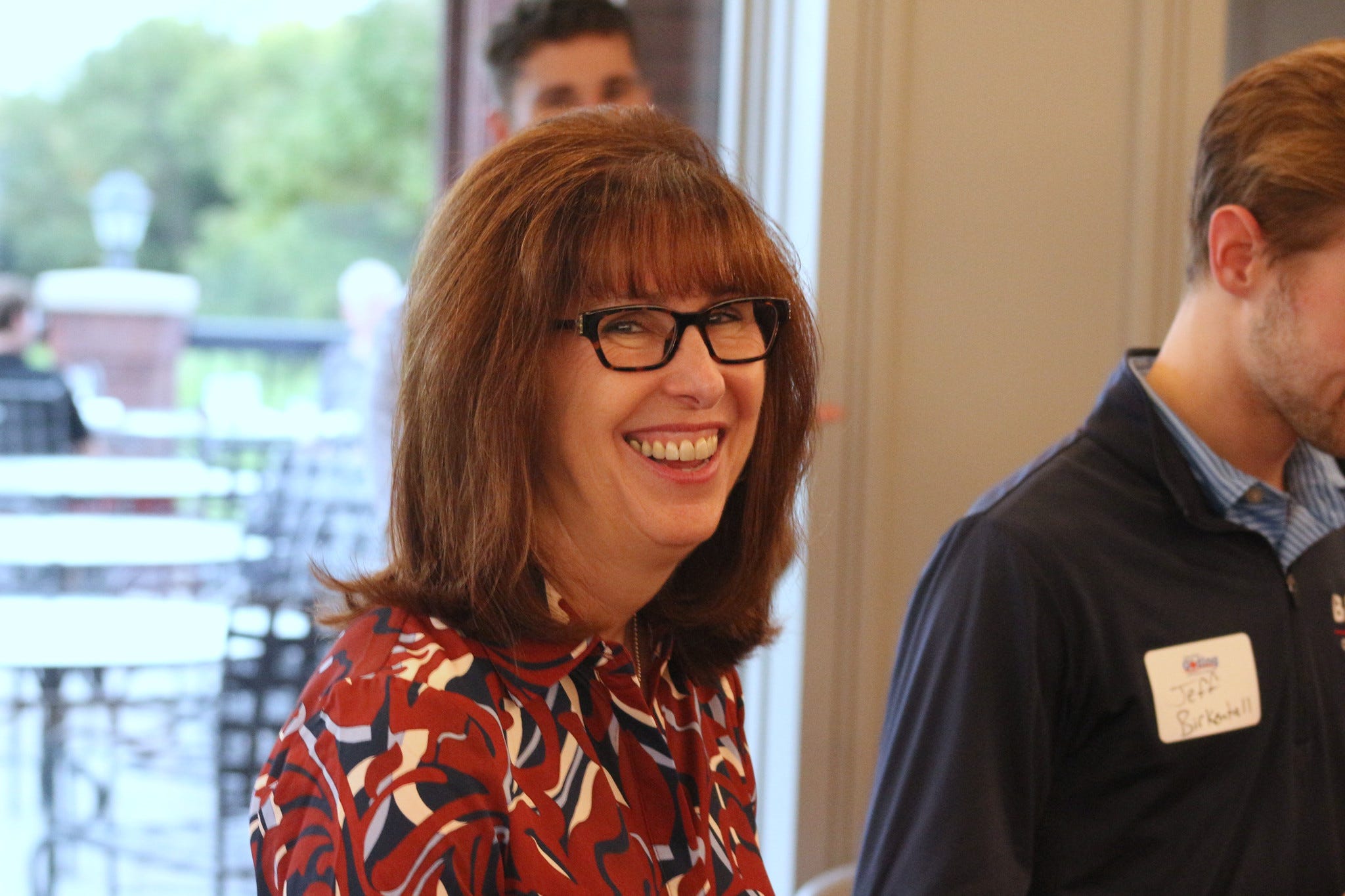
(Picture credit Matt Johnson)
OMAHA — When Lou Ann Goding, a candidate for the State Board of Education in District 8, faced Sherrye Hutcherson in the primary this year, she lost by 4.4 percentage points. On Tuesday, in the midst of a blue wave sweeping the nation, she went to bed not knowing the outcome of her race.
Then the phone rang.
“My team called me at 2:30 this morning,” Goding said. “I went to bed thinking, ‘Eh, I don’t know, I’m not ahead enough, I’m only up by 800. I’m going to bed.’ And then they called me and said, ‘No, you’re up. You’re up more than that.’”
Goding is currently ahead of Hutcherson by around 1,883 votes, or 2 percentage points, a victory that would mean flipping the board to the conservative side for the first time in years.
The Fifth Seat
While the State Board of Education is officially nonpartisan, it’s not difficult to tell which side the candidates fall on. According to the Nebraska Accountability and Disclosure Commission (NADC), Goding received substantial donations from Pete Ricketts, while her opponent, Hutcherson, received donations from Denise Powell and her PAC “Women Who Run.”
Goding emphasizes, however, that she will serve her role in a nonpartisan way.
“I’m here to represent every single parent, constituent, teacher, and to do the right thing by students, and I don’t really care what someone’s political party is,” Goding said. “If I can play a role in helping every student, no matter their parents’ political backgrounds, that’s what I care about.”
Goding believes her experience as a former Omaha Public Schools Board member and president helped get her across the finish line.
“I think they were looking for someone who had that experience on a local school board so that when I get there, it’s not a learning curve for me,” Goding said. “It’s experience that has been lived.”
Kirk Penner, the outgoing District 5 board member, agrees.
“Lou Ann brings a lot of knowledge and understanding as a former OPS president and board member,” Penner said. “I think in this race, you need to have a background in education, have some knowledge of what’s going on in the classroom, and that’s what Lou Ann brought.”
An Evolving Board
The makeup of the State Board of Education was very different just a few years ago. When Penner was appointed by then-Gov. Pete Ricketts to replace retiring board member Patricia Timm in 2021, there were no other conservative members on the board.
Earlier that year, the board had published a controversial new set of health education standards. This included asking fourth grade students to “distinguish between sex assigned at birth and gender identity,” and fifth grade students to “explain that gender expression and gender identity exist along a spectrum.”
Many voters did not even know that the State Board of Education existed, but they soon became aware and showed up to public meetings to voice their concerns.
Angie Eberspacher, who was elected on Tuesday to succeed the retiring Penner next year, was a part of that effort.
“It was like waking the sleeping giant,” Eberspacher said. “People didn’t know that the state board existed. They didn’t know who their state board representative was. They didn’t know what the job was even up for, what the job duties even were. And that’s when people, by the hundreds, would go and testify at these board meetings.”
Penner was also at the forefront and saw the proposed health standards as a turning point for the board.
“Schools now aren’t like they were when I grew up in the ’80s and the ’70s,” Penner said. “And then when those health standards came, everybody found out what was going on. Plus, we had COVID, so people were seeing lesson plans and some of the online stuff that we were doing while the kids were home.”
And then, a movement began to flip the board. Sherry Jones and Elizabeth Tegtmeyer were elected in 2022, followed by Lisa Schonhoff in 2024. The board remained 4-4 until Goding won on Tuesday to succeed Deb Neary, who is retiring.
The change in board makeup also represents a shift in power away from the Nebraska State Education Association (NSEA), the teachers’ union responsible for funding progressive candidates for the Legislature and local school boards.
“Five years ago, that board was 8-0, full of NSEA bought-and-paid-for candidates,” Penner said. “The four current conservatives haven’t gotten a dime from NSEA … and what we have been able to do as conservatives is buck that trend and put families first, students first, and really teachers first.”
Back to Basics
As an incoming board member, one of Goding’s priorities is a focus on literacy.
“One is the science of reading, which includes phonics instruction for helping students learn to read. I think that’s critical,” Goding said. “They have to be able to sound out words and be able to read. That’s happening across the country. Results are very, very positive.”
Other priorities for Goding include restrictions on screen time and parental notification when students are falling behind.
“We have, unfortunately, experienced social promotion and grade inflation, which give a false sense of security to parents on how their student is really doing,” Goding said. “So I think it’s important to have parental notification throughout the year when there’s key test times given if a student falls behind grade level.”
Eberspacher wants to give parents choices when it comes to their kids’ education. Her own family was involved in farming and competitive horse showing across the United States, which led them to take “school on the road.” Eberspacher wants other parents to have the same options.
“We have public school, parochial school, home school, and some options work better for some families than others,” she said. “I want to be that person that can oversee the education options for all families. I want it to be, if that works well for you, then how can we make that work for you?”
Eberspacher has also taught her first-grade students the importance of civic institutions like the National Anthem, which she taught them to sing. It was this enthusiasm that led to her being asked to lead the crowd in the National Anthem when President Trump visited Grand Island last month.
“If first graders could sing it, we all here should sing it,” Eberspacher said. “We are so fortunate to live in this country that God has provided for us. And we should be singing this together.”
Seated Next Year
The new board will be seated in January next year, and Goding is glad that the hard work and meeting with constituents face to face have paid off.
“I’m thrilled with the results, and we worked really hard,” Goding said. “People volunteered. When I knocked on doors, I knocked on everybody’s door in the areas I went to. It didn’t matter political affiliation. I received, I would say, the vast majority of the time, a very warm welcome and appreciation for what I was trying to achieve.”
And for Eberspacher, she feels the new board makeup that is no longer at an ideological stalemate may be able to move more policies forward.
“Let’s teach the basics. Let’s encourage our kids. And they need to become lifelong learners, right?” she said. “Now that we have a five-three board, maybe this is going to be a new era.”
— Matt Johnson is a freelance reporter with The Plains Sentinel.