

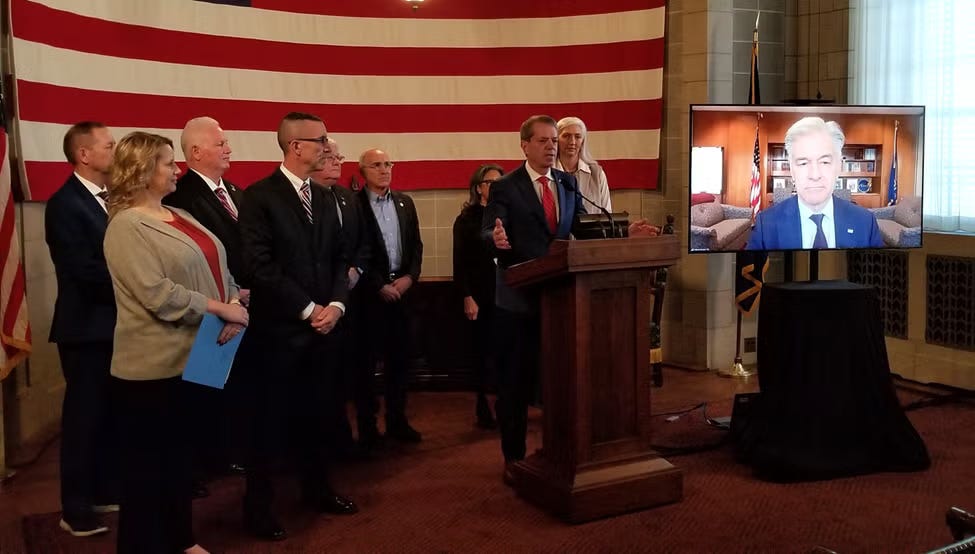
(Photo courtesy of Governor Jim Pillen’s Office)
Nebraska became the first state to implement new Medicaid work requirements that were passed as part of the “One Big Beautiful Bill” last year. The requirements, which provide that able-bodied adults between 19 and 64 work or complete community service 80 hours a month to stay on Medicaid, went into effect on Friday.
About 70,000 Nebraskans on Medicaid fall within the age range of the new requirements. The state has a long list of exemptions, including for pregnant women, certain disabilities, and medical frailty.
Jeff Powell, a spokesperson for the Department of Health and Human Services (DHHS), said that 60 to 72% of Nebraskans on Medicaid expansion would either meet the work requirements or qualify for an exemption.
Governor Jim Pillen joined Dr. Mehmet Oz, administrator of the Centers for Medicare & Medicaid Services, in December to announce that Nebraska would be the first state to implement the new requirements. Most states are waiting until January 1, 2027 when federal law requires the new provisions to be enforced.
“These requirements will help Nebraskans achieve greater self-sufficiency through employment and other meaningful activities,” Pillen said. “Working not only provides purpose but helps people become active, productive members of their communities.”
Oz said that Nebraska was “leading the way” in helping “support people engaged in meaningful work.” He said the program will lead to “long-term success” for people.
National Spotlight on Nebraska
With the requirements going into effect, the national spotlight has been put on Nebraska, with critics ready to pounce as the state steps out first.
“Eighteen months to implement such a massive undertaking of all these new eligibility and requirements is bad enough, but it’s even worse that for no reason at all, Nebraska has decided to start this process eight months early,” Anthony Wright, executive director of Families USA, a healthcare advocacy group, told NBC News.
NBC News put out a local call on Nebraska Reddit for people who were “impacted by these changes or are confused about them.” No one who commented on the social media thread appeared to have made it into their story on Friday.
Joan Alker, a research professor at Georgetown, told Politico last month that Nebraska was heading towards a “crisis” by implementing work requirements ahead of the rest of the country. “This is enormously complicated, states are on a very tight timeline, and I think it’s just a crisis in the making,” she said.
Locally, Appleseed, a nonprofit focused on health care and poverty, complained that the new requirements would increase “red tape.” “A vast majority of Nebraskans are working, or would be an exemption, but it is the red tape. That’s what causes the problems,” Sarah Maresh, the group’s healthcare access program director, said.
DHHS says they are ready to handle the new changes, despite outside concern. Powell said the agency has already been reaching out since December to enrollees to let them know about the changes.
The state says it already has most of the data to determine who remains eligible to stay on the rolls. Between 20,000 and 28,000 Nebraskans still need to provide documentation to determine if they are still eligible for coverage.
Powell said the state has moved forward with early adoption of the new federal rules because it was ready. “Nebraska’s implementation reflects a deliberate, phased approach focused on protecting eligible members.”
John Gage is the executive editor of The Plains Sentinel.
Editor’s Note: This story has been updated to correct a typo in the first paragraph. It should read “80 hours a month” instead of “80 hours a week.”
Bravo for Nebraska, the state with a heart. These requirements treat with respect and dignity those on Medicaid. Tragically there are still those who act like compassionate slave masters, wanting to "care" for those they beieve are inferior.
2 Thessalonians 3:10 (ESV):
"For even when we were with you, we would give you this command: If anyone is not willing to work, let him not eat."