

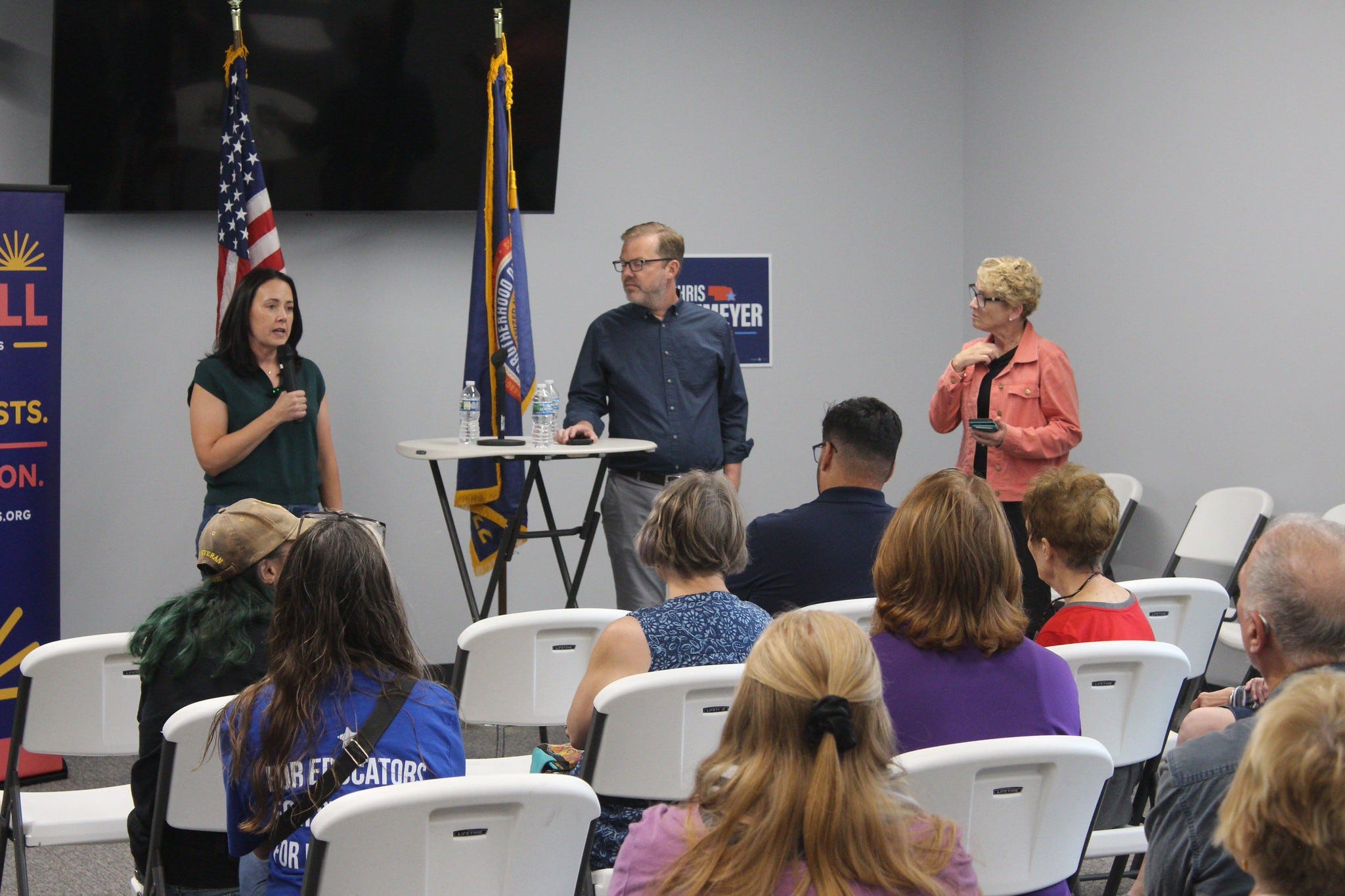
(Picture credit Matt Johnson)
OMAHA — Denise Powell and Chris Backemeyer, Democratic candidates for Congress in Nebraska’s 2nd and 1st Districts, hosted a veterans listening session Saturday afternoon with Rep. Chrissy Houlahan of Pennsylvania’s 6th District.
Houlahan, an Air Force veteran who served three years on active duty and 13 years in the reserves before separating as a captain in 2004, comes from a military family. She serves on the House Armed Services Committee, where she is ranking member of the Military Personnel Subcommittee, and on the House Permanent Select Committee on Intelligence.
1st and 2nd District Candidates
Powell told the group their primary job that afternoon was to listen.
“I know that I don’t have all the answers for our veterans, but I also know that it’s really important for me to show up for this community when I get to DC,” Powell said. “And so what we were hoping to have, we call this a listening session, because if we’re doing this right, we’re doing more listening than we are talking.”
Backemeyer, who is running in the neighboring 1st District, joked about voters not knowing which district they lived in.
“You may not even know it because you got gerrymandered out in 2020, and a lot of doors I knock on out there, people are convinced I’m not the person on the ballot,” Backemeyer said. “They think they’re voting for Denise. But as long as they vote for the Democrat on the ticket on election day, well, that’ll be okay.”
Backemeyer, who has a background in finance, spent 21 years at the State Department working on counterterrorism finance, including efforts to disrupt funding networks for terrorist groups. He has cited the Iran nuclear deal as one of his key accomplishments.
He served in the first Trump administration and left during the second, pointing to personnel cuts under the Department of Government Efficiency (DOGE) as a turning point.
“DOGE came in and just wanted to know how many of those people I could fire,” he said. “And that’s when I just decided that there was no mission left, there was no purpose left, and I couldn’t in good conscience stay in because that was a different set of rules than I thought I was playing under.”
Houlahan Takes Aim at GOP Admin
Houlahan described growing up in a split-ticket household. Her parents, one Republican and one Democrat, would walk together to the polls and cancel out each other’s votes.
She also described working with current 2nd District Rep. Don Bacon for eight years on military personnel issues.
“I am friends, good friends, with Representative Don Bacon. We have worked together for eight years on things that matter, like military personnel. And I know where you guys come from. I know him, and I know that we need to make sure that Denise is that person who replaces him,” Houlahan said.
She framed the immediate task as blocking the Trump administration.
“At a minimum, what we need is to make sure that we are stopping the progress of this administration, and hopefully, we have the opportunity to do a heck of a lot more.”
She was also blunt about Defense Secretary Pete Hegseth.
“Don’t get me started on Secretary Hegseth. You probably are aware that I am not a fan of his. And he is a danger. And so at a minimum, we need to be able to check him. And at a maximum, I’m hopeful that we’ll be able to push him out.”
Access to Care and Staffing
Veterans in the room described long waits, inconsistent care, and a system that is hard to navigate even for people who know it.
One guest named Kathy said she left the service 27 years ago and did not use her VA benefits until recently, when a friend helped her apply for disability through va.gov. Houlahan said she ran into the same wall trying to help her brother, an Army veteran, get mental health care.
“The fact that two of us couldn’t figure it out, you know, in a period of crisis, was a real indicator of, like, a need for reform and a need for a better system,” Houlahan said.
One guest said the quality of help depends entirely on who answers.
“Only people who are in the system can review those things, and it depends on who you get. They might help you, they might not. So that is not clear.”
A woman named Katy said she now spends her time getting veterans out of Omaha for mental health care.
“Right now my life’s work is getting veterans out of Omaha for mental health services because they’re literally so bad that people would rather die on the streets,” Katy said. “Nineteen veterans died homeless in Omaha last year alone. So, access to benefits is a joke.”
Powell said she has heard the same split in other states.
“I talked to somebody in South Carolina who said their VA’s working great. And then I talked to someone in Iowa who said maybe not. And that sort of standard of care across the board seems to really be missing,” Powell said.
Staffing concerns came up repeatedly. One man described playing phone tag just to get an appointment.
“When I get those appointments, I feel very well cared for. But getting them in the first place, they’re under-resourced, and there’s no excuse for that,” he said.
Legislative Obstacles in Congress
A 21-year Army National Guard veteran, who runs the Committee of Veterans with the IBEW, brought up the “Take Care of Veterans Act.” He said the package has worthwhile pieces, but also a provision that would cut disability for conditions such as sleep apnea and tinnitus to pay for other veterans’ care.
Houlahan said she voted against the bill. She described it as more than 60 veterans’ measures rolled together.
“It is one of the things that DC does,” Houlahan said. “I understand why it does the sort of lumping everything together, but it also ends up exactly as you pointed out, where there’s not poison pills, but things that are sort of toxic in there. And that was one of them, that prevented a good set of bills from being able to get through because of something that was beyond the pale, at least in my opinion.”
Congress, she said, may see 11,000 to 14,000 bills in a session, but only a few hundred reach a floor vote. When a VA bill does come up, she told the room to be the “squeaky wheel” and call their members.
“Congress has a really short attention span, and typically we get to something probably once every year. So if there’s a VA bill, then it’s gonna be once a year that you’re gonna get like a bite of that apple. So pay close attention to all of the things that are coming through.”
Focus for Election Day
Houlahan is one of several Democrats from outside Nebraska’s “blue dot” to visit the city in recent months. In July, both Pete Buttigieg and Rahm Emanuel visited Omaha to support Powell’s congressional campaign.
Douglas County is home to roughly 26,000 veterans. Offutt Air Force Base, just south of the city in Sarpy County, supports about 7,000 military personnel and several thousand civilian employees, as well as a large retiree population in the metro. That concentration of current and former service members is why veterans listening sessions have become a regular stop for anyone trying to flip seats in Nebraska’s 1st and 2nd Districts.
— Matt Johnson is a freelance reporter with The Plains Sentinel.