

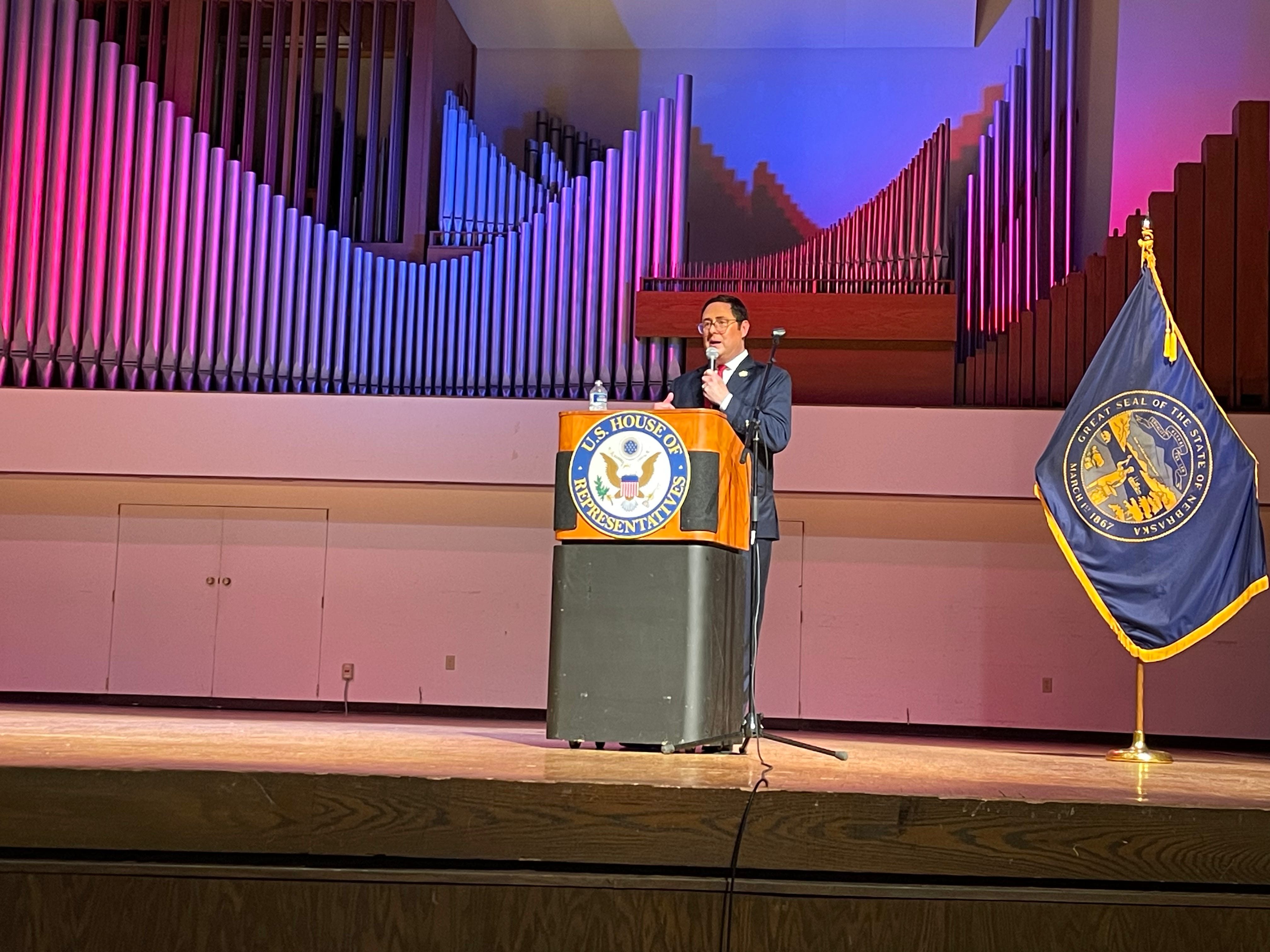
(Picture credit Lewis Thune)
LINCOLN — Congressman Mike Flood once again engaged an oppositional audience Tuesday evening in his third and final town hall of 2026.
Flood and multiple attendees were visibly sweating just a few minutes into the hour-and-a-half-long event at Nebraska Wesleyan University’s Vance D. Rogers Center for Fine Arts. Flood’s Democratic opponent Chris Backemeyer and supporters also felt the heat, tabling just outside the venue in mid-90-degree weather.
The tone for the night was set well before Flood took the stage, as multiple attendees audibly protested former state senator Suzanne Geist’s invocation, as well as the pledge of allegiance led by Lincoln City Councilman Tom Duden, and then Wesleyan student Eli Horner’s singing of the Star-Spangled Banner.
Flood was four minutes into his introductory remarks when audience members interrupted him, causing him to briefly digress from his explanation about his work with Missouri Democrat Emmanuel Cleaver on housing policy and the 21st Century Road to Housing Act.
“I know when you go to watch television at 9 o’clock central time, you see division, you see people screaming at each other, tearing each other down. I want you to know I don’t operate that way,” he said amid interjections.
Similar objections rang out as he championed the end of chassis requirements for new homes — which he stated could reduce the cost to construct a new home by almost 30% — as well as restrictions on home ownership for private equity and institutional investors.
As he has before, he also touted his appropriations totals.
“Out of 435 members of the House, I am ranked number nine this Congress for delivering resources to the people of the first district. I brought back $87 million. I think it’s important to note: I am not a member of the appropriations committee.”
As he detailed that total – including $19.7 million for Lancaster County roads and infrastructure, audience members repeatedly protested that his totals came from Biden-era policies, which drew scattered applause.
“Actually, most of that was in the budget we passed in January under President Trump,” Flood said.
He also cited inroads between Congress and the Administration in increasing national and individual spending power.
“In the One Big Beautiful Bill, we cut $2 trillion out of federal spending,” he said “We did deliver the biggest tax cut in US history, Nebraska take-home pay this year increased on average $10,300.”
After a few more brief highlights of his secured appropriations, he previewed the Q&A portion of the night. By that time, not a sentence was spoken by Flood without audience interjections.
“I would just ask that when somebody asks a question, let’s give them a chance to ask their question, and then give me a chance to give them an answer” Flood said interspersed with a mere five interruptions.
“I understand some people feel strongly, but we have a chance to show the rest of the United States that Lincoln is a place where we can talk in the town square, we can hold people accountable, but we can also do it by respecting each other. I respect you, and I want you to respect everyone else with me.”
With that, he yielded to former State Senator Chris Langemeier, who moderated write-in and live questions from the audience as he had in previous Flood town halls.
Voter Integrity and Entitlements
Flood’s first spate of questions dealt with the stalled Safeguard American Voter Eligibility “SAVE” Act and Medicare entitlements.
“90% of Republicans and well over 70% of Democrats believe it’s not too much to ask to show an ID when you vote,” he said among six interruptions. “I do not believe it is too much to ask you to show an ID to vote, and much of what is in the SAVE Act accomplishes that.”
When asked about the restrictions on mail-in voting, he distanced himself from the Trump Administration’s claims of nationwide fraud.
“President Joe Biden won the 2020 election. I believe, as it relates to Nebraska, that our elections are safe,” he said to some applause and three separate interjections. “There are states in this nation, and I’m not saying Nebraska, where you have people that are in this country without authorization that are voting, and that is not right.”
When pressed further about the further implications for rural Nebraska counties if President Trump’s preferred policies are implemented, he indicated he would not support wholesale changes.
“If there is credible evidence of ballot harvesting, that should be taken seriously” he said, “I don’t see it in Nebraska. It’s an effective tool in rural counties, where they don’t have the staff to get the polling places all out there.”
He took multiple questions from seniors and retirees about Medicare benefits and Social Security, the first of which took issue with the One Big Beautiful Bill’s tightening of Medicaid eligibility with work requirements.
“If you’re a 28 year old male, and you can work, and you choose not to work, you don’t get free healthcare” he said to some applause, “if you are persistently mentally ill or developmentally disabled, you do not have to work to get those benefits… if you find yourself in that situation, you have to reach out not only to state government or federal government, but you can call my office as well.”
He also committed to working across the aisle to address a potential depletion in Social Security by 2032.
“It is an absolute promise” he said, “We will need Republicans and Democrats to sit down and figure this out. We have to make sure those benefits are available, and they are paid. People at that age range should not be worried about that.”
Iran, Israel, and Ukraine
Flood also took a slew of questions on the ongoing conflict with Iran and Congress’ recent passage of the National Defense Authorization Act.
“That authorizes up $1.2 trillion, but we have not appropriated that,” Flood said in response to criticism. “The only bill that could pass the House to appropriate any money has been $67 billion to replenish our munitions.”
He reiterated a need to modernize the American military in light of China and unrest across the Middle East.
“Unmanned aircraft, drones, our sentinel project, the efforts of nuclear deterrence, making sure we have an army for warfare in this century – all of that is important, and the federal government has a responsibility to provide national security,” he said over multiple loud protests.
Amid unceasing arguments from the audience, he states his support for military action in Iran remains strong, especially in light of recent attempts at negotiation.
“I don’t think any Americans want to be in a war with Iran, but we also can’t live in a world where this country, for the better part of 50 years, has been funding terrorism, funding Hezbollah, the Houthis, Hamas, funding these terrorist organizations. I want them not to be a present danger to the United States — I also don’t think it’s the right thing to be voting against the President’s war powers when he’s at the negotiating table.”
On subsequent charges that his vote for the NDAA amounted to a merger of the United States and Israeli militaries, he responded immediately.
“We are not merging militaries – we share intelligence with the Israelis; the Israelis have shared intelligence with us for a long time. When you go to Offutt Air Force Base and you’re in the Stratcom building, you’ll find out that we have partnerships with South Korea, with the Royal Air Force, with the German military,” he said, pausing for four different interjections.
“We have allies, and thank God we are allied with Israel, because their intelligence is saving American lives,” he concluded.
When asked where he commonly departs from his party, he indicated he is a strong supporter of military aid to Ukraine.
“Not every Republican in Congress supports Ukraine, and at times, the Administration has not supported Ukraine. That is something I feel very strongly about. We should be proud of how they’ve stood up to Putin, we should lift them up and give them resources,” he said. “Every time I’ve been given an opportunity to vote on funding Ukraine, I have voted yes.”
After a full hour of Q&A, Flood delivered his brief closing to the combative Lincoln assembly – over repeated shouts from the night’s top contributors.
“I know that I probably didn’t answer every question to your satisfaction, but I am trying to do a good job. I respect all of you, I am working for Lincoln, I am working for Nebraska. I will remain accountable, and I will remain transparent, and I will come to events like this.”
With that, the congressman closed his 2026 town hall tour. Should he defeat Backemeyer in November, his town halls will resume in summer of 2027. Cook Political currently lists the NE-01 as Solid Republican, while Polymarket betters favor the GOP by a 66% margin.
— Lewis Thune is a writing fellow with The Plains Sentinel.
Editor’s Note: a previous version of this article misidentified Eli Horner’s last name.
People wonder why more of our GOP representatives don't do town halls - well, here's your answer. "The resistance" makes it near impossible to hold a proper town hall anymore. It's really sad that society has devolved to the point where "protesting" during town halls and interrupting people speaking has become acceptable. I think people need a lesson on the 1st amendment and what it actually entails. Just a hint, it doesn't give a person the right to be rude to others and interrupt their speech