

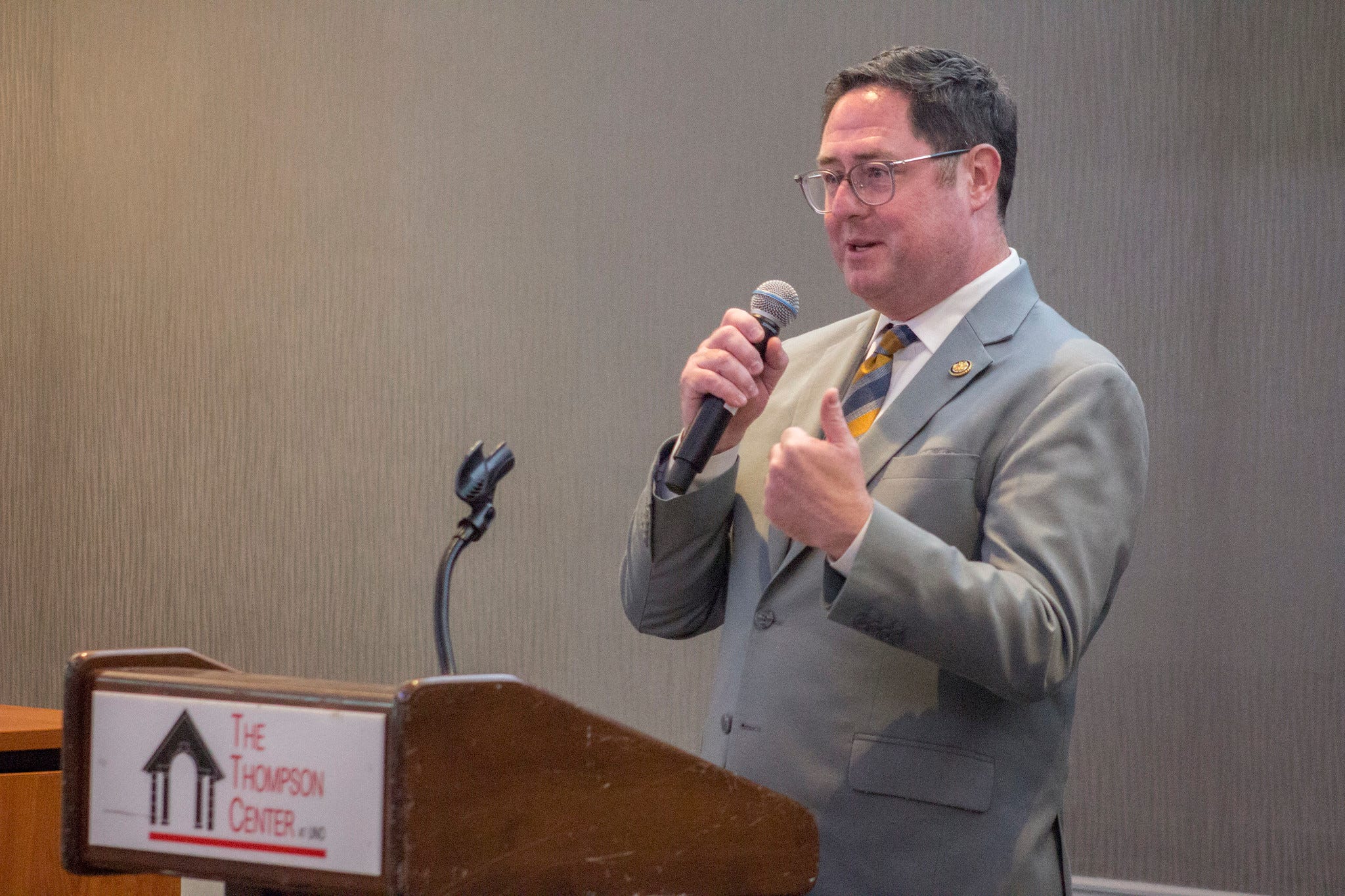
(Picture credit Matt Johnson)
OMAHA — Congressman Mike Flood is traveling through Nebraska during the House summer recess. On Thursday morning, he spoke at a housing leadership forum at the University of Nebraska at Omaha’s Thompson Alumni Center, highlighting the newly enacted 21st Century ROAD to Housing Act.
The event, hosted by Front Porch Investments in partnership with Enterprise Community Partners, drew approximately 80 attendees, including developers, nonprofit leaders, foundation representatives, city and state officials, and housing advocates.
Flood, who chairs the House Housing and Insurance Subcommittee, highlighted the bipartisan work that went into the bill, co-leading key provisions with Ranking Member Emanuel Cleaver (D-MO).
The measure passed the Senate 85-5 and the House 358-32 in late June. President Trump had stated he would not sign any bill before the SAVE America Act was passed. Without a veto, however, the bill automatically became law on July 11, 2026, without the president’s signature.
“Would I have preferred the President to sign it? Absolutely,” Flood said. “But you know what they call it today? A public law.”
A Bipartisan Success Story
Also speaking at the event was Shaun Donovan, former HUD secretary under President Obama and now CEO of Enterprise Community Partners. He described the legislation as “the most important federal housing legislation of the 21st century” and stressed its rare bipartisan support.
“You literally could not get motherhood and apple pie through our Congress with more than ninety percent support today, and that is because of the leadership of Mike Flood and his partnership across the aisle with Emanuel Cleaver,” Donovan said. “People say bipartisanship is dead. It is not true.”
Flood told The Plains Sentinel that Donovan’s organization was instrumental in getting the legislation passed by helping bring Democrats onboard, specifically on the issue of rolling back certain regulations.
“Enterprise helped us convince longtime Democrats that waiving the environmental study requirements had value, that waiving the Section 3 requirements to make sure that you had indigent people building homes had value, and that, you know, ‘Build America, Buy America,’ while it sounds great, isn’t necessarily in the best interest of a homeowner or a builder that has to go hire a compliance officer to find out if there’s a little, teeny Chinese piece in that hinge there. And they were helpful in bringing Democrats to the table,” Flood said.
State Sens. Terrell McKinney (LD-11) and Victor Rountree (LD-3), both Democrats, were also in attendance. Rountree told The Plains Sentinel that he hopes the new legislation will help elderly residents modify their homes rather than move into assisted living.
Rountree also praised the bill’s bipartisan support.
“We serve in a unicameral, which should be nonpartisan. We look out for the greater need of all Nebraskans,” Rountree said. “When disasters come, they don’t single out Republican, Democrat, or independent. It impacts everyone. So we survive and we thrive together as a state, regardless of whatever the political issue is.”
Rolling Back Regulations on Manufactured Homes and Other Benefits
Among the law’s biggest wins are regulatory rollbacks that make it easier to build new housing, including the removal of the chassis requirement for manufactured housing.
“Stick-built homes that aren’t built on site are not the trailers of yesteryear—no more chassis requirement,” Flood said. “Back in 1905, you could order a house out of the Sears catalog, and many of those homes are still standing today. That is a big win.”
Shannon Harner of the Nebraska Investment Finance Authority (NIFA) also spoke, noting that NIFA is preparing a modular order and delivery program and hopes to launch it in the fall.
Other benefits in the bill include raising Area Median Income (AMI) eligibility from 80% to 100%, ensuring veterans receiving VA benefits still qualify for housing assistance, and expanding flexibility for Community Development Block Grants (CDBG) and related funds so cities can use them for housing, infrastructure, streets, and sewers.
Flood and Donovan spent the day traveling through Nebraska with stops in Lincoln, Howells, Madison, and Norfolk. Flood stressed the stakes in small communities, where 25 new homes in Howells could help keep the local school open and preserve its classification.
“Twenty-five homes doesn’t sound like a lot to somebody on the East Coast,” Flood told The Plains Sentinel, “but it’s the future of Howells, Nebraska. It’s the future of Madison, Nebraska.”
— Matt Johnson is a freelance reporter with The Plains Sentinel.