
(Picture credit John Gage)
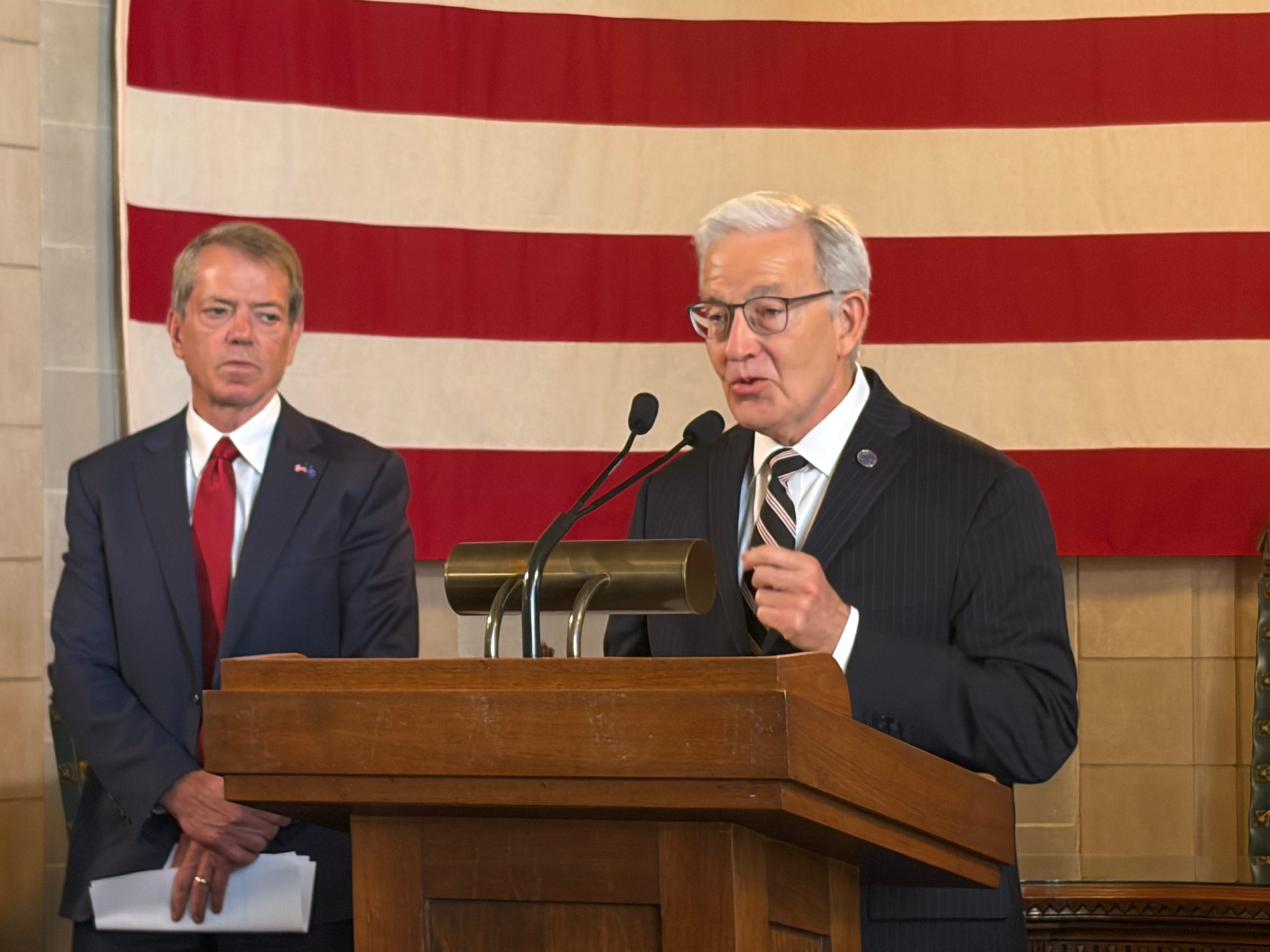
LINCOLN — Governor Jim Pillen held a press conference on Thursday with Secretary of State Bob Evnen and county election officials to push for changes to the ballot initiative process following fraud being found across multiple petitions this cycle.
“The process of bounty signature gathering is sabotaging legitimate petition initiative efforts. It’s as simple as that — it’s not the Nebraska way,” Pillen said, adding that banning the pay-per-signature model “would significantly reduce the flood of invalid and fraudulent signature collection efforts.”
“We have to shift the culture of petition drives to prioritize genuine voter engagement over raw volume,” he said. “Moving to an hourly compensation model reframes a circulator’s role, encouraging an accurate and lawful conversations with everyday Nebraskans rather than speed.”
In 2015, Nebraska removed a seven-year ban on paying petitioners per signature rather than by the hour. Pillen praised the 2008 ban, championed by former Democratic State Senator DiAnna Schimek, as a successful act of bipartisan legislation in the Unicameral.
The governor also took aim at out-of-state companies that were hired for petition gathering and said the ballot initiative process had been hijacked by “out-of-state special interests.”
Evnen backed Pillen’s calls for reforms and said he would be working with him on finding solutions. “The legislation that I support will prohibit paying a bounty-per-signature,” he said. “No more paying circulators by the signature. The legislation also will include a requirement that circulators be U.S. citizens, and it will prohibit circulators who are felons. Petition circulators will be required to complete training and to consent to the jurisdiction of this state.”
Tracy Overstreet, Hall County election commissioner, said that Hall County had discovered fraud on petitions that had been handed over to law enforcement. She also said as the co-chair of the Nebraska Association of County Clerks, Register of Deeds and Election Commissioners that all 93-county election commissioners were looking for additional reforms to the petitioning process to recommend to the Legislature.
“Our association is pledging to work closely with the governor’s office, the secretary of state’s office, the Legislature’s Government, Military, and Veterans Affairs committee, and the full Unicameral in making our gold standard of elections system even better,” Overstreet said.
Evnen Says System is Working
Evnen said he wanted to be clear with Nebraskans that the system is working at catching fraud. All four statewide ballot initiatives submitted to the Secretary of State’s office were found to have significant fraud as well as three charter amendment petitions in Lincoln.
“The attempt to perpetuate signature fraud in the petition process of our state is a despicable act,” he said. “But here is what I want Nebraskans to know today: We caught it. Our county election officials did their job and caught it.”
“Only valid signatures have been accepted in our election petitions,” he added.
Evnen took aim at “people” who criticized the security of Nebraska’s elections. It was unclear if Evnen’s comments were pointed at recent Democratic criticism of the petition fraud investigation or Scott Petersen, who beat him in the GOP primary and has been critical of the state’s election security.
“There are people running around our state doing everything they can to make Nebraskans feel worried and unsure and uncertain about our elections. They don’t have facts or evidence, so they are peddling false implications and phony innuendos. It’s shameful what they are doing. No state runs better elections than Nebraska,” he said. “Look at what happened here; we caught the signature fraud.”
When asked to clarify what “people” he was referring to, Evnen declined.
Election Fraud Caught by Humans
The Plains Sentinel asked election officials if more fraud had been found this cycle because of new technology or techniques that were being used by their offices. Evnen and Lancaster County Election Commissioner Todd Wiltgen said fraud is still caught by humans going line-by-line with every single signature being observed and verified by staff.
“The technologies we use, is more or less, the human factor,” Wiltgen said. “We use more staff with more training to conduct the progress to review petitions.”
“When comparing signatures, we train our staff to look for signature characteristics,” he added. “Is the signature printed, cursive, is it a symbol or mark? How are the T’s and X’s crossed? How are the I’s and J’s dotted? How are the loops made on other letters? How does the signature start, transition, and end?”
Evnen said the use of more advanced technologies, such as artificial intelligence, was still years away from being deployed in Nebraska.
“There is growing technology that can look at these signatures and give you a percentage likelihood that that signature is authentic. The problem with the technology is that it isn’t sufficiently accurate and it is very expensive. So as this technology increases, as this technology progresses, I would anticipate down the road, in the future but I can’t tell you when, that it will become inexpensive enough and accurate enough that we may want to look at utilizing technology like that as a first pass through the signatures.”
— John Gage is the executive editor of The Plains Sentinel.
Give signature gatherers the incentive to commit fraud by paying for each signature, then pat yourselves on the back for catching the fraud. Baffling.