

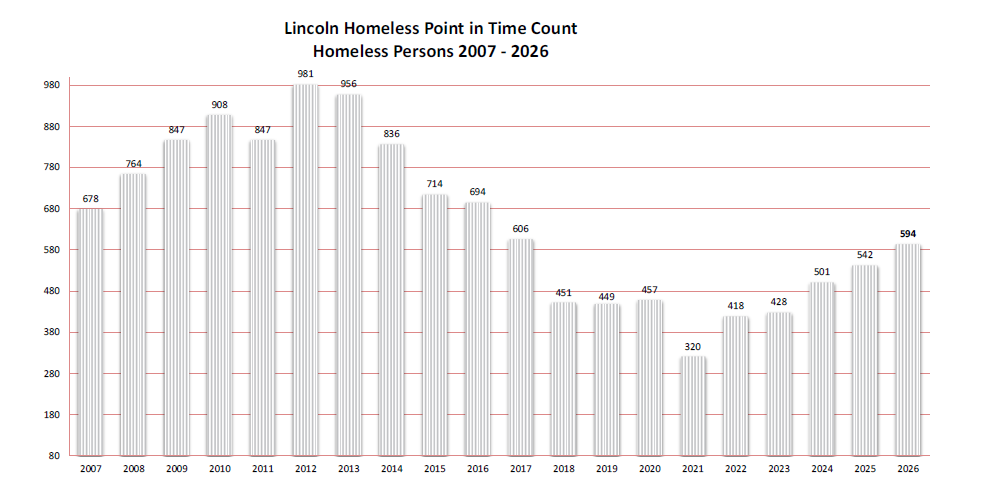
LINCOLN — The number of homeless people in Lincoln has risen by over 85 percent in the last five years, and local nonprofits are struggling to have enough beds and food to cover the increase.
CEO of the People’s City Mission Tom Barber said Lincoln has less than half the shelter space per capita than any city in the United States. Omaha has a shelter bed for every 240 citizens, whereas Lincoln has one for every 983.
“Lincoln is way behind the rest of the country in shelter space, and also we’re the only homeless shelter in the city, which is a little unusual for a city this size,” Barber said.
Built for 250 people, their building reached 445 people this winter with over 150 individuals sleeping on the floor. To help combat this issue, People’s City Mission is planning a new building across the street from their current one. This will house women and children and will hold 300 people. Their existing building will then serve solely men. The building will cost $30 million, and they hope to have it funded and completed by the fall of 2028.
“We were overloaded this year,” Barber said. “Over the years, we’ve seen an increase in homelessness.”
Domestic Violence Causing an Increase
Barber said one of the main causes of homelessness in the City of Lincoln that he has observed is domestic violence. He said they see a lot of crisis homelessness, meaning someone who suddenly becomes homeless but likely won’t be returning to the homeless shelter.
According to a study done by the Nebraska Coalition to End Sexual and Domestic Violence, nearly half of Nebraskans face physical violence from an intimate partner in their life. Barber said this is a situation they see often at their shelter, and someone just needs a safe place to stay for a night. There is only one domestic violence shelter, Friendship Home, in Lincoln, and they have fifty beds. So, often, these individuals need to turn to the homeless shelter.
“The homeless count doesn’t count any of the crisis homeless, which is the biggest population in Lincoln,” Barber said. “So, homelessness is bigger than people know. Lincoln’s future problems are going to be the crisis, not the chronic.”
The chronic homeless count contains individuals who have been homeless for an extended period of time, usually due to issues like alcoholism, drug use, or mental health issues. The chronic homeless count for 2026 is at 594, according to the University of Nebraska’s Center on Family, Children and Law, compared to 320 in 2021.
Rising Costs Hurting Homeless
Alynn Sampson, the Executive Director of Matt Talbot Kitchen and Outreach, said they’ve seen a 13 percent increase in the last year in the meals they are serving, and it has been a steady increase in the number of people they are seeing since the pandemic.
“I think we will continue to see that,” Sampson said. “The numbers are not decreasing for the number of individuals who are experiencing homelessness. There’s so many people on the edge right now, and it’s so easy to fall into homelessness.”
Sampson said one reason for the increase that they are seeing is that since 2008, the fair market rent has gone up by 36 percent, but wages have only increased by 29 percent, and they are seeing the effects of people struggling to keep up with rent.
“It’s not even necessarily what we think of stereotypical homelessness,” Sampson said. “We see a lot of families who are sent into this unexpectedly when they just didn’t anticipate an added cost like a medical bill, and that’s the unfortunate part.”
She said the largest population she is seeing affected is single parents, as help decreases. During the pandemic, Sampson said there were so many resources and funding available for people that kept them housed, but now the funding is disappearing, even though these individuals haven’t recovered.
“The number of individuals that are just needing assistance has gone up, and the number of resources available has gone down,” Sampson said.
The current market isn’t just causing issues for those struggling but also those trying to help them, Sampson said.
“It’s brought a ton of challenges for us,” Sampson said. “There is an increase in the number of meals we are serving and, at the same time, an increase in food prices. We’re preparing more food than we’ve ever had to prepare, which means we’ve spent more than we’ve ever had to spend on meals. It’s definitely affected our budget.”
Sampson said, along with those struggling financially, the issue that they see the most that leads to homelessness is persistent mental illness and substance abuse.
“If they’re having a mental health crisis, there is just nowhere in our city that will take them, and that makes it very hard, which contributes to their chronic homeless status,” Sampson said. “I think that people don’t quite understand the complexities of that when there aren’t resources to address those things. When there aren’t enough resources, that limits the stability of what individuals can do.”
Sampson said she wishes that this would be treated like a pandemic and have resources thrown at the issue.
“People are dying of this, and people are hurting other people,” Sampson said. “I wish that we would throw the resources that we threw at the pandemic at the mental health and substance use issue, instead of taking away resources. It is so severe, and I think that that’s how we need to treat it.”
Sampson said their organization could use volunteers to serve meals, help with laundry and just come and learn about the issue.
“I think that’s the first way to break down some of the stereotypes, and that’s really how you become the best advocate to make the changes and to talk about this issue with others,” Sampson said. “If you see it, you feel it. These are human beings, just like you and I.”
Barber said People’s City Mission is always taking volunteers as well, and there are all kinds of ways people can help.
“Everybody can do something,” Barber said. “It doesn’t take people giving a lot – just a lot of people giving a little bit: time, money, stuff in your closet you don’t need. How do we solve it? It’s encouraging people to give and to give what they have, because everybody can give something. If we get more people doing that, we can do tremendous things.”
City Blames County; County Blames City
A spokesperson for the city of Lincoln said the city was continuing to invest in services for the homeless, while also saying it was a county problem.
“While the County is responsible for human services, including homelessness in Lincoln, the City continues to invest in programs and services that help Lincolnites experiencing instability in housing,” the spokesperson said. The city also noted that homelessness was down from its overall peak in 2012.
Matt Schulte, a member of the Lancaster County Board, said the city, not the county, was responsible for homeless services. Schulte noted that there were generally no homeless people outside the city of Lincoln and in other parts of the county, which is why the county has not had programs to help the homeless, while the city does.
“The homelessness problem is a city problem,” he said. “Homelessness is happening in the city, not the county, and the city should be dealing with it.”
— Olivia White is a freelance reporter with The Plains Sentinel. She previously was a staff writer for The Northside Sun.
READ MORE:
Lincoln Mayor Touts ‘Safe’ City as Violent Crime Surges 32% in One Year

LINCOLN – Lincoln Mayor Leirion Gaylor Baird was joined by the Lincoln Police Department (LPD) to discuss the release of the city’s annual crime report for 2025. The report showed that violent crime in the city has risen 32% in just one year, despite overall crime dropping.
Lincoln Rape Incidents Up 65% in 2026 Following Historic Surge Last Year

Reports of rapes continue to rise in the capital city following a historic spike in the number of reports in 2025, according to recently released data from the Lincoln Police Department (LPD).
Lincoln's LGBTQ 'Conversion Therapy' Ban in Legal Limbo Following SCOTUS Ruling

The city of Lincoln is weighing legal options regarding its LGBTQ “conversion therapy” ban following a ruling Tuesday by the U.S. Supreme Court striking down a similar ban in Colorado.
Great story. Once again The Sentinel scopes the mainstream media. Consider doing a follow up story about the real cause of homelessness. The answer is greedy politicians who forced churches out of helping the poor. For documentation, read Marvin Olasky's "The Tragedy of American Compassion."