

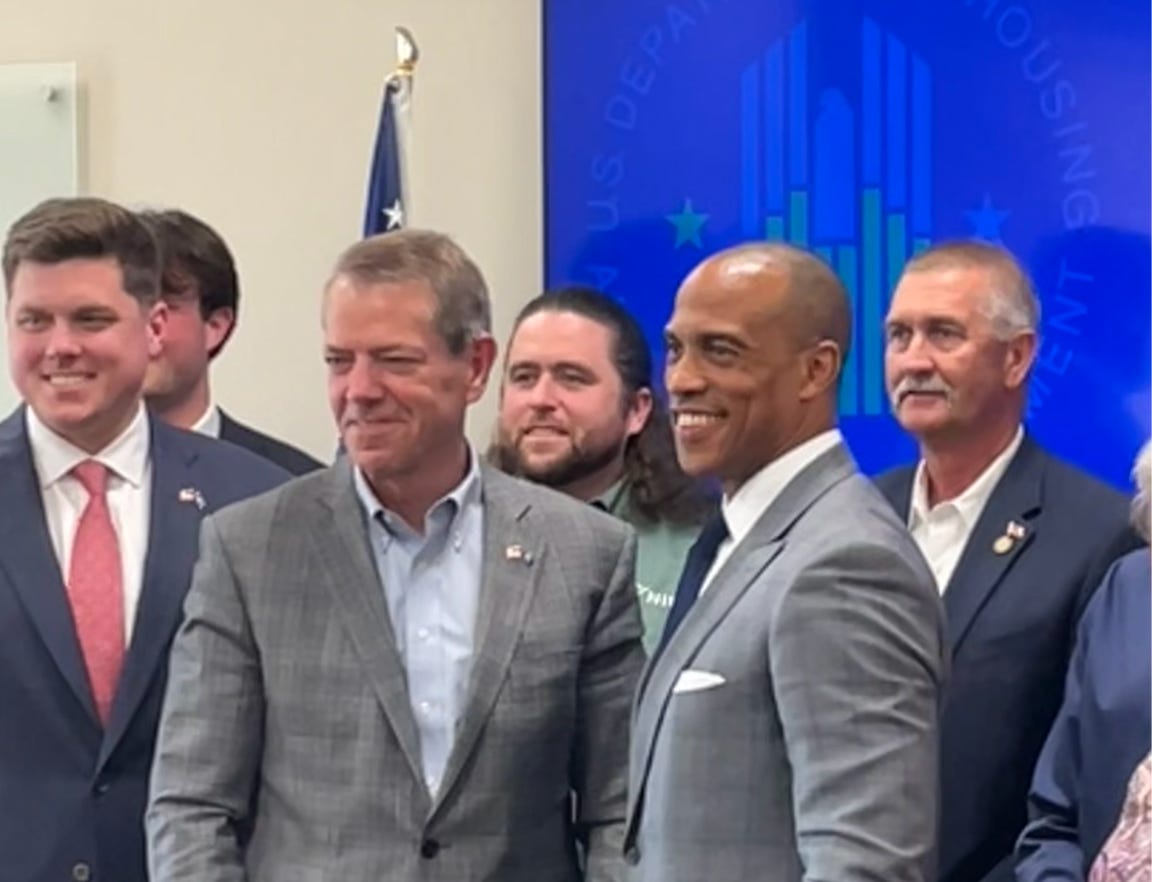
(Picture credit Lewis Thune)
OMAHA — Housing and Urban Development Secretary Scott Turner visited with Governor Jim Pillen and Omaha Mayor John Ewing on Thursday to highlight the promise of Opportunity Zones for impoverished communities.
The three men toured Omaha’s Highlander Accelerator Neighborhood, which sits within North Omaha’s federally designated Opportunity Zone.
“This is an amazing full-circle moment for me, having lived here as a child,” Ewing said.
Opportunity Zones, a creation of the 2017 Tax Cuts and Jobs Act, are low-income census tracts designated by state governors and certified by the Department of the Treasury.
“There’s 8,764 around our country, and the money that is invested inside of these opportunity zones are capital gains,” Turner said.
Capital gains invested in a Qualified Opportunity Fund (QOF) enjoy deferred taxation, and QOF investments appreciate free of tax if held for 10 years. The QOF in turn, invests in business, housing, and revitalization within its designated Opportunity Zone.
Governor Pillen likened such community investments to those of Nebraska farmers.
“The day any farmer has ever bought a farm in the history of this state, the day they bought the farm, it made no sense – no economic sense. It takes 10 to 20 years before you could ever think about a return,” he said. “We need to put community investments together and not worry about the return for 10 or 20 years.”
Of particular concern was how to create affordable housing in and around these Opportunity Zones. Observing the Highlander Neighborhood’s 400 housing units, Secretary Turner stressed the importance of deregulation as detailed in HUD’s best regulatory practices.
“I’m encouraging all localities, states, and cities to take inventory of the regulatory environment. Regulatory environment cripples development,” he said.
In response to a question from The Plains Sentinel, Turner pointed to two Trump Administration initiatives to lower the cost to construct a single-family home.
“The International Energy Conservation Code — which is a final determination that was made during the Biden Administration — it said, if you do not comply with this code, then you won’t be able to build new single-family construction. Well, that was added up $31,000 per project, and so we rescinded that. We also took down the Affirmatively Further Fair Housing Rule, which made Washington a national zoning board” he said.
Ewing pointed to projects of Omaha’s Affordable Housing Task Force in the city’s efforts toward creating affordable housing units.
“We know there are more than one way to build a house. It doesn’t have to be a stick house, it can be SIPs panels, it can be pre-manufactured. We need to look at all of those types of things because they add quality housing to our inventory,” he said.
Pillen expressed encouragement at the bipartisan and cooperative efforts.
“We all three were singing out of the same hymnal. It doesn’t matter what color vest we’re wearing, we all want to make these incredible homes for our people” he said.
And with eyes toward the Highlander Accelerator, all three expressed their continuing optimism. Turner found Omaha’s Opportunity Zone exemplary:
“When you have the federal, the state, and a local working together, and you have mayors who are dialed in and want to be great partners, and the governor who’s leading with an entrepreneurial mind and a private business mind, this is a great example of what can happen!”
— Lewis Thune is a writing fellow with The Plains Sentinel.