

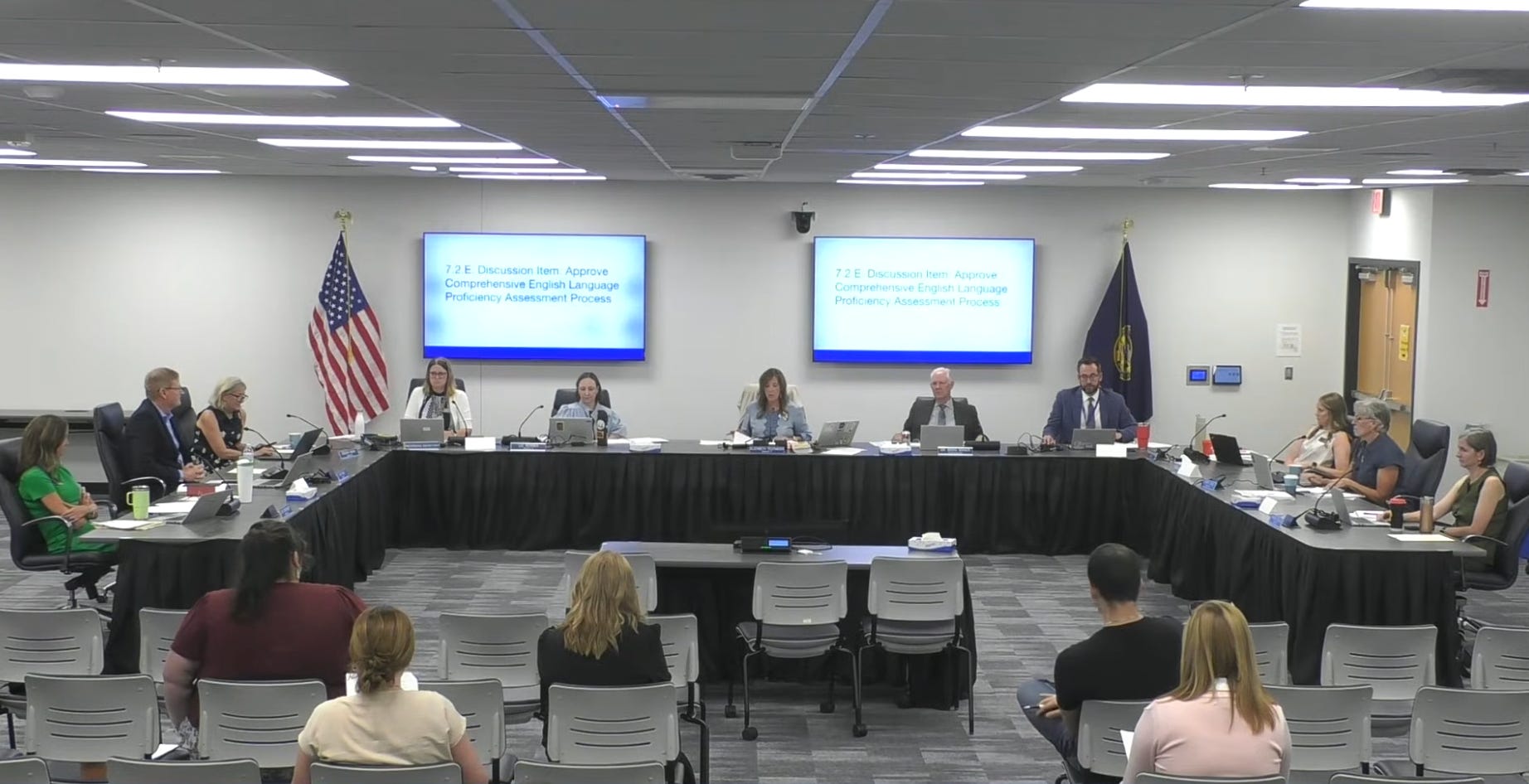
(Picture credit State Board of Education)
After a summer that has already seen fireworks out of the State Board of Education, board members once again butted heads in a Friday meeting that saw repeated allegations of politicking and partisanship, and the proposed 2026 social studies standards shot down 4-4.
The Board has already been the subject of recent controversy, after concerns over a seeming endorsement of a radical approach to education delayed the approval of a North Omaha private schools’ Rule 14 nonpublic status, a series of events that led to multiple accusations of racism from the public and from board member Deborah Neary of District 8, the latter of which Kirk Penner of District 5 called “bulls***.”
Subsequent discouragement over the committee process saw Neary and Sherry Jones trade barbs, with such charges as “dysfunction” leveled against one another. Even in light of an eventual 8-0 vote to approve Identity Preparatory Academy, it became quickly apparent on Friday that the summer fireworks were not over.
Public Comments Over Priority Schools
The first matter to set the board on edge was a routine report from the Planning and Evaluation Committee. After what appeared to be some initially productive discussions over action items advanced through the committee process, Neary was recognized to speak, proposing a discussion item for the executive committee to consider over the next month.
“In my 8 years on the state board, I have always understood our priority schools process to be a very positive and constructive,” she said. “Until this year, our culture has historically been to make sure that we as a board members — what we say publicly about each school on that list — that our comments are thoughtful grounded in a not just some data but a comprehensive review of the data.”
The “list” in question is Nebraska’s list of Priority Schools – a 12-year old designation for underperforming schools most in need of support. Neary’s comment was an apparent reference to a moment from August’s meeting that had initially seemed minor in comparison to the debate over radical curricula and the board’s authority that had directly preceded it.
In August, the board opened discussion on priority school plans to increase measurable student success. Board president Elizabeth Tegtmeier stated her concern that certain schools’ plans aimed too low. She cited Northwest High School in Omaha as an example, a school that aimed to increase proficiency in English Language Arts by 46 of its nearly 1600 students, saying she would like to see a more aspirational goal.
Neary commented that such an examination was “superficial” and impeded on staff business. Tegtmeier expressed her discouragement that discussion on a discussion item was greeted with hostility, which prompted another dialogue between her and Neary as to what “discussion” entailed.
“I hope we can be careful in our public discussions that are supposed to be focused on helping schools improve rather than creating unnecessary controversy or negative public media with board members sharing opinions that could potentially be detrimental to the priority school process,” Neary said on Friday. “I’m hoping this can be added as I mentioned to our executive committee agenda next month for further discussion.”
As to what would be the exact terms of that discussion, Neary was unclear. However, Tegtmeier intuited a clear meaning to the gesture and spoke immediately.
“Well, I guess we’re having a discussion now. Let’s go. Let’s do this,” she said. “I was the person who made the comment last month, and while I’m not on the planning and evaluation committee, I was accused of shaming the priority schools in that committee room.”
“This isn’t about me shaming anybody, this is about me wanting more wanting better for these students.”
Visibly irritated, she then directed her comments to Neary specifically.
“We’re constantly shut down; you constantly try to micromanage this board. I will not be told what I can and cannot say at this boardroom table by you or any other board member, Deb. I am a duly elected member, and I represent 44 counties. We all represent the same number of population, and I’m tired of it. Four years of it.”
Tegtmeier’s incredulity was matched by Kirk Penner of District 5, seated directly next to Neary, who turned and offered choice words to her regarding her proposal to control what board members could say publicly regarding priority schools.
“That was absolutely amazing, comrade Neary. I mean that is USSR type stuff,” he said. “Please remember – and I’m not gonna bring up the schools’ names – we were lied to by two priority schools while they sat right there. They sat right there and lied to our face.”
And regarding Neary’s frustrations that the board and committees had become dysfunctional as of this year, Penner pointed out that this was the first time that the board was evenly split between liberal and conservative-minded officials.
“The reason you didn’t have any trouble is because you were never a tied board. It was 8-0, 7-1, 5-3, and now you’re tied and you don’t get your way.”
Lisa Schonhoff of District 3 and Liz Renner of District 4 also made brief statements, with Schonhoff advocating for challenging schools in order to move the needle for students, and Renner asking the board to allow schools to underpromise and overdeliver.
Moments later, Neary attempted to provide some additional rationale for her proposal.
“I just think maybe I’m just more focused on the process and the dignity that I believe each one of these schools deserves,” she said. “There’s so many things going on in the school, and so for us to just only look at data and not give the school the opportunity to weigh in and round out that information… I’ve seen all sorts of information and attacks on school districts that weren’t based on the big picture. I mean we don’t need more political talking points.”
Tegtmeier said she found Neary’s final statement “rich,” and reiterated that the data points she’d raised back in August were fully accurate. At this, the discussion finally moved to the proposed social studies standards.
Social Studies Standoff
Multiple citizens – all from Omaha – had initially risen for public comment to oppose the proposed social studies standards over concerns they removed emphasis on “diverse perspectives” and “cultural inclusion,” and prioritized producing “automatons for business success and shareholder profits.”
Sherry Jones of District 6, one of three members who had refrained from the initial melee, spoke first regarding her support for the proposed standards, which removed targeted provisions from the 2019 standards, such as prompts focused on “underrepresented” and “marginalized” groups, terms she believed were intentionally vague.
“To determine underrepresentation, there must be a predetermined number of expected or adequate representation. How would this number be determined?” she asked, employing examples of nursing and professional sports as examples of “underrepresentation” in its plain meaning.
“I believe the word marginalized is subjective and is an inflammatory word which can bring about feelings and thoughts of hopelessness helplessness and unwarranted guilt in our children… How do you define ‘marginalized?’”
She also cited a previous point of contention between her and Neary – the fact that the 2019 Nebraska social studies standards received a D- grade from the Fordham Institute.
Lisa Schonhoff agreed with Jones, taking issue with subjective terms given the board’s statutory duty.
“The Nebraska State Board of Education is to adopt measurable academic content standards for at least the grade levels required for statewide assessment,” she said, quoting state statute.
“If we are going by state statute, our 2019 standards are not legal because you can’t measure ‘marginalized’… I’m not leaving it to the teachers to have to deal with determining what is ‘marginalized.’”
Maggie Douglas of District 2 disagreed, citing the terms offered deference to students who were poor, required special education, or spoke English as a second language.
“Removing this language sends a message that understanding the experience of these groups of these subgroups is less important,” she said.
Douglas further took issue with the replacement of verbs like “explore” with “identify,” worrying that such actions would hamper inquiry and discussion, which Schonhoff expressed interest in looking into.
Liz Renner agreed with Douglas, saying she saw the removal of words like “marginalized” and “underrepresented” as regressive.
“There’s a way of teaching history where you can position certain people as heroes and other people as the beneficiaries,” she said, specifically mentioning slavery, and her desire to teach of resistance among enslaved people in addition to emancipation and the Civil War.
“If there’s not room for both then I think we’re getting an incomplete picture for the kids.”
Kristen Christensen of District 1 opted for brevity, stating plainly that her constituents did not support the 2026 revisions to the 2019 standards. After her came Neary, who once again stated that the current board had upended the old order of business, this time in regard to standards.
“I saw a complete change in the process this time than I had ever seen in any of the standards that I’ve been a part of approving. And I didn’t want to go there, but since we’ve gone there, I was disappointed,” she said, stating that in her prior experience, “we really try to go back to the people that have worked on the standards before.”
She praised the 2019 standards as forward-thinking and inclusive. As Jones had again raised the Fordham Institute in relation to the 2019 standards, she stated her belief that the Institute was “an extremist political think tank” and that its assessment flew in the face of “evidence-based research.”
She then returned to her frustration with the proposed 2026 standards, expressing incredulity “that we didn’t accept people on the writing committee that had asked to be because they had been before,” and said that the staff was tasked with the impossible in developing standards for a board split 4-4 between conservative and liberal voices.
Kirk Penner again took exception, this time on the matter of Neary’s “evidence-based research.”
“Several months ago at a board meeting, Deb went off on ‘experts’ and ‘evidence-based research.’ I emailed her and asked her for the research. I don’t have it,” he said. “You talk about evidence-based research and experts, but you don’t provide that, and you haven’t provided it to me in the last couple months since I asked for that.”
Neary did raise a personal defense in response to Penner, indicating the present board was creating problems and characterizing her dissent as apolitical.
“I have been deeply disappointed by how our culture and decorum of this board has changed so dramatically over the last two years. I’ve watched transparency diminish, and important decisions move outside our committee process, and individual schools and districts and even our own commissioner have faced public attacks by our board members. And almost every time these attacks were based on political agendas,” she said.
“I’ve never missed a meeting to attend a political event, I’ve never used political talking points, every comment I make is based in evidence-based strategies commonly accepted by the majority of educators in our state.”
Commissioner Dr. Brian Maher was then recognized to speak, noting Neary’s claim that board members had attacked him and saying he was unaware of any attacks.
Tegtmeier Alleges ‘Horse Trading’
Tegtmeier spoke to close out the day, and in response to Neary’s point of apoliticism, alleged that a liberal board member had engaged in politicking to the point of offering a trade to break the 4-4 gridlock:
“I don’t think these standards are probably as bad as they’re being presented, because I got a call yesterday saying ‘Hey, we can get you a fifth yes vote if you’ll horse trade the presidency next year.’”
Lisa Schonhoff had earlier mentioned that some members of the board had privately expressed a willingness to change their vote, but a claim of an outright trade evidently came as news to multiple board members.
“I can see the looks going around, you’re trying to figure out who did it — we can talk after the meeting. But we don’t, we don’t horse trade votes,” Tegtmeier said. “Sorry, but I don’t buy and sell votes, and I need people around this table to quit playing politics. And if you vote ‘no’ after that horse trade, that’s partisanship — and we’ve been told that we don’t do that on this board.”
She challenged opponents to vote no if conscience compelled them, but to “have some leadership” and offer specific areas of compromise, as the board had previously done to move an initial 4-4 split on the topic of mental health grants to a matter of unanimous approval.
While the 2026 standards as proposed did fall 4-4, putting Tegtmeier, Penner, Schonhoff, and Jones against Douglas, Renner, Christensen, and Neary, the board did unanimously approve Northwest High School’s revised progress plan.
Following the meeting, Neary, Renner, and Douglas released a joint statement saying they were unaware of any vote trading.
“We would never trade our votes on academic standards—or any other substantive matter before the Board—in order to advance the political position of ourselves, another Board member, or our political party,” the trio said. “Public confidence in this Board depends upon Nebraskans knowing that our decisions are being made openly, independently and in accordance with the responsibilities entrusted to us.”
— Lewis Thune is a College Fix writing fellow with The Plains Sentinel.
Wow, what a clown show. It only takes one or two members to make it look that way. Everyone can make their own determination as to who those one or two are.
FOR IMMEDIATE RELEASE
Issued jointly by:
Nebraska State Board of Education members: Deborah Neary, Liz Renner, Maggie Douglas
Media Contact: Deborah Neary
THREE STATE BOARD OF EDUCATION MEMBERS AFFIRM COMMITMENT TO ETHICAL DECISION-MAKING OVER POLITICS
LINCOLN, Neb. — Sep. 4, 2026 — Nebraska State Board of Education members Deborah Neary, Liz Renner and Maggie Douglas issued the following joint statement today following information shared publicly during the September 4 State Board of Education meeting:
“During today’s meeting, it was stated publicly that a member of the State Board of Education had attempted to negotiate their vote on Nebraska’s proposed social studies standards in exchange for consideration of a Democrat for president of the State Board beginning in January 2027.
We want Nebraskans to understand that these reported discussions did not occur on behalf of the three Democratic members issuing this statement. There are four Democratic members of the board. Not one of us three had knowledge of these discussions, nor did we authorize them or give support to such an arrangement.
The Nebraska State Board of Education’s own operating policies establish expectations for how Board members carry out their responsibilities. The Board Member Code of Conduct states that members should make policy decisions based on available facts, their individual judgement, and the best interests of the state. It also calls upon members to follow the rule of law in policymaking.
Those principles matter.
Each Board member has an obligation to independently consider the matters before us and reach a decision based upon the merits of the issue and what we believe is best for Nebraska schools.
A vote on academic standards should never be treated as political currency. Likewise, the selection of Board leadership should stand on its own and should not be connected to how a member votes on an unrelated policy matter.
We would never trade our votes on academic standards—or any other substantive matter before the Board—in order to advance the political position of ourselves, another Board member, or our political party.
Public confidence in this Board depends upon Nebraskans knowing that our decisions are being made openly, independently and in accordance with the responsibilities entrusted to us.
We hope this serves as a reminder to all of us that the integrity of the Board’s decision-making process must always come before politics, leadership positions or personal interests.
Nebraska students, educators and families deserve nothing less.”
###