

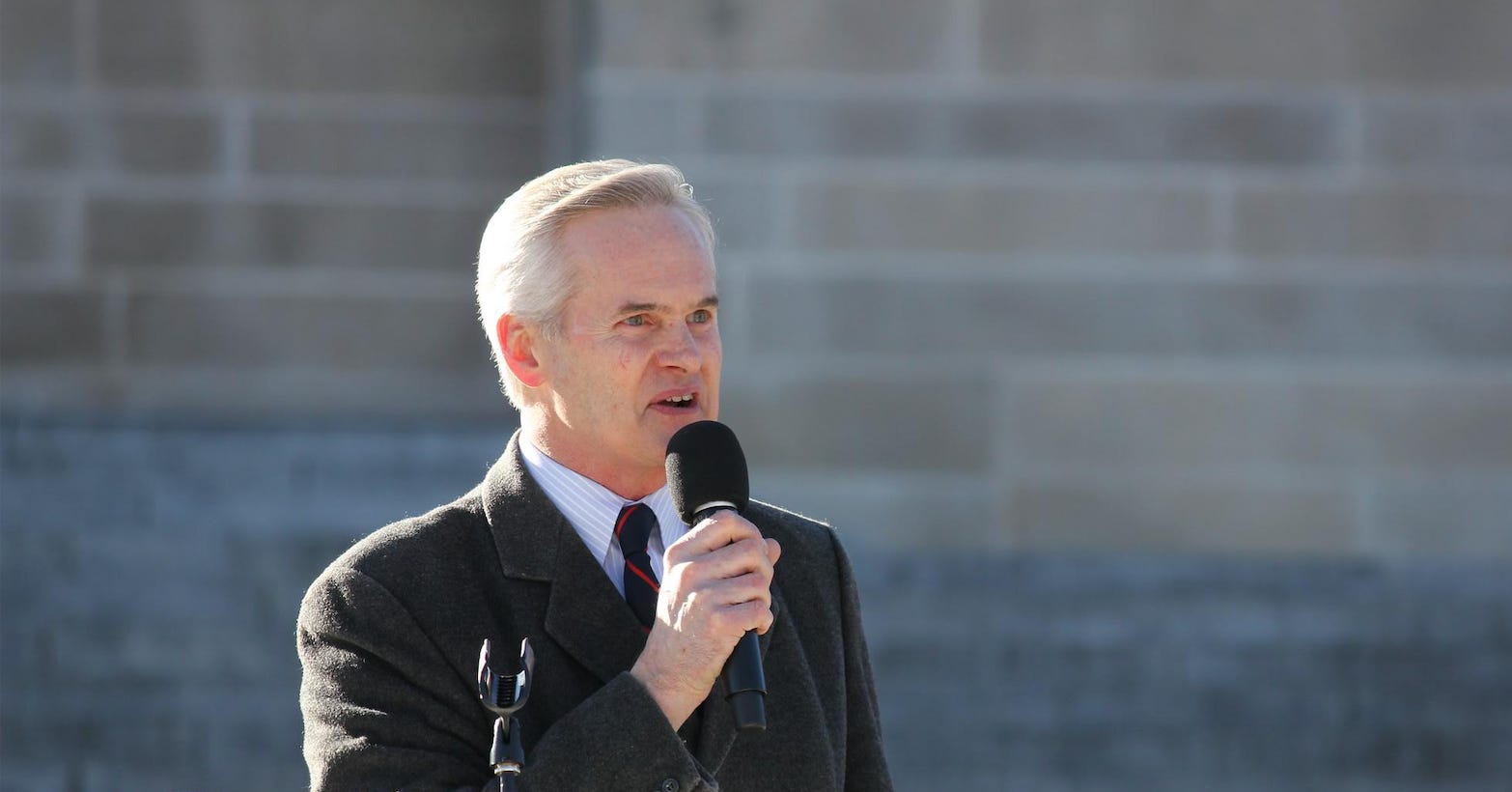
(Picture credit Matt Johnson)
OMAHA — Nebraska Auditor of Public Accounts Mike Foley and staff publicly released an 11-page letter to Nebraska’s Department of Economic Development (DED) Tuesday morning, strongly recommending corrective actions after their office found alleged misuses of state-directed funds, myriad misrepresentations, and conflicts of interest in an Omaha nonprofit.
The Nebraska Startup Academy is an Omaha-based nonprofit nominally established in late 2022 to spur entrepreneurship and innovation in the Cornhusker state. Of its near $1.3 million total receipts, $1.1 million came from state and federal funds, with $887,000 from Nebraska’s North and South Omaha Recovery Grant Program.
“In bureaucratic doublespeak, the Academy’s progress to date is sub-optimal. In more accurate, everyday language, it’s pathetic,” Foley said.
The North and South Omaha Recovery Grant Program, created in 2023, aimed to foster “small business development, job creation, and economic development” after COVID-era turmoil. The Academy received its funds after estimating in its application that it would create and support 60 startups and upwards of 300 new jobs within its first three years.
“Where are all those promised startups and new jobs?” Foley asked Tuesday morning.
The auditor’s team found that not only did the Academy appear to misrepresent its meager job creation numbers, but it also appeared to misreport its revenue, fail to disclose other business affiliations among its staff, and spend its money on seemingly nothing.
“The Academy spent most of the money on itself, leaving behind a trail of cancelled paychecks but almost nothing in terms of meaningful results,” Foley said.
With total funding of $1.3 million, the Academy spent $813,000 to pay four of its seven personnel, with the other three – all board members – receiving no compensation.
The four compensated personnel are employees or members of the Omaha-based firm Move Venture Capital, which took a partial stake in at least three companies that the Academy had previously identified as partners in its collaborative workspace.
MVC’s managing partner is the Academy’s executive director, while two of its general partners serve on the Academy Board as Chairman and Treasurer, respectively. All three men are compensated for both positions, with managing partner/executive director Charlie Cuddy making $387,000 over the past two years from the Academy alone.
In 2025, the Academy reported to the IRS that none of the nonprofit’s officers, directors, trustees, or key employees had any business relationships with one another.
This was only one of the Academy’s reporting woes.
Reporting Disaster
In 2024, the Academy made a rather jarring error in reporting its revenue. It listed $184,000 in revenue to DED. When Foley’s office attempted to verify this number, it found that the nonprofit had reported $770,000 in revenue that same year to the IRS.
The Department of Revenue failed to catch that disparity, but Foley’s letter indicates it was already taken with multiple other errors from the same source, observing that funding disbursements from the grant program were issued a full 16 months apart.
“The issues leading to this funding hiatus included problems with expense and budget reporting, inadequate invoices and other supporting documentation, and failure of the Academy to submit required financial and performance reports to the Department” the letter notes.
And yet for all its lax financial accounting, nothing rivaled the Academy’s inaccurate reports of job creation.
Foley’s letter found that the Nebraska Startup Academy fell well short of its self-imposed goal of 300 jobs in 3 years. In actuality, the nonprofit tallied 46 – 15 direct and 31 indirect – to the Department of Economic Development. When Foley’s office inquired about the supporting documentation and found it lacking, the Academy corrected its total with the Department.
For $887,000 in grants, the Nebraska Startup Academy created 4 jobs.
And even if those funds are not deemed to be misused, they were at the very least misplaced. The letter observes that the grant program requires its funds not be co-mingled with other funding, mandating the use of a separate, dedicated account. Despite initially using one, the Academy repeatedly transferred grant funds into its other accounts.
While much of the report was devoted to the Academy, Foley’s final words on the matter were directed at DED, saying they needed to take action regarding its oversight practices.
“When utilized properly and carefully, certain public funding mechanisms can prove extremely beneficial to Nebraska’s economy. In order to succeed, however, they must be subject to strict oversight and effective compliance measures. Hopefully, the DED will take steps needed to implement that type of necessary stewardship here.”
The Plains Sentinel has contacted the Department of Economic Development for comment.
— Lewis Thune is a College Fix writing fellow with The Plains Sentinel.