

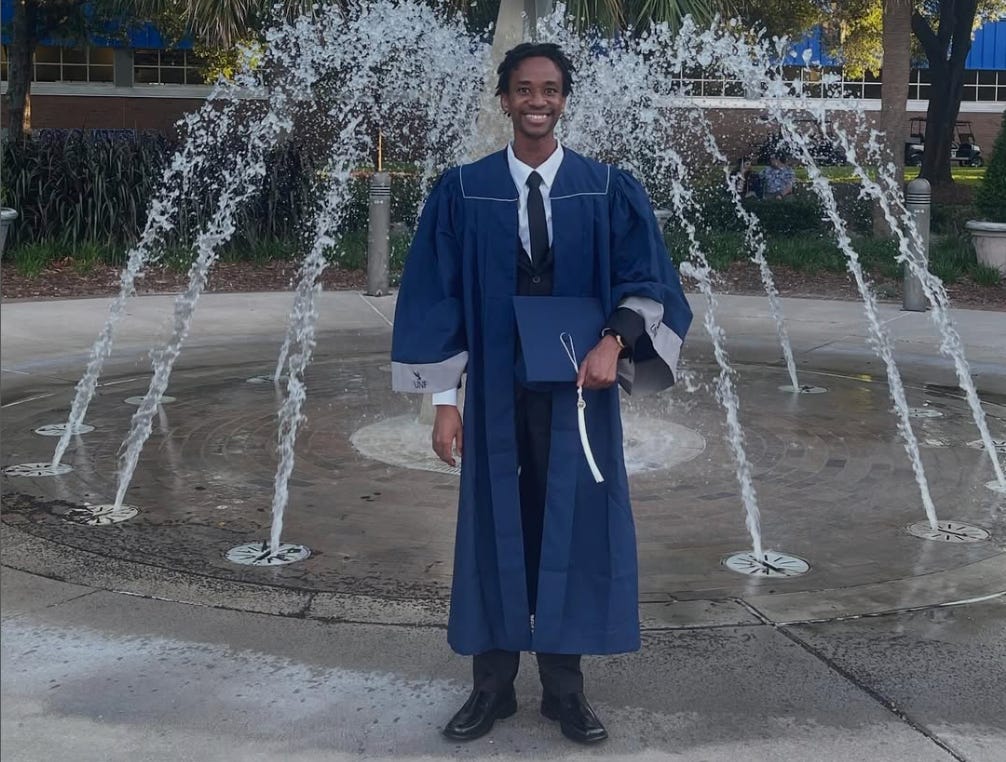
(Picture credit Tyreese Learmond)
In what some observers are calling a case of affirmative action run amok, a former University of Nebraska at Lincoln College of Law student filed a suit against multiple UNL Law staff last week alleging negligence, hostile educational environment, equal protection violations, and conspiracy, among other counts.
Tyreese Learmond was a UNL student until June of this year, when his enrollment was rescinded following poor grades. He has since lodged a complaint in Lancaster County District Court arguing that UNL Law failed him. Listed defendants include four UNL Law professors, one adjunct instructor, the college’s Dean and Associate Dean, the University of Nebraska Board of Regents, and the state of Nebraska.
The case surrounds a spate of “racially motivated microaggressions” and other targeted hostility alleged to have taken place based on Learmond’s race, color, attire, and classroom positioning that were not properly addressed by the Board of Regents or the state. Such activities, the plaintiff says, rose to the level of chilled speech, hazing, conspiracy, and hostile environment.
The complaint specifically targets some of UNL Law’s most liberal law professors, including Anthony Schutz and Harvey Perlman.
Learmond states the activity took place consistently throughout the 2025-2026 academic year up until the time his enrollment was rescinded – beginning in early September of 2025 when he was disheartened by a professorial comment about his decision to wear a suit every day.
Later that month, the deans declined to act on a disagreement that Learmond had reported between himself and another student with whom he shared a group project. The next day, a professor reportedly made a remark to the class about a questionable answer Learmond had given moments before.
Learmond also alleges that an instructor told him that “a lot of law school is hazing” and that he had to endure it.
In a January meeting with the associate dean regarding his poor academic performance, he stated that such interactions with professors were negatively affecting his mental health conditions, which include bipolar disorder and schizophrenia affective disorder. He alleges the associate dean told him that law may not be the field for him.
Also in January, a professor accused Learmond of violating the college’s AI use policy on the first assignment of the semester, to which he objected. The professor eventually relented but Learmond noted no evidentiary basis for the accusation in the first place, and no similar accusations against anyone else for the duration of the semester.
Following a subsequent meeting with the associate dean, Learmond was required to register with Services for Students with Disabilities, visit a school therapist, and consult his psychiatrist. He reported all incidents in March. Following meetings with appropriate staff, the University’s Office of Institutional Equity and Compliance found that it could not act based on the reported incidents and referred the complaints to the associate dean.
In June, Learmond’s enrollment was revoked after he failed to score C+ or higher in a class, and was told he had no other channels by which to continue except to wait a year and apply for readmission.
He further states he was not offered proper recourse after lodging multiple internal complaints. His subsequent state contract claims were objected to, and his state tort claims were denied.
He succeeded in attaining records of communication from College of Law officials under the Family Educational Rights and Privacy Act, which show multiple staff had raised behavioral concerns regarding him, while multiple others had stated no concern.
On this collective basis, Learmond alleges a hostile educational environment, breach of implied contract via hazing and chilled speech, negligence, due process violations, equal protection violations, First Amendment violations, Americans with Disabilities Act violations, defamation and civil conspiracy.
He has requested damages from all defendants. Tyreese Learmond has also previously sued Experian Information Solutions and Fidelity Brokerage Services in April of this year. Currently available information suggests Experian was released from the suit in June, while Fidelity is seeking arbitration.
Perlman Promoter of BLM
The lawsuit includes current UNL Law professor and former UNL chancellor Harvey Perlman, who pushed Black Lives Matters (BLM) and similar racial causes during his tenure at the head of the university campus.
In 2015 when he was UNL Chancellor, Perlman issued a statement in support of BLM following a protest by students. A couple months later, Perlman caved to the activists demands and issued a series of university actions to implement diversity programming.
“I understand and respect your impatience for more visible signs of progress. While I am committed to continuing our progress, I am under no illusions that change will be rapid or complete. Legacies so deeply rooted in our past are not easily overcome,” he said in a letter at the time.
Perlman is cited in Learmond’s lawsuit over a comment he made towards the student that allegedly “exacerbated his mental health diagnoses” as well as for an F grade he gave Learmond in one of his classes.
Learmond said Perlman acted “implicitly in concert” with other professors to get him thrown out of UNL Law.
This lawsuit is also not Perlman’s first dustup with minority members on campus. In 2012, Perlman took aim at NU assistant football coach Ron Brown for testifying against an LGBTQ+ ordinance being pushed by the Omaha City Council.
Perlman said he was “personally offended by the comments” made by Brown, who said the city ordinance was opposed to the teaching’s of Christ.
— Lewis Thune is a writing fellow with The Plains Sentinel.
I have empathy for the young man. He's suffering from mental health issues. From reading the article, he is hypersensitive to having his feelings hurt and lashes out at anyone and everyone he felt offended him. Being told he may not be cut out to be a lawyer should have been taken as constructive guidance, not as an offensive remark. I'm certain if I enrolled in the college of law, it wouldn't be long before I would be told I'm not cut out to be a lawyer. I would be appreciative and would hopefully have the sense to pursue another vocation.
I understand what you’re saying, but I don’t think telling him he was “not cut out to be a lawyer” was simply constructive guidance. He was capable enough to be admitted to law school, he was there because he had earned his place, and he was paying tuition just like the other students.
I believe there may be a larger campus culture issue at play. If he was experiencing microaggressions or other incidents that made him feel targeted or unsupported, and nobody stepped in to help him navigate those experiences, I can understand how things could eventually reach a breaking point. That, and being told youre not cut out for your dream profession after being admitted and enrolled in law school must have been triggering for this young man. I think it’s important to look at what led him there rather than reducing the situation to him simply being “too sensitive.” Sometimes people need support before they reach a crisis point, and I don’t think he received enough of it.