

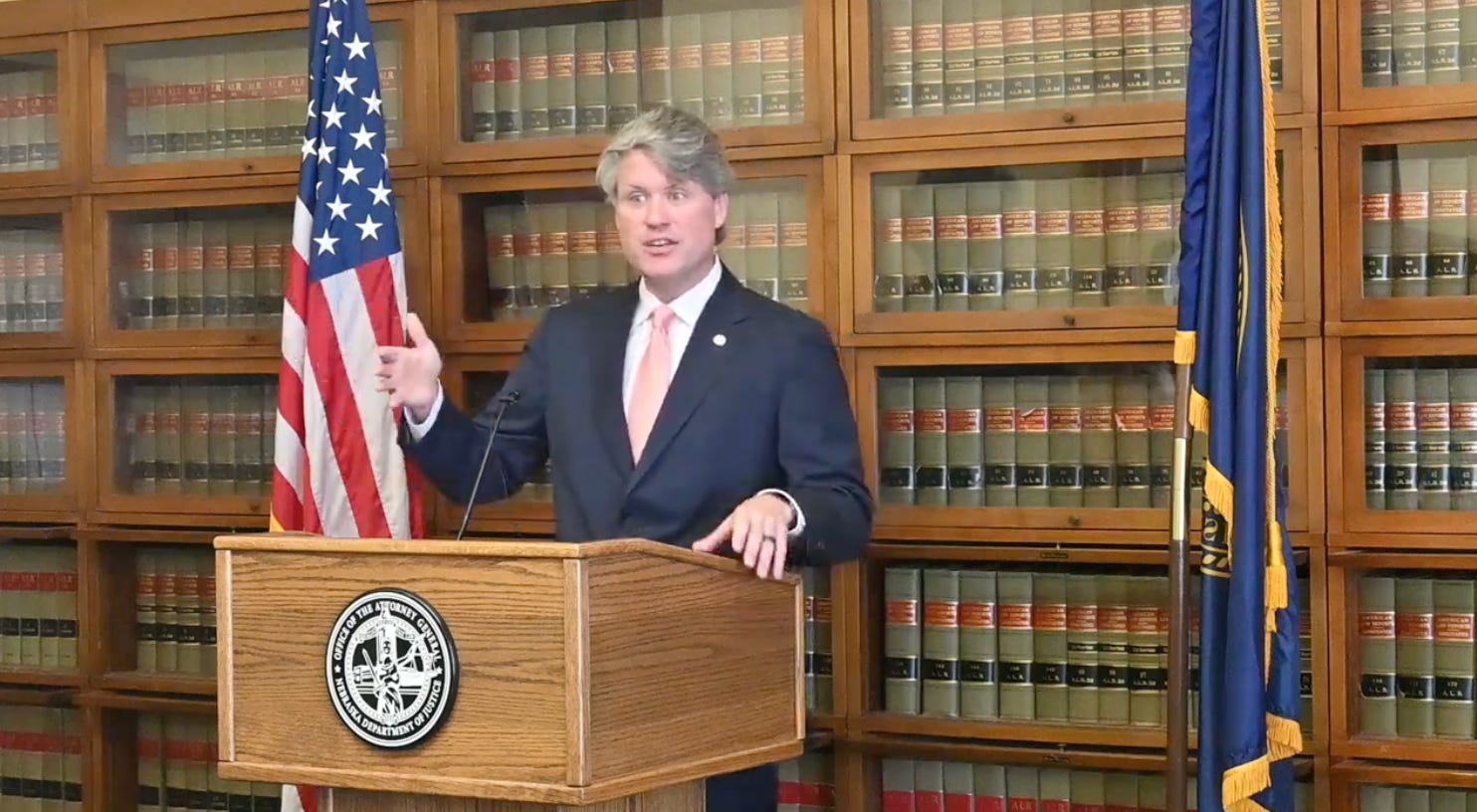
(Picture credit Nebraska Attorney General’s Office.
The Nebraska Supreme Court ruled Wednesday afternoon that the city of Lincoln must put three charter amendments on the November ballot following a lawsuit by Attorney General Mike Hilgers.
The court said the city of Lincoln is “obligated to submit the proposed amendments in conformity with this constitutional mandate,” and directed “Respondents to submit the proposed charter amendments to a vote of the qualified electors at the November 3, 2026, election.”
The legal fight came as Good Government Lincoln sought to put three charter amendments on the ballot, including term limits for city council members, allowing eligible residents in the city’s three-mile extraterritorial zoning jurisdiction (ETJ) to vote in most municipal elections, and moving Lincoln city elections to even-numbered years.
The city of Lincoln had argued that Good Government Lincoln had missed the deadline following its need to redo its petition drive and resubmit signatures due to fraud. Supporters of the charter amendments said that Lincoln officials were preparing to use delay tactics regardless of when the amendments were submitted.
Attorney General Mike Hilgers filed a lawsuit two weeks ago against the city of Lincoln, saying they were attempting to illegally delay placing the charter amendments on the November ballot. The city said they planned to put the amendments on the 2027 ballot.
“The local officials’ unprecedented neglect of their ministerial and constitutional duty to submit timely filed petitions to amend the city charter for a vote at the next general election warrants this Court’s immediate and plenary review,” Hilgers said in his lawsuit.
City Attorney Yohance Christie said, at the time, that the city had several processes it needed to follow before the amendments were eligible to make that ballot and that the city was unable to perform those duties before the 30 day deadline would be reached.
“For an issue to be included on the November general election ballot, the City Council must pass a resolution authorizing the ballot issue and provide it to the Election Commissioner by September 1st,” Christie said. “The City Council is under no obligation to bypass their processes for placing petitions on the ballot because of a missed deadline.”
Hilgers responded to the court’s decision on Wednesday, saying it was an “important” decision “for the rule of law in Nebraska.”
“The Lincoln voters did the hard work of gathering enough signatures to earn a spot on the November ballot. Unfortunately, Lincoln’s elected officials decided to play political games instead of obeying the Constitution,” he said. “I am grateful to the Supreme Court for protecting the right of the People of Lincoln to participate in their government at the ballot box this Fall. City officials do not get to ignore the Constitution.”
At an event Wednesday, Hilgers told a group of Republican supporters that the Lincoln Mayor Leirion Gaylor Baird and her allies on the city council were trying to “silence” opposition in the city.
“Had the city, the mayor, the city council gotten away with it, they would be able to silence the people’s voices.”
Former State Senator Tony Fulton, the sponsor of the charter amendments, said he was “thrilled” by the court’s ruling.
“We are thrilled that the voters of Lincoln will have the final say on term limits, increased voter participation in city elections, and that every citizen who is subject to Lincoln government is able to vote on the officials who are ultimately governing them.”
Split Decision
The decision by the court was a split decision with Justice Stephanie Stacy dissenting along with Court of Appeals Judge Michael Pirtle, who joined the dissent in place of Chief Justice Jeff Funke, who did not participate in decision.
“I think compelling the city council to submit a strictly local matter to Lincoln voters at the statewide general election in November will require the city council to ignore provisions of its home rule charter and to violate the established timeframes prescribed in the Election Act,” Stacy said in her opinion.
In a statement, Christie said the city believed Stacy made the correct interpretation of the law, but said Lincoln would “comply” with the court order.
“We are concerned that sacrificing steps in the public process undermines public understanding and confidence in the ballot process and does not allow for adequate time to educate the public on the impacts of the charter amendments.”
Christie left the possibility open that the city may put alternative amendments on the ballot — a move the Supreme Court approved of in its ruling.
— John Gage is the executive editor of The Plains Sentinel.
Mayor Baird, Lincoln City Council & Lincoln City Attorney, that was a valiant effort you employed in trying to stop Lincolnites from voting on these amendments in November. You're there to serve us, not yourselves. Thankfully, justice prevailed.