

(Picture credit Food and Drug Administration)
For the first time ever, marijuana is the most popular addictive substance in America, now outpacing the number of people who drink alcohol or smoke cigarettes, according to data from the Substance Abuse and Mental Health Services Administration (SAMHSA).
On Monday, SAMHSA released its 2025 survey on drug use and health across the country. The survey found that 21.4 million Americans consume marijuana on a daily basis, while only 17.2 million drink alcohol on a daily basis.
Marijuana finally passed cigarettes as America’s favorite addictive substance. Only 19.9 million Americans smoke cigarettes daily. In 2024, 22.2 million Americans smoked cigarettes, while 21.6 million Americans used marijuana.
“2025 is the first time on record that marijuana is the most popular daily-use addictive product,” Charles Fain Lehman, a senior fellow with the Manhattan Institute who specializes in marijuana research, said Monday on Twitter.
The popularity of marijuana as the drug of choice comes as American public opinion has plateaued, or even declined, in support for legalization. According to a recent Gallup poll, less than 50% of Republicans now support legalizing marijuana, while support from Democrats and Independents has flattened after 2022.
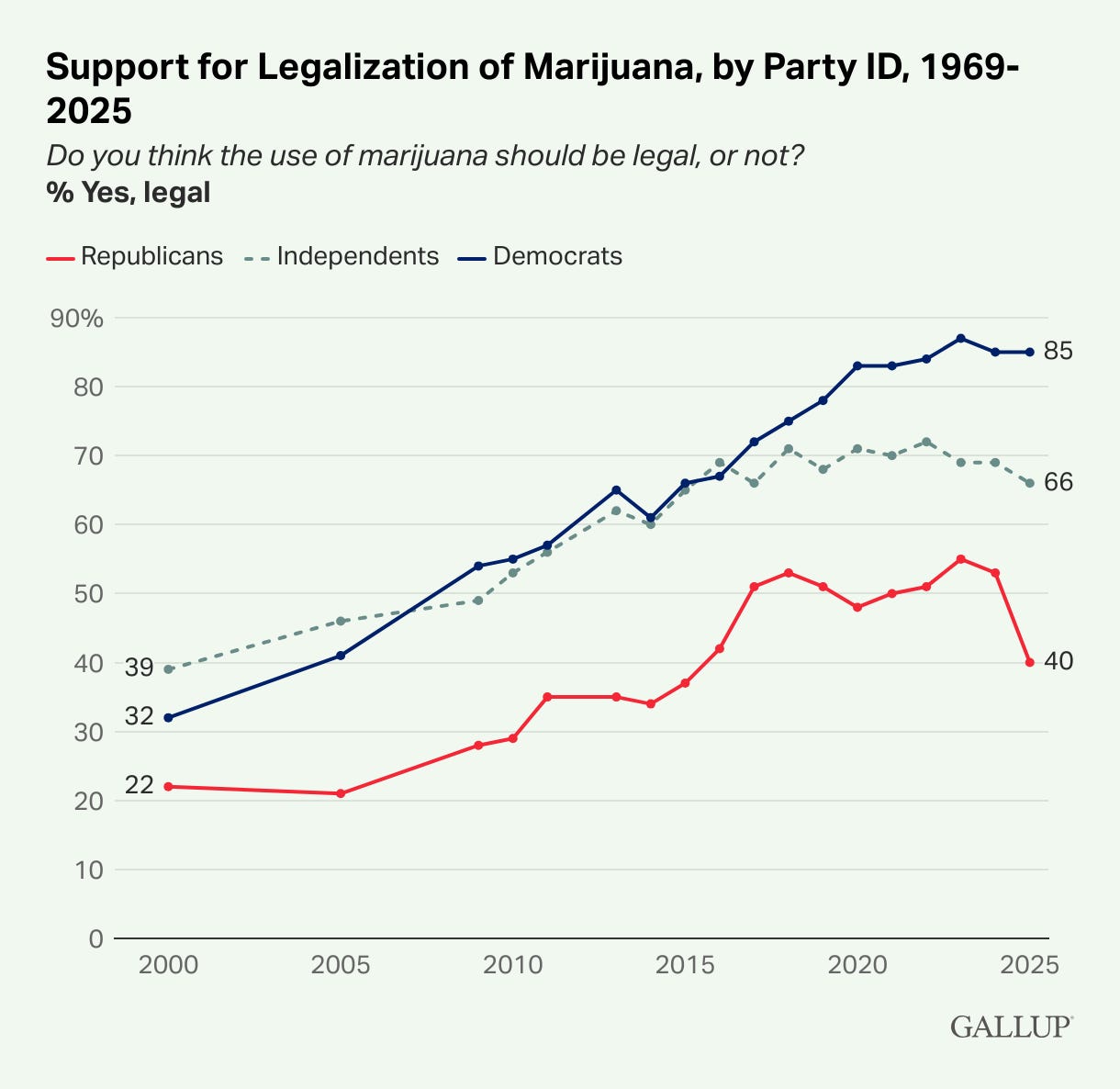
(Graph credit Gallup)
The survey found that over 70% of Americans view the country’s drug problem as “extremely” or “very” serious. Republicans were more likely than Democrats to be concerned about the “seriousness” of the country’s drug problem, according to Gallup.
Lehman said the increase in marijuana usage has been fueled by the surge in legalization by states across the country. Marijuana is currently legal in some form in over 40 states.
“Legalization has increased rates of marijuana addiction—typically called ‘marijuana use disorder’—including rates of heavy use among teens,” he said in a recent Wall Street Journal piece. “State-legal businesses have a profit-motivated reason to nurture addiction. Due to legalization, today’s pot is far more potent than it was decades ago.”
Paul Skallas, an online cultural commentator, responded to the latest news on marijuana, saying the country was headed to unprecedented territory — “Well, that’s fascinating. I don’t think history has ever produced a marijuana society before. We’re about to find out what one looks like.”
— John Gage is the executive editor of The Plains Sentinel.
As if we already didn't have enough addiction problems with alcohol. Dems favor this strongly as they want to destroy whatever brain cells they have left. Read Alex Berenson's book, "Tell your Children." Pot is not harmless.
Partisan piece. The Plains Sentinel brands itself as "dedicated to restoring integrity and balance." This article is not balanced.
SAMHSA's data comes from an agency now bending science to politics. SAMHSA falls under HHS, led by Secretary Robert F. Kennedy Jr., who has pushed vaccine policy reversals contradicting established science. The same department recently redirected teen pregnancy prevention funding toward abstinence-only criteria. SAMHSA, tasked with advancing public health, has cut its staff by roughly half since January 2025 and has been canceling grants with little explanation. Their focus is no longer public health. It is partisan politics.
Trustworthy data requires an agency insulated from partisan pressure. SAMHSA no longer qualifies.
Additionally, the word "addictive" and "addiction" appear no less than five times in this short piece. Only one expert gets quoted: Charles Fain Lehman of the Manhattan Institute, a right-leaning think tank.
This article ran the same day the outlet published an unrebutted commentary calling state universities "far-left super PACs." Plains Sentinel is starting to read like an outlet with a conservative editorial lean, not the balanced coverage its branding promises.
Note, I am not a marijuana user, but I am opposed to incarceration for marijuana and Nebraska's failure to obtain tax revenue in a state with over a one billion budget shortfall. That's my commentary, which I frequently write. I don't brand myself as being balanced. Fact based, yes. Balanced, no. I suggest the Plains Sentinel adjust their branding or write truly balanced pieces.
—A Disappointed Reader