

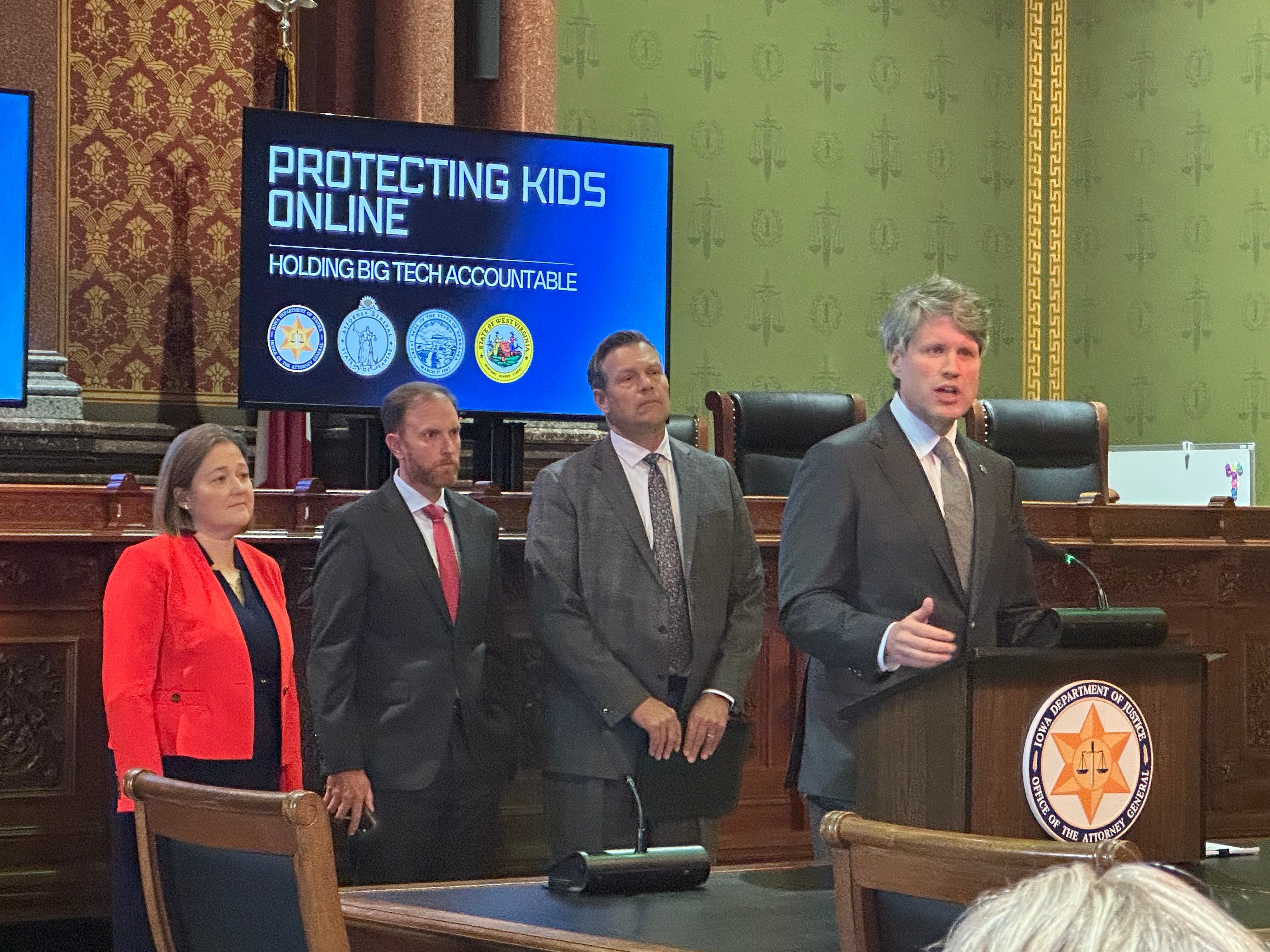
(Picture credit Nebraska Attorney General’s office)
Nebraska Attorney General Mike Hilgers made a two-and-a-half-hour drive from Lincoln to Des Moines Wednesday morning to announce a spate of state lawsuits against OpenAI, the American tech giant behind ChatGPT.
Iowa Attorney General Brenna Bird welcomed Hilgers to the Iowa State Capitol beside Kansas AG Kris Kobach and West Virginia AG John B. McCuskey.
“OpenAI told Iowans and their users all across the country that ChatGPT is safe. It is not. That is why we are here today,” Bird said. “The states of Arkansas, Arizona, Idaho, and Montana are also suing OpenAI in their home states.”
The eight simultaneous suits across eight different states are launched under each state’s various consumer protection acts, Kobach explained:
“These consumer protection acts protect our respective citizens against being deceived by companies that have put a product on the market that is dangerous and then tell the public something that is also misleading about the product, thereby deceiving and harming consumers.”
Hilgers states that the charge, in a near-identical vein to recent actions against TikTok and Meta, is that OpenAI is falsely billing its chatbot ChatGPT as safe for children.
“If you have a product that is not safe for children, one, you should not sell it to children. And two, you should not tell parents and you should not tell family members that it is safe for children,” he said.
“That is precisely what OpenAI has done here – they have marketed their product, their chat product, on the Apple marketplace, saying it’s appropriate for 13 and up. It is absolutely not appropriate for kids at that age.”
Bird, Kobach, and Hilgers all brought up similar examples.
“When ChatGPT coached its users, including a teenager, to commit suicide, that was wrong. That crossed a line. When ChatGPT coached kids on how to harm and kill other people, that is wrong and that crossed a line,” Bird said.
“When ChatGPT offered dangerous medical advice, like telling a teen in Texas to take Xanax for nausea after taking Kratom – also known as gas station heroin – it crossed the line. And it led to the loss of that teen’s life.”
Hilgers mentioned the Hugging Face incident by name, where multiple OpenAI AI agents autonomously hacked the hosting platform.
“You have a device, a platform, that is trained to be sycophantic,” Kobach said. “This is especially dangerous when you’re talking about young users… it’s also not safe for the elderly.”
He likened the eight-state effort to the opioid and tobacco litigation of preceding years, arguing against waiting for a federal fix.
“The notion that we should wait for Congress to develop a universal solution that covers the entire country and then apply that solution, apply those standards, is foolish,” he said. “Many in Congress appear not particularly willing… even laws that have passed so far at the state level generally ask companies to come up with their own safety plans.”
Hilgers too stressed that this legal endeavor was nothing new.
“This is an application of authority we have had for decades that we applied to all sorts of different markets,” he said. “Even though this is a very cutting-edge technology, it does not exempt those particular companies, OpenAI in this case.”
McCuskey, “somewhat of a new attorney general,” praised the industry’s future but maintained it is presently unsuitable for kids.
“It’s gonna cure cancer. It’s gonna help our military. It’s gonna make sure that we have the best processes for energy development… but it can’t hurt our children. What we know is that it does; it is harming our children in real time,” he said.
“We believe that American Exceptionalism is going to create an AI world that’s better than China, it’s better than Russia, it’s better than Iran, it’s better than our adversaries, but it’s going to be safe for our children.”
The four attorneys general tackled a slew of questions from gathered press. Kobach and Hilgers explained that OpenAI was a target for its specific actions, not simply to make an example.
“OpenAI is the most egregious offender,” Kobach said. “You’ll find, if you read our legal filings, that they reduced or acted prior to imposing any safety considerations when other companies did stand back and try to put in place some kind of safety precaution… that does not mean that in the future, we wouldn’t consider taking similar actions against others.”
Hilgers explained how deliberate that appeared to his office.
“They know what bad and unsafe looks like,” he said. “We know for instance when Fable, I think, was first released, they pulled it back because some of the concerns that it could have on the jailbreak and maybe even teach people to build bombs.”
And in the AI race to train and release better and better models, chatbots giving improper medical advice or counseling to children is a large enough matter to warrant a similar move.
“These are things, basic things that we know – that they know – how to put them in and train your models such that these things don’t actually happen,” Hilgers said. “I know everyone is trying to rush, be at the frontier, be at the bleeding edge, they want to get market share. I understand that rush because they think if they lose, they lose everything. But the truth is we lose everything when these models are actually put into the marketplace without protections for kids.”
A favorable verdict for states would include both injunctive relief and civil liabilities. Regarding the latter, Bird encouraged any Iowans who have been harmed by ChatGPT to contact her office, as the dollar amount of potential damages will become clearer in subsequent discovery.
“We don’t know what is going on behind this curtain, but with our lawsuit, we will be able to,” she said.
And toward that end, Hilgers closed by stressing that keeping the suits separate and in states was a far better deal for Nebraska than launching one joint suit as in the recently settled Meta case.
“We want to make sure that we have agency and autonomy, be able to drive the case at our pace,” he said. “And then secondly, I want to make sure that Nebraska parents are on a Nebraska jury to be able to determine what the Nebraska harm was.”
With Wednesday’s announcement, Nebraska and company become the latest to sue OpenAI, with Florida being the first. Kobach stated he was aware of multiple other states now considering similar lawsuits.
— Lewis Thune is a College Fix writing fellow with The Plains Sentinel.