
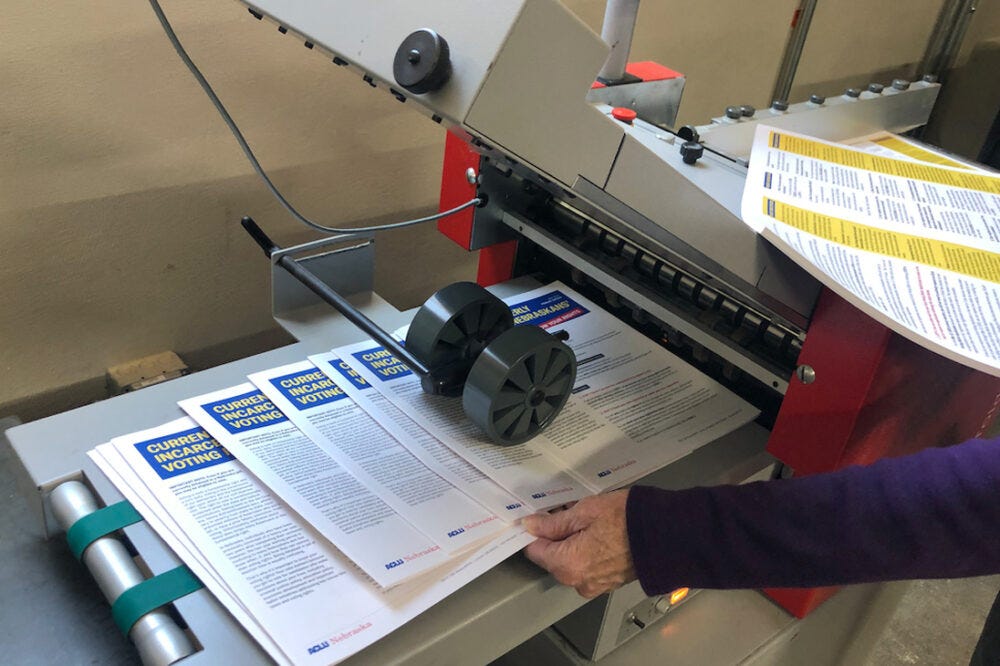
(Picture credit ACLU of Nebraska)
OMAHA – Nebraska nonprofits are working to help sign up former inmates to become voters ahead of the 2026 primary election. The ACLU of Nebraska announced last week it was working with RISE, a nonprofit reentry program, to sign up felons so they could vote in the May 12 primary elections.
“As someone who just got his vote back last year, I get it. It can be confusing to understand your rights and the process when you have had contact with the system,” Jason Witmer, a policy strategist with the ACLU of Nebraska, said. “But plenty of Nebraskans who are in jail right now have a right to vote, and we hope they use it.”
RISE said they have been working for years to restore voting rights for Nebraskans. “Our coalition has worked for years to guarantee everyone has the ability to use their right to vote,” RISE Policy and Advocacy Associate Olivia Larson said. “If it didn’t have real power, voting rights wouldn’t be under constant attack. I vote because I’m not comfortable with letting other people make decisions for me. If you’re off papers, get on the voting rolls.”
In addition to sending mailers to felons, the ACLU of Nebraska said they were putting up information on voting rights in every county jail in the state. “Unless you are serving an active felony sentence, you most likely have the right to vote even if you are in a county jail,” Witmer said.
The ACLU of Nebraska said the latest round of mailings were part of a multiyear civic education project started in 2020. The organization has been aggressive in its attempts to restore voting rights to felons.
In 2005 and 2023, state lawmakers passed bills which restored voting rights to felons upon completion of their sentence and eliminated any waiting period to vote.
Attorney General Mike Hilgers issued an opinion in 2024 stating that he believed the bills were unconstitutional. Secretary of State Bob Evnen responded by directing county officials to not sign up felons who had finished their sentences if they did not receive a pardon from the state’s Pardons Board.
The ACLU of Nebraska sued the Evnen following the decision — ultimately winning at the Nebraska Supreme Court. Following litigation, the 2026 primary elections will be the first primary many Nebraska felons will have voted in.
State Senators Stand by Vote
LB20 the 2024 bill which sparked the opinion by Hilgers and subsequent litigation initially passed 38-6 on a bipartisan vote. The bill waived a two year waiting period for felons to vote following the completion of their sentences.
The six no votes came from some of the body’s most conservative state senators — John Lowe, Brian Hardin, Rob Clements, Bruce Bostelman, Loren Lippincott, and Julie Slama.
Slama told The Plains Sentinel she voted against the bill because she thought it was unconstitutional. “I believe LB 20 is an unconstitutional delegation of authority by the Legislature away from the Pardons Board,” she said. “Moreover, it was yet another example of the Legislature taking the time to care more about the rights of criminals than their victims.”
She added the the ACLU was likely pushing registrations aggressively because they believed it would help Democratic candidates. “The liberal ACLU is clearly operating under the belief that this new block of voters would vote for Democrats. In a midterm cycle with razor-thin margins, 7,000 votes could decide a Congressional or Statewide race,” Slama said.
Former State Sen. Steve Erdman, an outspoken conservative who voted for the bill, said he does not regret his support. “I’d vote that way again,” he told The Plains Sentinel. Erdman said he initially opposed the measure until he observed the state’s Pardon Board.
He said he believed the Pardons Board had too much power in determining who had the right to vote before state lawmakers made the restoration automatic. Erdman added it was “heartbreaking to see” people who had served their sentences years ago feel like they were serving them again when they were denied rights by the Pardons Board.
Evnen, Hilgers, and Governor Jim Pillen make up the state’s Pardons Board. Pillen allowed LB20 to go into law without signing the measure, citing legal concerns with the bill.
John Gage is the executive editor of The Plains Sentinel.
Great story, but there's a far greater need to tell the backstory. We used to be a civilized nation that knew the difference between right and wrong. Being compassionate meant caring enough to be honest. That meant telling prisoners they did something bad so they are disenfrancised. The same with immigrants. It was about whether they were good immigrants who are here legally (like my in-laws) or bad immigrant who are hear illegally and need to leave. That's the way it was before the cultural Marxists took over.