

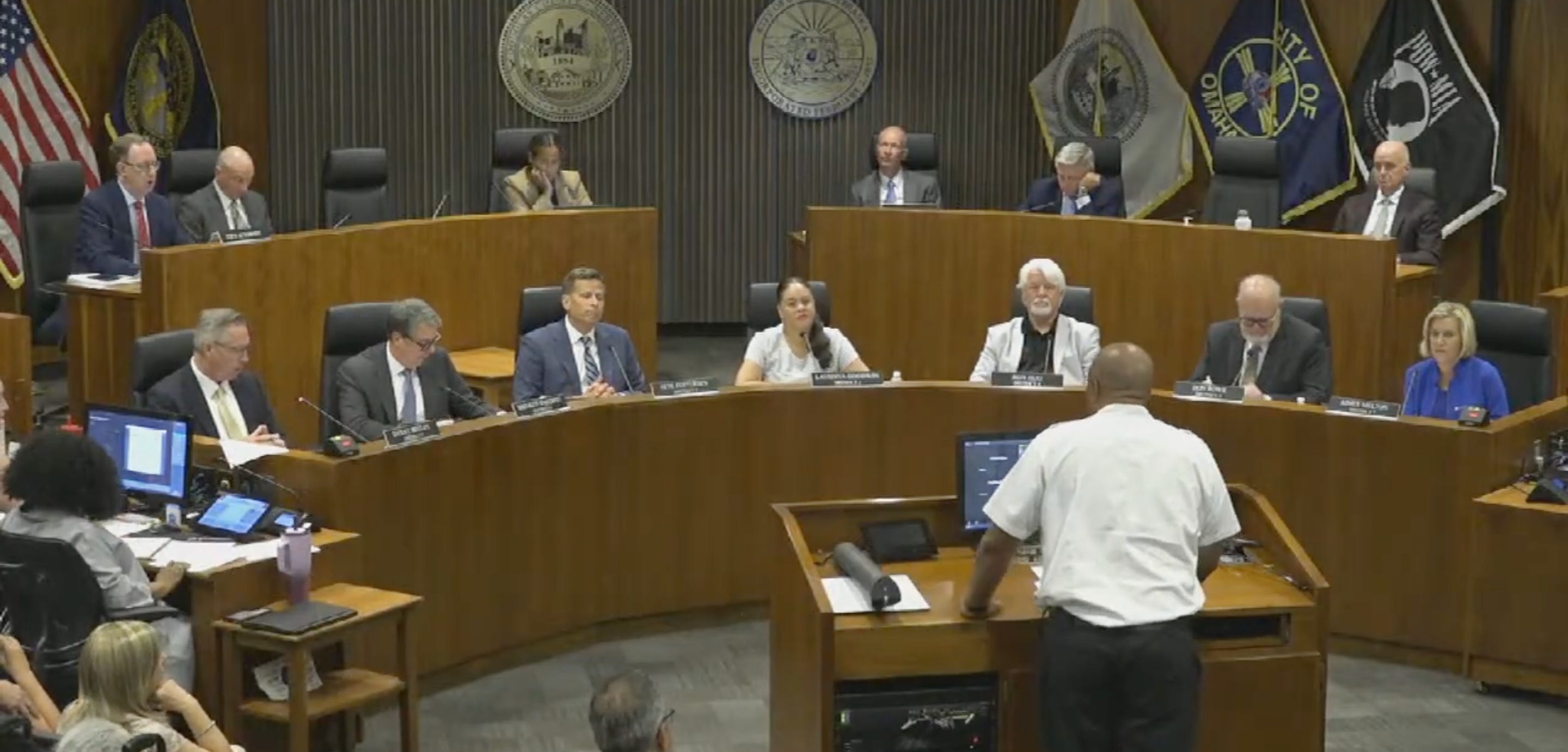
(Picture credit Omaha City Council)
OMAHA — The Omaha City Council voted 4-3 Tuesday afternoon to pass Council President Danny Begley’s proposal to reverse the Nebraska Legislature’s changes to the minimum wage law by raising the cost-of-living increase and abolishing the youth wage the state established.
Councilmembers Pete Festersen, LaVonya Goodwin, Ron Hug, and Begley himself voted in favor while Don Rowe, Brinker Harding, and Aimee Melton opposed.
Omaha’s move mirrors that of Lincoln, who passed an equivalent minimum wage in May, prompting Nebraska Attorney General Mike Hilgers to announce he was suing the city. Omaha will likely face a similar lawsuit from the state of Nebraska.
The basis for state action was the key point of debate on the measure, which occupied the council for over 45 minutes. In 2022, Nebraska voters approved a ballot initiative that would gradually increase the state's minimum wage year-on-year until it reached $15 and then raise it each year based on the consumer price index. The state legislature has since modified provisions to install a youth minimum wage below the $15 threshold.
The question is whether the city council can locally sidestep the statewide law.
The Case Against
Councilmember Aimee Melton of northwest Omaha was the first to speak on the matter, once again stressing her belief that the city does not have Constitutional authority to enact a minimum wage, and the defeat of such a measure in the Nebraska Supreme Court is a foregone conclusion.
“Today’s vote isn’t about whether we support minimum wage or not, it’s whether we have the legal authority to do it,” she said in opening. “The City of Omaha operates under a home charter rule. Charter cities may act with real independence on matters of strictly local concern, but on matters of statewide concern, state law controls,” she said.
The state of Nebraska having decided on the minimum wage would preempt any city ordinance, she argued.
“When it comes to labor and employment and wages. That’s a matter of statewide concern. So whether you support a minimum wage or don’t support a minimum wage, we need to take that up with the legislature. I took an oath of office as a councilmember that I will uphold the laws of the state of Nebraska.”
She indicated Article XI of the Nebraska Constitution was entirely clear on the matter.
“[Article XI] specifically identifies labor relations and labor practices as matters of statewide concern. Wages are labor practices, the Nebraska Supreme Court has already told the City of Omaha this more than once.”
She cited Midwest Employers Council v. City of Omaha and City of Omaha Human Relations Department v. City Wide Rock as ironclad precedent of that fact.
“Good intentions do not confer legal authority,” she said emphatically, “Not only are we going to lose that legal argument, we’re going to lose the taxpayer dollars that it’s going to cost to fight it. We are literally just throwing good taxpayer money down the drain. I’m not going to pass something because it feels good, and say ‘Who cares? I’ll just blame the courts later for not upholding it,’ when I know very well what the case precedent says.”
In closing, she raised the ongoing case between Hilgers and Lincoln, pointing out that if the Court did side against precedent, Omaha could then pass the ordinance without incurring a legal fight and the costs therein.
Don Rowe of Millard voiced his agreement.
“We should allow the process to work and see what happens in Lincoln rather than invest, say, four or five hundred thousand dollars not knowing which way it’s going to go. We serve at the pleasure of the state, and for us to pass this puts us in direct violation of state law,” he said.
Councilmember Brinker Harding, who is the GOP nominee to replace Don Bacon for Nebraska’s Second Congressional District, did not immediately voice an opinion. He elected to ask City Attorney Matthew Kuhse a series of questions about what a legal battle with Hilgers would entail for the city in county and state court.
He then compared that timeline to that of tabling the ordinance and waiting for Lincoln.
“We would be back here, potentially, if it were put in file, in October?” he asked, which Kuhse confirmed.
“Which is about the same time as the effective date you have in there,” Harding observed, referencing Kuhse’s earlier affirmation that the ordinance as currently proposed would take effect October 1.
“In that scenario, we could save not only the money but also not have the legal challenge of whether or not we’re violating state statute by passing this?”
Kuhse said yes, but qualified that the Lincoln result could lack a clear guarantee:
“That’s correct assuming that we do have some sort of legal certainty from the courts. This ordinance is not like Lincoln’s – it’s similar, but different.”
Harding then indicated he would opt for caution.
“Until it’s resolved, I don’t think we have the authority to be passing this, so I would certainly support placing it on file, because I think it gives us that flexibility to be able to bring it back in an orderly fashion.”
The Case For
Support for Begley’s ordinance came early Tuesday morning from a letter signed by fourteen of fifteen Democratic state senators and Omaha independent Megan Hunt.
While Begley would deliver the primary case in support of his ordinance, he first recognized LaVonya Goodwin of District 2, Ron Hug of District 4, and Pete Festersen of District 1 to speak in support of it.
“I do agree with councilmember Melton that it’s really about where does the strength of home rule charter live,” Goodwin said, but she located that strength in the people. “There is an urgency for the voters’ voices to be heard, people want to know that their vote matters, and that’s where the complexity of where we sit today as a council really is.”
She indicated that home rule charter cities elsewhere in the country had succeeded in passing their own minimum wage ordinances.
“We do have a home rule charter, but I’ve talked to many very sound lawmakers who sometimes believe you need to push back.”
Hug commented to respond to Melton’s point about the oath of office and Nebraska Constitution.
“We take an oath of office every time somebody is elected. But that’s secondary to how we get here. We get here because our constituents send us here,” he said. “I’m not willing to guess on what a judge may or may not do, what I am willing to do is give my constituents their day in court.”
Festersen took up whether they could put up a fight on that day in court. While reiterating his strong support for the bill, he also touted the City of Omaha’s record.
“The legislature recently adopted concealed carry legislation, and it forced the city to then repeal about 20 sections of code related to gun safety,” he said. “We then introduced ordinances around making ghost guns and bump stocks illegal in the city. The attorney general said, ‘you can’t possibly do that, we’ll sue you if you do.’”
While Hilgers did not sue, he did file an opinion in support of the eventual plaintiff, the Nebraska Firearm Owners Association. A Douglas County judge sided with the City of Omaha.
“We did get sued, but we prevailed,” he recounted. “There are things that sometimes we don’t agree with our colleagues in Lincoln about, that sometime need to get resolution in some way, and I think that’s what this will do.”
In his speech, Begley pitched his ordinance on one simple ground:
“Can Omaha do this, and should Omaha do this? The answer to both is yes. We have unique local economic conditions and concerns in the city of Omaha, including a higher cost of living than the rest of the state of Nebraska” he said, citing Economic Research Institute figures.
He also expressed his confidence that a demonstrable local interest such as this could overcome an Article XI challenge:
“The attorney general’s opinion is just his opinion. The legislature repealed the ability of the attorney general to sue to enforce his opinions recently, and it’s unclear if he has legal standing to bring these matters forward. The attorney general concedes the legislature has not expressly preempted this action.”
And regarding public opinion, Begley simply referred to the landslide numbers of the 2022 ballot initiative.
“Overall in the City of Omaha, 70.2% of voters said yes to this. I see 70.2% of the people in Omaha that went to the ballot box, there was about $3.5 million spent to get it passed, and we’re undercutting the will of the voters?” he said.
His final pitch was direct to them:
“I want to voters to listen clearly to me: I am fighting for you, not for a pat on the back, because I heard what you said.”
With that, he yielded.
Rowe’s motion to table failed on the same lines as the subsequent vote to pass succeeded. Pending Mayor John Ewing’s signature and barring any court-issued injunctions, the $15 city minimum wage will take effect October 1.
At this time, Attorney General Mike Hilgers has yet to announce whether he plans to contest the ordinance.
— Lewis Thune is a writing fellow with The Plains Sentinel.