

(Picture credit state of Nebraska)
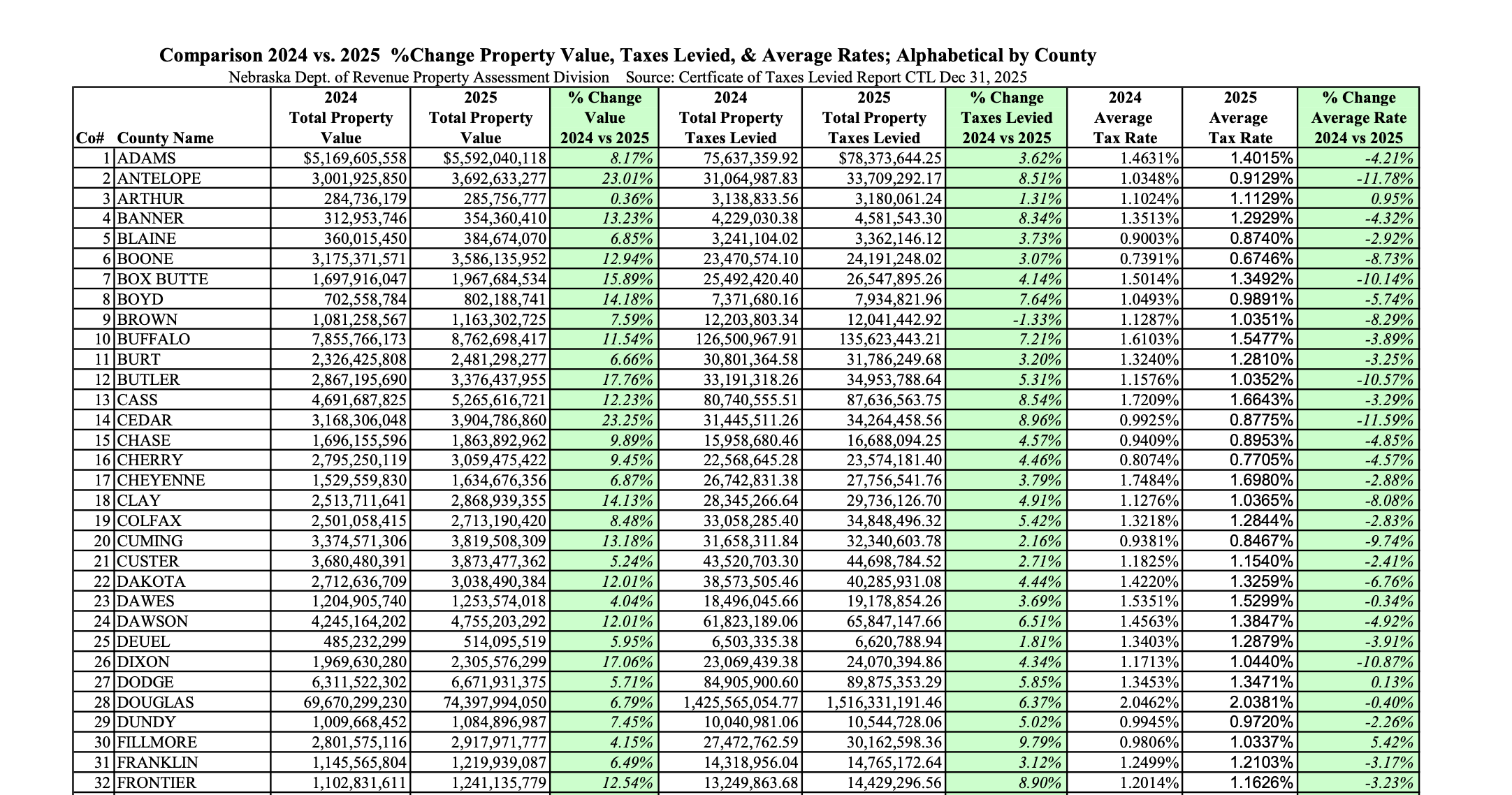
Both the Omaha and Lincoln city councils succeeded in passing their respective mayors’ proposed budgets, both maintaining current property tax levy rates despite rises in assessed home value.
The City of Omaha approved Mayor John Ewing’s $1.7 billion 2027 budget after debate over an amendment to lower the levy by 0.0075%, which ultimately failed. Lincoln passed its biennial budget with its levy rate unchanged at $0.2973 per $100 of assessed property value.
The far greater levies of Lincoln and Omaha Public Schools are also unlikely to drop this year, with OPS proposing to raise its levy eight cents to $1.21 to account for an erroneous calculation of state aid. Lincoln Public Schools proposes to stay put at $1.02.
With rises in assessed property values and no offsetting drop in local levy rates, Omaha and Lincoln homeowners can expect to pay more in taxes this year. With the average Douglas County home assessed just below $300,000, the average Omaha homeowner will pay slightly less than $5,000 in city and school district taxes. With the average Lancaster County home assessed just above $310,000, the average Lincoln homeowner will pay slightly over $4,000.
When reached by The Plains Sentinel, Platte Institute CEO Jim Vokal gave his input on the increased tax burden in the state’s two largest cities.
“It is disappointing that political subdivisions all across the state, and most recently city of Omaha and city of Lincoln, continue to raise property taxes when valuations go up,” he said. “They are spending the valuation windfalls rather than lowering the levies.”
Omaha councilwoman Aimee Melton stated that, based on her experience, assessed values and levies was “everyone’s number one issue.” While she backed the proposal to lower the Omaha levy 0.0075% (three quarters of a cent), she commended Omaha Mayor John Ewing’s budget and stated lasting property tax reform would have to begin at the state level.
In a Tuesday campaign event, Governor Pillen also addressed the issue, recommitting to a broad restructuring of tax policy at the state level. Nebraska, both he and Melton pointed out, is consistently top ten and top five among all US states in highest effective property tax.
“We will come together and solve it and have transformative tax policy change. I’m thick-headed. We will not give up until we get there.”
Pillen had previously taken aim at property assessors, saying some of their actions were “unacceptable,” and launching a property tax hotline in June to garner legislative attention to the issue.
With regard to that ongoing fight, Vokal disagrees, indicating the longstanding willingness of political subdivisions to spend the windfalls as the single issue.
“This landscape has occurred for over a decade across the state, and it’s the sole reason — the increased spending by these political subdivisions — why we have high property taxes. Not the actions of county assessors.”
— Lewis Thune is a writing fellow with The Plains Sentinel.