

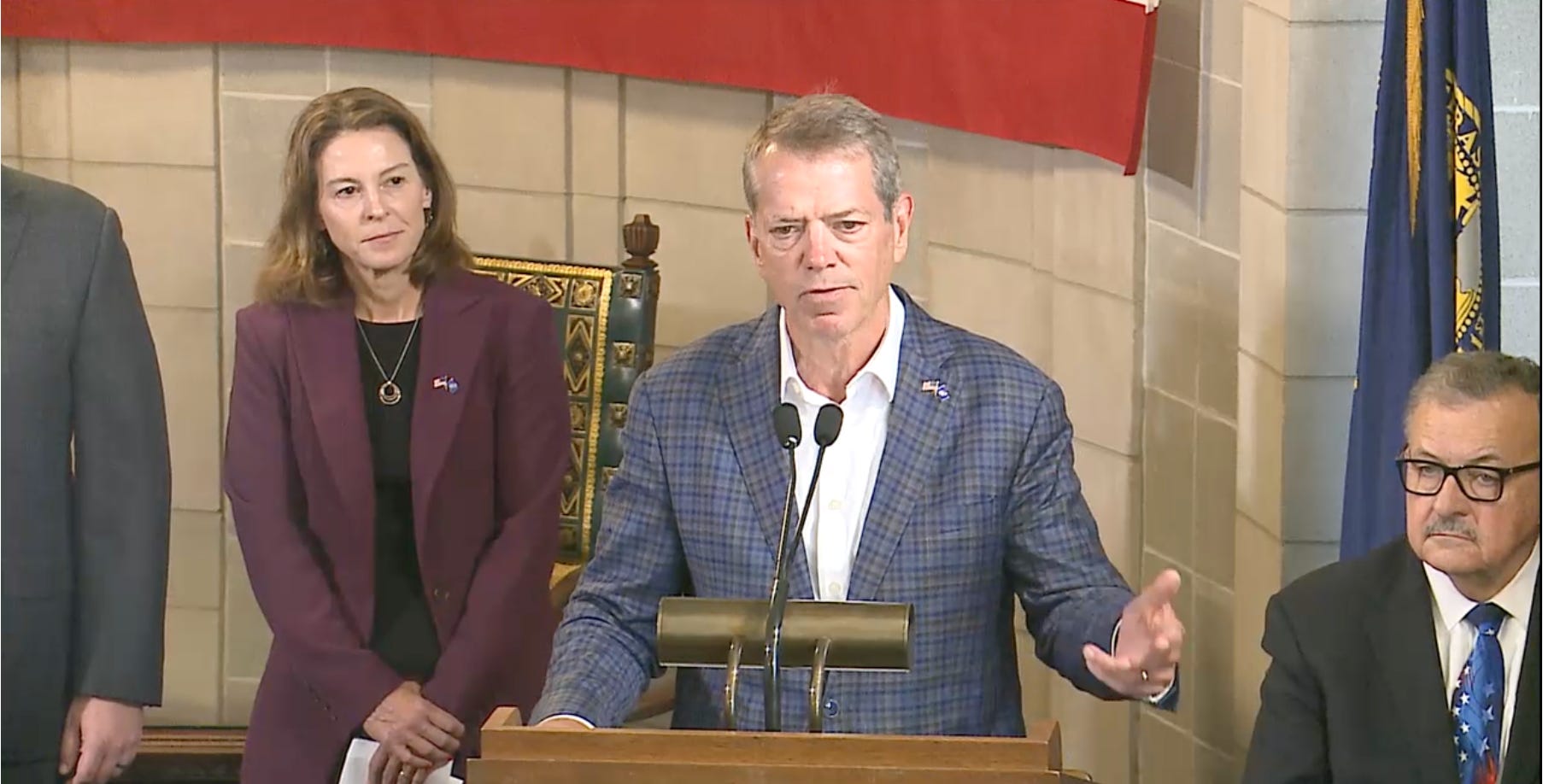
(Picture credit Nebraska Public Media)
LINCOLN — Governor Jim Pillen signed an executive order Monday morning to ban AI companies from accessing the ImagiNE Nebraska Act tax incentives for data center projects, as well as creating a task force “to propose additional safeguards of the state’s natural resources from data center use.”
“We’ve done extraordinary work way above our weight on data centers,” Pillen said during a press conference on Monday. “I’m not here talking about a moratorium on data centers, I’m simply talking about making sure we do what’s best for all Nebraskans, what’s best for our land, and what’s best for our water.”
Citing the state’s abundance of the latter two, he stated his firm belief that Nebraska didn’t need tax incentives to attract interest from AI companies.
“We just simply believe that we do not need to bring people together by incredible tax incentives,” he said. “We’ve done way, way more than our fair share, and we’ve been giving the farm away.”
Pillen said that the order, in tandem with April’s LB1261, will ensure that AI companies will invest in and expand the state economy rather than simply feed off of it.
“We need to make sure that we attract givers, not takers,” the governor said. “Globally, it’s estimated that in the next three and a half years, there will be over $3 trillion invested into this process of artificial intelligence and data centers. I don’t think it’s appropriate that we in the state of Nebraska give them cash credits.”
Department of Economic Development Director Maureen Larsen agreed.
“To be clear, data centers are important,” she said. “We want to be supportive of data center projects when they’re clearly in Nebraska’s best interests. However, it’s also incumbent upon us to guard against out-of-state entities looking to extract Nebraska’s resources without contributing to our job creation, energy generation, or infrastructure.”
It would simply be wrong, she added, for the state to provide incentives to projects of that nature. District 42 State Senator Mike Jacobson further detailed the general basis for state incentive programs:
“Number one, we want to create an incentive when there’s competitive pressure with other states to get people here and get business and industry here. And then we also look at creating incentives when there is a need to grow a business out of the gate making seed money. So typically, these incentive programs are giving them back what they produce in tax revenue.”
Jacobson then explained that in the current climate, data centers don’t meet either test.
“They have plenty of money to come and locate here, and there’s no real strong competitive pressures right now to get them located here,” he said. “We welcome them to come and work with political subdivisions who are gonna make their own set of rules, and then work with our state agencies that have control of our water and our energy.”
And to that effect, Jacobson indicated Sarpy County as a model approach for how AI companies can cooperate with subdivisions and the state.
“All we have to do is look at Sarpy County and the significant reductions they’ve seen with political subdivisions’ tax costs and what they’re charging for property taxes. Now they’ve got the data centers, and the other follow-through growth is occurring in Sarpy County.”
Critics claimed Pillen’s executive order was a reversal for him on the issue. Lynne Walz, his Democratic opponent in the upcoming gubernatorial election, said he’d pushed tax incentives for data centers as recently as this spring.
“Less than four months ago he was lobbying senators to pass the same incentives,” she said via Twitter. “We are tired of politicians saying one thing and doing another.”
When asked by the press if this move was prompted by the recent moratorium debates across multiple counties, Pillen indicated his concerns regarding AI data centers far predated them.
“I was the first governor in the United States of America to say timeout on data centers. Three and a half years ago,” he said, recounting a time when 11.5% of Nebraska’s electricity was used for data centers – then second in the nation. “I wish that everybody that is saying ‘moratorium’ could have been exposed to everything I’ve been exposed to the last four years.”
And regarding the moratorium debates across multiple counties, Pillen hoped the data center task force would help ease tensions.
“We love our neighbors, we love our land, we love our water, I think that’s the intent. I have 100% confidence in the intent. I do think that with the work of this task force is a way to help local communities take a look and learn more about it. We protect our counties, we protect our communities, but we don’t overreact – I think that’s a piece of it.”
The governor’s office said since the beginning of 2021 that $317 million had gone to data center projects through total credits used, direct refunds issued, and sales taxes exempted.
The value of personal property that has been exempted for data centers is $15 billion and the estimated property tax exemption on property that data centers sit on at 2% is $519 million.
“These incentives are not checks written, they’re past rebates,” Pillen said, calling the amount the companies were getting in tax incentives “Too much.”
— Lewis Thune is a writing fellow with The Plains Sentinel.
— John Gage is the executive editor of The Plains Sentinel.
The ImagiNE Nebraska Act tax incentives for data center projects is categorically unjust. The balanced scales of blind justice requires equal treatment of all businesses.
Data centers are resource hogs regarding water and electrical power. It is more than prudent to back up and take a hard look at whether or not these data centers even belong in Nebraska. I am not a leftist environmentalist, but one of the greatest resources this state has is water and we need to protect that precious resource.