

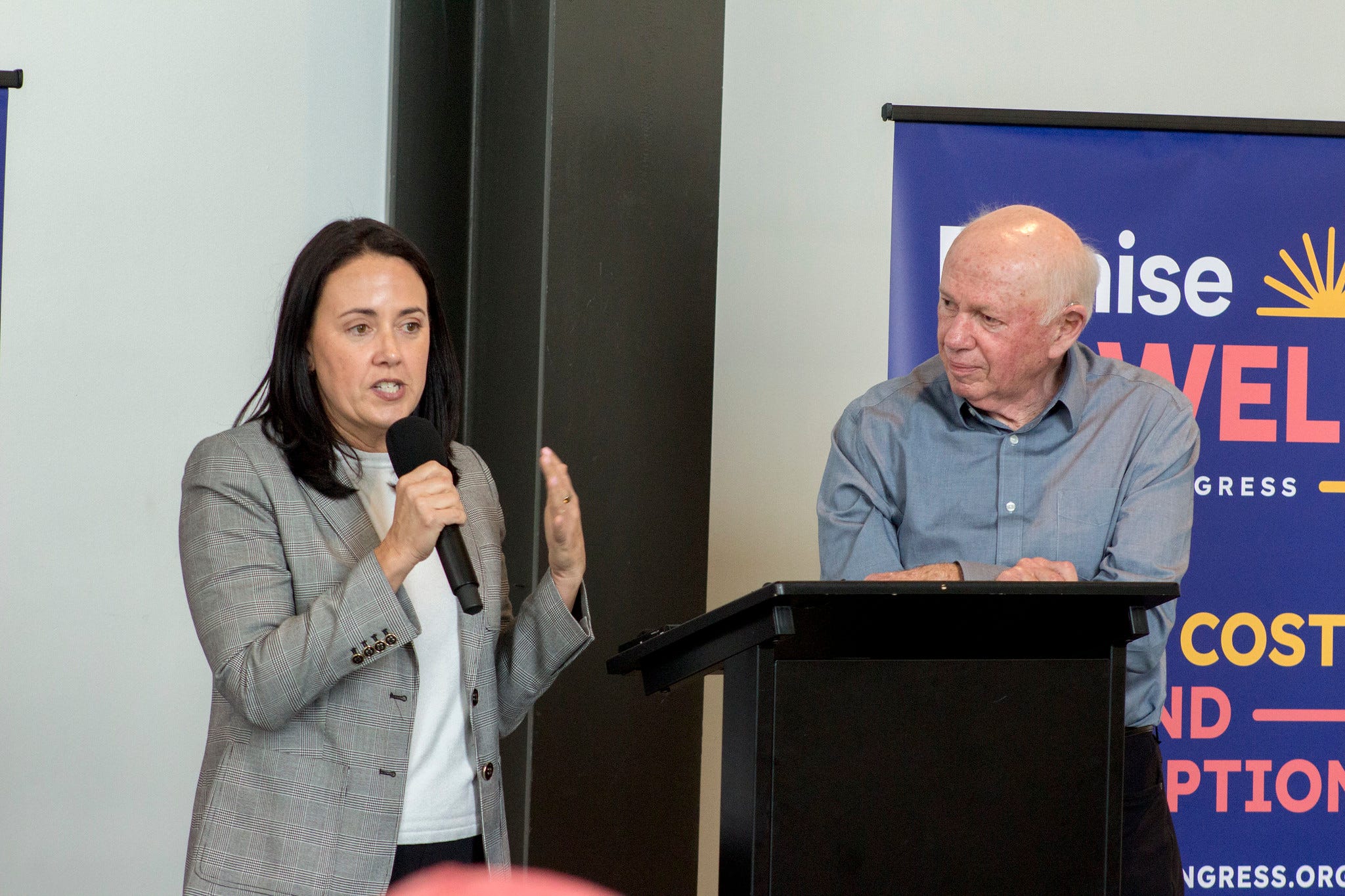
(Picture credit Matt Johnson)
OMAHA — Denise Powell, the Democratic candidate for Congress in Nebraska’s 2nd District, held a listening session Tuesday on Social Security and Medicare for about 25 to 30 guests at The Venue at Highlander, a few blocks from 30th and Lake in North Omaha.
Joining Powell was Max Richtman, an Omaha native and president of the National Committee to Preserve Social Security and Medicare.
Endorsements
Richtman endorsed Powell’s primary rival, John Cavanaugh, in March. He now stands behind Powell and emphasized what is at stake in the 2nd District.
“This is the most Democratic-bluest House district that can be flipped in the country,” Richtman said. “It’s a district that Kamala Harris won by almost 5%, and presently, it’s represented now by a Republican, so it is really a district that is the focus of change in the composition of the Congress.”
Candidates seeking an endorsement from Richtman’s organization must complete a questionnaire for the organization’s PAC board, a test Richtman said Powell passed with flying colors.
“Normally, these responses are very long, detailed answers to the questions that we ask,” Richtman said. “I wrote down some of the reactions when you met with our PAC board: ‘Wow,’ ‘Fantastic,’ ‘Yes.’ Not a lot of detail, but you can tell—she made an incredible impression.”
As for incumbent Don Bacon, Richtman was less impressed.
“[For] an incumbent, we don’t have a questionnaire, because we have a voting record,” Richtman said. “Your current congressman has a voting score of about zero—he voted wrong almost every time.”
Richtman also said he had a gift for Powell to go with the endorsement.
“I had sent a pair of red boxing gloves, and I was gonna present them to Denise Powell to go back to Washington and fight for seniors,” Richtman said. “They never made it, but I’m gonna give them to you when you’re sworn in, and you can use them.”
Benefits, Cuts, and Structural Problems
Social Security was a central topic for guests in the room. When Richtman asked who was currently receiving benefits, nearly every hand went up.
Richtman was clear that the program is not “broke.” It is, however, on an unsustainable path. With fewer workers paying in for each retiree collecting benefits, the Old-Age and Survivors Insurance trust (OASI) fund is projected to be depleted in late 2032. At that point, incoming revenue would cover about 78% of scheduled benefits—an across-the-board cut of about 22% unless Congress acts.
For Powell, benefit cuts are off the table.
“There’s a lot of people trying to fix Social Security, but in particular, our seniors, they’re really very worried about any sort of talks about cuts to a plan that is already in some cases, for some of them, it’s not enough,” Powell said.
Richtman said even raising the retirement age counts as a cut.
“You have to ask candidates, ‘Where are you on cutting benefits? Where are you on raising the retirement age?’ Which is a cut in benefits, because you’re gonna have to wait longer to get your benefits,” Richtman said.
Richtman also advocated a larger cost-of-living adjustment, a point Powell echoed after the event.
“Looking at some of those other elements like cost of living adjustments that haven’t been adjusted in multiple years now, when we know that the cost of living is going sky high,” Powell said. “So I think we need to make some common sense changes to the system to keep it solvent, to make sure that we’re not threatening people’s access to these benefits.”
Raising or Scrapping the Cap
The only specific solvency proposal raised at the event was more revenue: raising or eliminating the cap on wages subject to the Social Security payroll tax. That cap is $184,500 in 2026. The idea has drawn support from some Republicans, including Ohio Sen. Bernie Moreno, as reported recently by The Washington Post.
“I think there are plenty of Republicans who are interested in also looking at the cap adjustment too,” Powell said. “Whether or not we agree on what that cap should be, I don’t know. But I think those are some common sense things that we could do.”
Powell said that she has looked at raising the cap to $400,000, while Richtman stated that he was open to scrapping the cap altogether.
“We can fix a lot of the short run and long run about the finances of Social Security by adjusting that cap,” Richtman said. “We believe it should be eliminated altogether or raised considerably.”
According to Social Security’s own website, however, even eliminating the cap entirely would only push back the date the combined trust funds run dry—not close the long-run gap completely.
The Plains Sentinel asked Powell whether she supported any other revenue sources besides making changes to the cap.
“I think we need to look at a broad range of them,” Powell said. “I think we need to be creative. I think we need to be thoughtful in how we look at, you know, investing their funds, our Social Security funds, for the right return on investment. I think we need to be thoughtful, and I think we need to be willing to explore lots of other opportunities too.”
Reaction From the Crowd
Guests were largely supportive of Powell. Some carried “blue wave” stickers that they gave to Richtman after the event.
Richtman told Cavanaugh’s audience in March that there are 107,845 Social Security and Medicare recipients in the 2nd District, making the “blue dot” a prime target for messaging on these programs. Whether Congress can agree on a plan before the retirement fund is exhausted remains to be seen.
— Matt Johnson is a freelance reporter with The Plains Sentinel.