

Nebraskans looking for a major overhaul of the state’s property tax system this year may be running out of options both in the Legislature and on the ballot. In Nebraska’s 2026 legislative session, various property tax bills proposed—primarily by Republican senators—aim to cap future increases, limit growth, adjust valuations, or tweak relief credits rather than cutting current rates outright.
Two different property tax proposals to limit the growth of valuation increases have been prioritized by senators this session.
Among these is LR292CA from state Sen. Bob Andersen (LD-49), which proposes a constitutional amendment to cap annual increases in taxable property values by separating fair market and taxable valuations, at a level of around 3% per year in many cases. This would not, however, lower current rates, which have risen significantly—cumulatively around 20-30% in many areas over the past five years amid valuation spikes.
“It is going to stabilize the valuation and then take the annual year-to-year increase of your tax obligation and cap it,” Andersen said. “The whole point of that is to stop the bleeding.”
Another property tax bill, LB1219, would only allow political subdivisions to increase property taxes by two percent above real growth. The measure was introduced by State Sen. Tom Brandt and prioritized by State Sen. Ben Hansen.
With only a few weeks of session left, neither bill has been scheduled for debate.
Nebraska state senators have been limited in their attempts to push property tax relief as the state’s budget deficit has taken most of the fiscal attention this year. The budget deficit peaked at $646 million earlier this year. And while lawmakers have found ways to fill in over $500 million of the gap, they have just one week to finish filling the gap and sending a budget to the governor’s desk.
EPIC Ends Petition Drive Again
The most daring proposal for dealing with property taxes in recent years has been the EPIC Option, which would eliminate property taxes entirely—along with income and inheritance taxes—and replace them with a consumption tax. This proposal originated with the FairTax movement around 2011.
The proposal failed to gather enough signatures for the 2024 ballot. It relaunched in a simplified form last year as “EPIC Option 2.0,” simply eliminating the taxes entirely with no specific replacement outlined in detail. There was still concern about whether the organization could collect enough signatures to make the 2026 ballot using only volunteers or would need to resort to paid circulators or a professional firm.
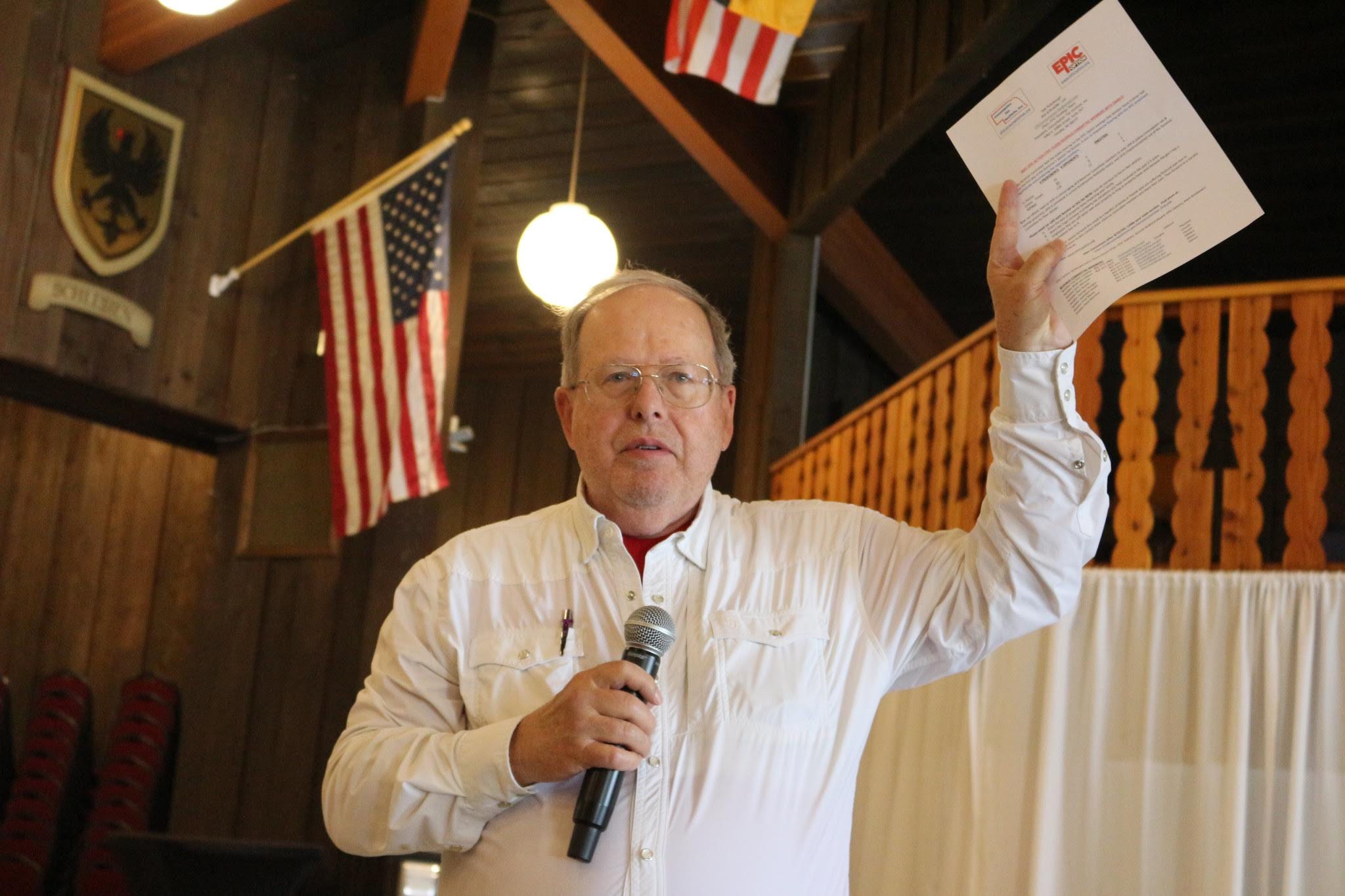
Rob Rohrbaugh has been an advocate for the EPIC Option for several years, and he spoke with The Plains Sentinel about its current status.
“If we started at the first of the year, we would need on average 5,000 signatures a week,” Rohrbaugh said. “So we ran this experiment to see if we could collect 5,000 signatures in that elongated week. And the answer was no—we ended up with about 3,000.”
Last week, Steve Jessen, President of EPIC Option, issued a press release announcing that they were pausing volunteer-driven signature collection for the 2026 ballot. Projections showed they would not reach the required signatures by the July 1 deadline. Instead, they plan to focus on fundraising to hire paid petition circulators and aim for the 2028 ballot under the banner of “EPIC Option 3.0.”
“Our immediate goal is to raise $1.86 million to pay circulators to collect 160,000 signatures. If just 8,000 Nebraskans donate $250, Nebraska’s Second House will raise $2 million. This is a small investment compared to the annual tax burden that will be eliminated.”
The AFAN Alternative
At least one other property tax group is continuing to try to gather signatures for the 2026 ballot.
Eric Underwood and his organization, Advocates for All Nebraskans (AFAN), have launched a series of ballot initiatives, two of which specifically target property taxes. One is a constitutional amendment modeled after Andersen’s to cap annual property valuation increases at 3% (or the growth rate of general fund tax receipts, whichever is less).
A second is a statutory amendment that would reduce the taxable portion of property valuations in half—for residential and commercial property from 100% to 50%, and for agricultural/horticultural land from 75% to 37.5%—providing immediate relief while keeping actual valuations in place.
Underwood told The Plains Sentinel that these proposals would bypass the stalled legislative process and empower Nebraska’s “second house”—the people—to cut taxes directly.
“This is Nebraska saying, ‘I sent you there to do what you said you were going to do. And you indicated that because you are a Republican or Democrat, you could get it done. And you haven’t. Then we will take matters into our own hands,’” he said.
Previous ballot initiatives have required substantial funding, largely for paid circulators, to gather enough signatures to qualify for the ballot. Underwood said his campaign is relying on volunteers and modern technology to target potential signers.
“We have created a system now and are using a walkbook app, and we have a list of almost 250,000 names of people who we believe strongly identify with the petitions and would likely sign,” Underwood said.
While Underwood has not ruled out using paid circulators, he currently has close to 200 volunteers, along with targeted lists pulled from a Republican voter database. Underwood believes this will yield a high return rate—potentially 90%—on signatures collected at the door, assuming potential signers are home.
The task is still daunting, as state statutes require signatures from about 7–10% of registered voters for statutory initiatives (approximately 88,000–90,000 valid signatures) or 10% for constitutional amendments (around 125,000–130,000), distributed across counties. Underwood is optimistic, however, and pointed to the success of Initiative 434 in 2024, the “Protect Women and Children” constitutional amendment, as a model for success.
“434 was filed March 1 of 2024,” Underwood said. “In 91 days, they collected 1,500 signatures a day. They collected those signatures over Easter, Mother’s Day, Father’s Day, all the graduations. I find it very interesting, and it can be done clearly with enough money to collect 1,500 signatures a day.”
Costs to collect signatures to put constitutional amendments on the ballot have increased significantly in recent years. Last cycle, “Protect Women and Children” spent over $3.1 million on their signature campaign to make the ballot, while the dueling constitutional amendment, “Protect the Right to Abortion,” spent over $2.1 million on signatures.
All together, ballot initiative campaigns last year spent around $40 million in Nebraska persuading voters to sign, support, or oppose various measures.
— Matt Johnson is a freelance reporter with The Plains Sentinel.
There is a large problem with people not knowing how much their mortgages have had to be adjusted for property tax. If the taxation system was more transparent to the taxpayer, there would be a revolt.