

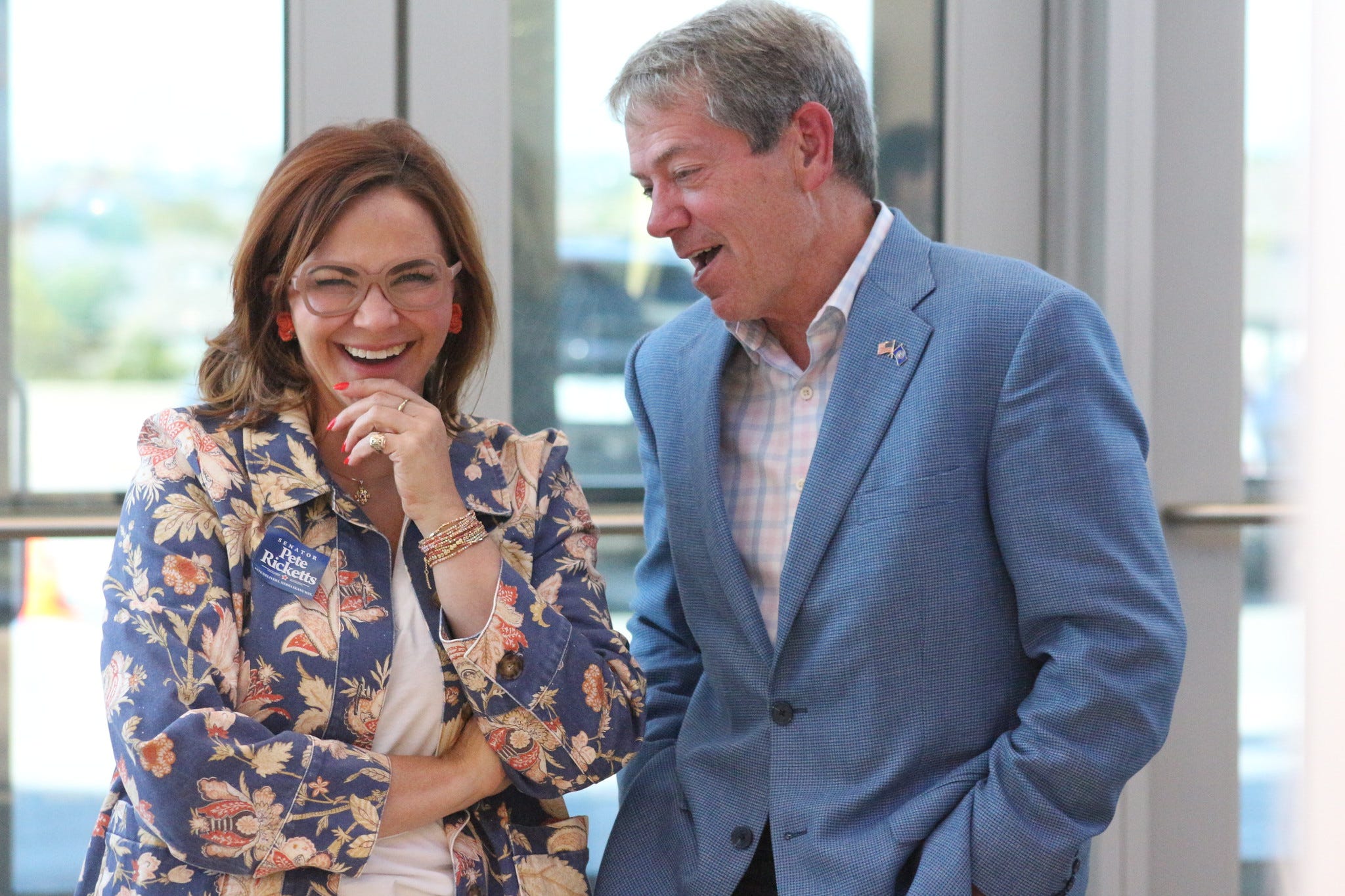
(Picture credit Matt Johnson)
OMAHA — Nebraska’s leading political consultants could see the blue wave coming, but some didn’t know quite how large it would be until it hit.
Jessica Flanagain, a partner with Axiom Strategies who has worked on Pete Ricketts’ campaigns for 20 years, compared the midterms to notable elections in the past.
“We could see 2006 coming,” Flanagain said. “I didn’t actually expect it to be Watergate, which is what we got. We got the aftereffect of Watergate.”
“There was no mercy for any Republican. There was just no mercy,” said Matthew Zacher of Flyover Strategies, who managed Brinker Harding’s campaign in Nebraska’s 2nd District. “Democrats certainly didn’t vote Republican, Independents did not vote Republican, and there’s a big chunk of Republicans that didn’t vote Republican either.”
Now, the GOP must reflect on what went wrong and what can be done over the next two years before it has the chance to retake lost ground.
Economic Issues Hit Republicans Up and Down Ballot
During his 2024 campaign, President Trump made affordability and the cost of living a key issue, highlighting the cost of gas and groceries and adopting the tagline “Make America Affordable Again.”
When these problems remained a major issue in 2026, some voters turned against the president.
“If you’re going to make pledges and promises, you’ve got to make sure that you deliver on those results in real time for the voters,” said Rod Edwards, a Nebraska political consultant. “I think what we ended up doing is there were a lot of promises made, and the results—although I believe the results are in progress—the results weren’t seen yet, and that’s what mattered to the voters.”
Being seen as “out of touch” on affordability came back to bite Mississippi Sen. Cindy Hyde-Smith, whose response to beef prices—“pick another protein”—became a viral ad campaign for her opponent Scott Colom.
Flanagain said nationally Republicans had become “ridiculously out of touch” on the issue of affordability while “people can’t afford gas.” The anger over the economy hurt Republicans up and down the ballot indiscriminately.
“If you were a registered R, you pretty much got lumped in with it. We’ve seen that across the board,” said Derek Oden of Flyover Strategies. “I mean, Aaron Hanson and Don Kleine lost. It’s ridiculous. Those guys are some of the best, and they got swept up in it, too, which just shows you it wasn’t one specific candidate. It was pretty much a referendum on the entire party.”
Bulwark in the Third District
While the blue wave hit candidates hard in Nebraska’s urban counties of Douglas and Lancaster, Western Nebraska proved to be a “firewall” against the blue wave, pushing statewide Republican candidates like Pete Ricketts and Jim Pillen to victory while candidates in Ohio, Kansas, and Iowa fell to Democrats.
“There’s no doubt that without Nebraska’s Third District, we would be looking at a Democrat governor and a Democrat senator right now,” said Oden. “So, no doubt we owe a lot of gratitude to those guys.”
Chris Vail, 3rd District chair of the Nebraska Republican Party, credited Republican victories in “Greater Nebraska” to county-level grassroots organization and outreach efforts to local party leaders.
“It isn’t the Republican Party—it’s common sense values of people that get out and vote that happen to be Republican,” said Vail. “I believe the grassroots, which are really the people that go to the county meetings and get involved, they reached out to their people.”
President Trump and Vice President JD Vance also held high-profile rallies in Grand Island and North Platte during the election, which may have helped boost turnout. And while Trump’s unpopularity may have been a drag elsewhere in the country, the attention Trump paid to Nebraska’s 3rd District helped make many voters there feel noticed.
“He’d never been to Grand Island. Vance had never been to North Platte. It made people out here stand up and go, ‘Wow, we really must be important,’” Vail said.
Vail organized an event after the Vance rally as a catalyst to connect volunteers and state senators with one another.
“Some of these people, they didn’t even know their senators. They didn’t even know who they were,” Vail said. “Now they’re on a first-name basis with them. … We don’t have to scream at them when they run down to the Unicameral. We can pick up the phone and call them.”
And while victories for Nebraska Democrats have remained largely inside the “blue dot,” Flanagain warned that Democrats are still trying to make inroads into Western Nebraska.
“I think people underestimate Jane Kleeb,” Flanagain said. “She’s taking hard-left Democrats to Valentine, like congressional members, and organizing there. … Cherry County now has active Democrats, and they’ve never had active Democrats before. Madison County used to be the most conservative county in the state of Nebraska, and you can’t go up there without getting protested by The Handmaids.”
GOP Plan Moving Forward
Now, with Democrats preparing to take control of the House and the Senate, some are expecting them to steer far to the left—and perhaps hand Republicans an advantage in the next election.
“The best thing honestly that could happen is to allow the Democrats to expose themselves for as crazy as they are,” said Oden. “You know—impeachment hearings, investigations all day long, constantly—just like it was in 2019 and 2020. And I think that honestly is gonna help set up a contrast for 2028.”
Edwards agrees.
“A lot of them seem, especially in Congress, ready to get revenge on Trump and his affiliates,” Edwards said. “If their entire plan for the next two years is going to be investigate and impeach, it’s going to be a great 2028 for Republicans.”
On Election Night, shortly after Brinker Harding conceded his race, The Plains Sentinel spoke to outgoing Congressman Don Bacon about what he expected from Denise Powell in the next two years.
“I think she’s going to vote pretty far left and they’re going to overreach,” Bacon said. “She’ll be very vulnerable in two years. You’ve got to win independent voters in this district. That’s the bottom line.”
For the next two years, however, the Republicans’ worst enemy may be themselves.
“There seems to still be a lot of infighting, and we have to get back to fighting Democrats instead of fighting each other,” said Flanagain. “Merv Riepe is with us 80% of the time. You’re pissed at him the 20% of the time he’s not, but he’d make a hell of a better senator than the one we’re getting.”
Oden echoed the sentiments.
“It’s important for our party to actually have some adults in the room and put forth an articulate vision that captures these 80/20 issues,” Oden said. “We may not agree on some of the more divisive issues, but there are 80/20 issues within our party that the American people support.”
And if Republicans want to make inroads in two years, Flanagain had one last bit of advice: go on offense.
“Brinker Harding was going to run a positive campaign. It’s a really nice idea—and it’s going to make you lose,” Flanagain said. “You have to create a contrast. You have to create a wedge. … And when it’s an economic election year, and the economy’s not gonna get better, you have to remind your people, who are social conservatives and Christians, why you are still the team.”
— Matt Johnson is a freelance reporter with The Plains Sentinel.
No one seems to want to talk about the Republican Senate being the firewall to the Trump agenda. Two years later hundreds of appointees are not confirmed. They gavel in pro forma to prevent recess appointments, and they are always in recess. The media spun up Epstein as an issue to obfuscate the real issues of the rogue judiciary where even a ballroom is a lawsuit and every criminal Democrat is protected in NY and DC. Most importantly the SAVE America act was swatted away like a mosquito and we were forced to participate in another unverifiable black box election with machines proven to be 100% hackable decades ago and voter rolls that are fiction. Conservatives continue to be censored and debanked and the national media continues to mockingbird. The message to voters was clear. The Senate Republicans abhor the majority position and the Uniparty isn’t giving up it’s ballot rigging system.