

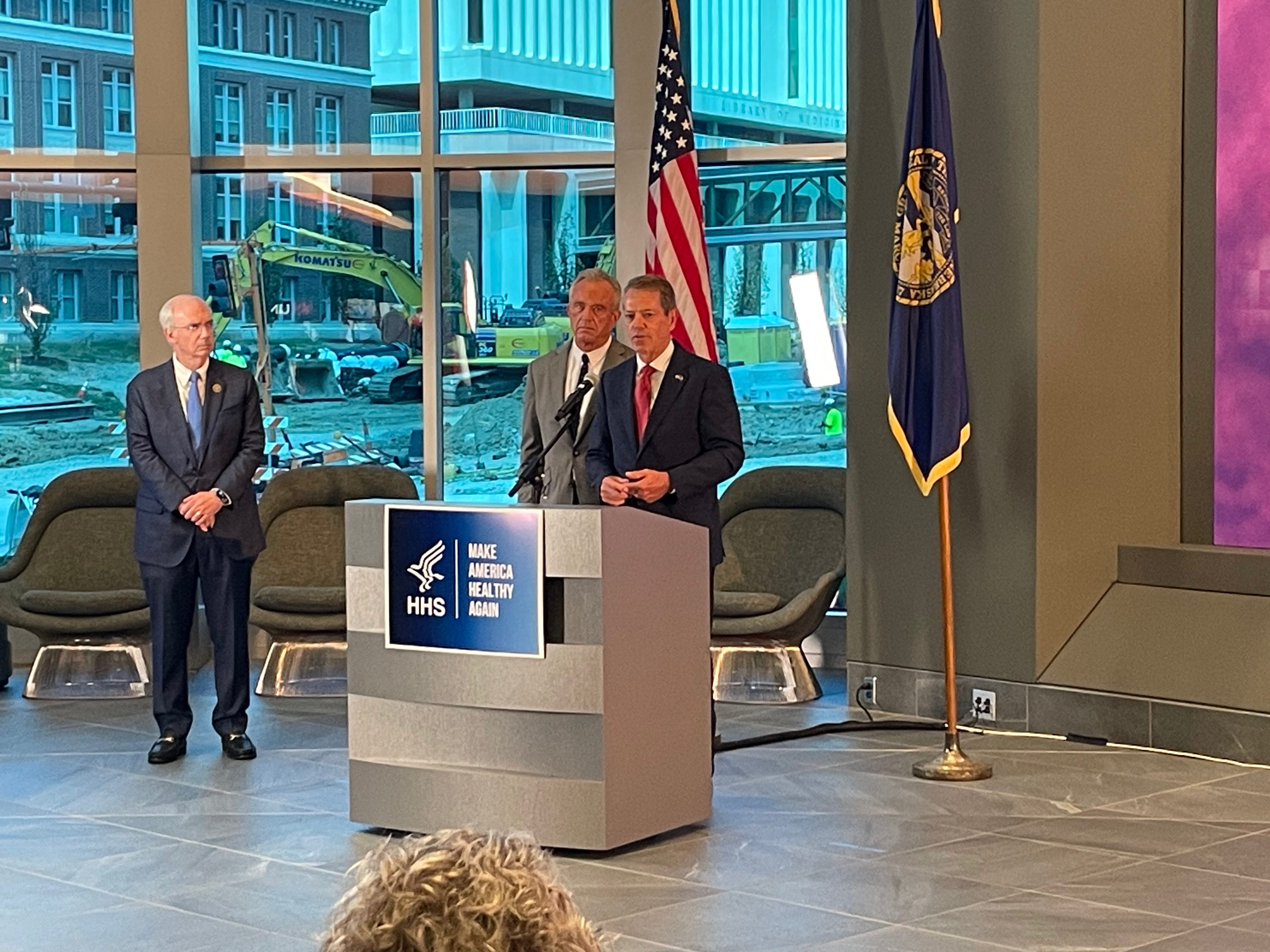
(Picture credit Lewis Thune)
OMAHA — Secretary of Health and Human Services Robert F. Kennedy Jr. addressed the press and reiterated his Make America Healthy Again priorities Thursday afternoon amid a tour of the University of Nebraska Medical Center’s National Quarantine Unit with University of Nebraska President Jeffrey Gold and Governor Jim Pillen.
“This facility is absolutely critical to our national security,” Kennedy said. “One of the reasons I wanted to come out here today was just to see this legendary place, this kind of Mecca for biocontainment.”
UNMC drew national attention in May when it housed the 18 U.S. citizens exposed to the Andes hantavirus in its quarantine unit for the virus’ 42-day incubation period, achieving no confirmed cases in that time.
“I’m very grateful to the University of Nebraska for the care that it took. I went and toured their bedrooms and saw that they were making steaks out there — Omaha Steaks in the parking lot — and delivering it to their rooms, doing everything they could to make up for an unfortunate situation,” he said.
He also asserted that UNMC’s influence on global health, specifically quarantine facilities, will continue to be invaluable in HHS efforts worldwide:
“We’re now in the process of standing up a biocontainment center in Kenya with the Department of War, and the peer review for readiness will be done by people at this facility. We’ve got 60 public health service officers from the Uniform Commission Corps, and their training will come from people at this facility.”
UNMC has assisted HHS in its efforts to control Ebola in the Democratic Republic of the Congo, and continues to train medical staff for efforts elsewhere.
“We’ve got 30 people in the DRC right now, Ituri and Kivu provinces, which are really the hot cells, and their training comes from people at this facility… I just toured the Global Center for Health Security at UNMC, and the Air Force is training military and civilian medical teams to respond to biological threats, disasters, and other emergencies around the world,” said Kennedy.
“It’s extraordinary” said Pillen, “something to be incredibly, incredibly proud of.”
In addition to heaping high praise on UNMC, Kennedy lauded Pillen for his shared commitment to making nutrition an absolute priority, an integral part of MAHA.
“Governor Pillen has led the country on the MAHA agenda,” Kennedy said. “He was the first to pass the SNAP waiver, he was one of the first to get bell-to-bell legislation to control cell phones in schools… [he] banned petroleum-based dyes in the state and then we’ve gotten to work together on the Medicaid work requirements.”
Pillen lauded the SNAP waivers as well, which would have remove soda and similar nutrition-deficient items from the Supplemental Nutrition Assistance Program. The waivers have been blocked by a district court judge since late June.
“I was the first governor in the country to sign on to it. Obviously, there’s a judge that doesn’t understand food groups and has a difference of opinion” Pillen said.
To that effect, Kennedy stated that at the beginning of his tenure, 10% of food stamps were going to purchase soda.
“Anybody ought to be able to buy a soda if they want to, but taxpayers shouldn’t have to pay for it,” he said. “Hopefully we can get this crazy decision reversed.”
It is poor nutrition policies like these, Kennedy argued, that help create chronic disease epidemics in the country.
“We’re giving the poorest kids in the country diabetes at the outset, and then they got on Medicaid, 73% of them, and we spend the rest of their lives treating them and paying for them… roughly 70% of American adults are obese or overweight, 77% of our children cannot qualify for military service.”
A renewed focus on nutrition as medicine would make a difference in those numbers, he said.
“For decades, we trained doctors to treat the consequences of poor nutrition, while giving many of them remarkably little training in nutrition itself… 70% of type 2 diabetes cases can be reversed, and in some cases, you can lose the diagnosis just by changing your diet.”
He again turned to Gold to thank him for assisting him in refocusing nutrition education for healthcare workers.
“Participating medical schools have agreed to provide 40 hours, or its competency equivalent, so that future physicians can understand how nutrition can prevent, manage, and treat chronic disease,” Kennedy said. “Nebraska helped lead that effort from the beginning. They helped advise us as we developed the initiative.”
He also noted, as did Pillen, that Nebraska had scored the eighth largest award grant from the Rural Health Transformation Fund, totaling $218 million.
“That is gonna be a big deal,” said Pillen. “Getting more kids in rural Nebraska to be able to have access to healthcare. That’s really good.”
Kennedy closed by thanking the two men for their respective leadership in improving outcomes in American and global health.
“We spend more on healthcare than any country in the world, two or three times what Europeans pay per capita, and we have the worst outcomes. We should have the healthiest population. President Trump has given us a mandate to close that gap, Nebraska is leading by example and delivering results.”
— Lewis Thune is a writing fellow with The Plains Sentinel.
UNMC was a big player in the communist covid tyranny.
Medical doctors know little about real health and where it comes from.
They also get their drug education from drug salesman.