
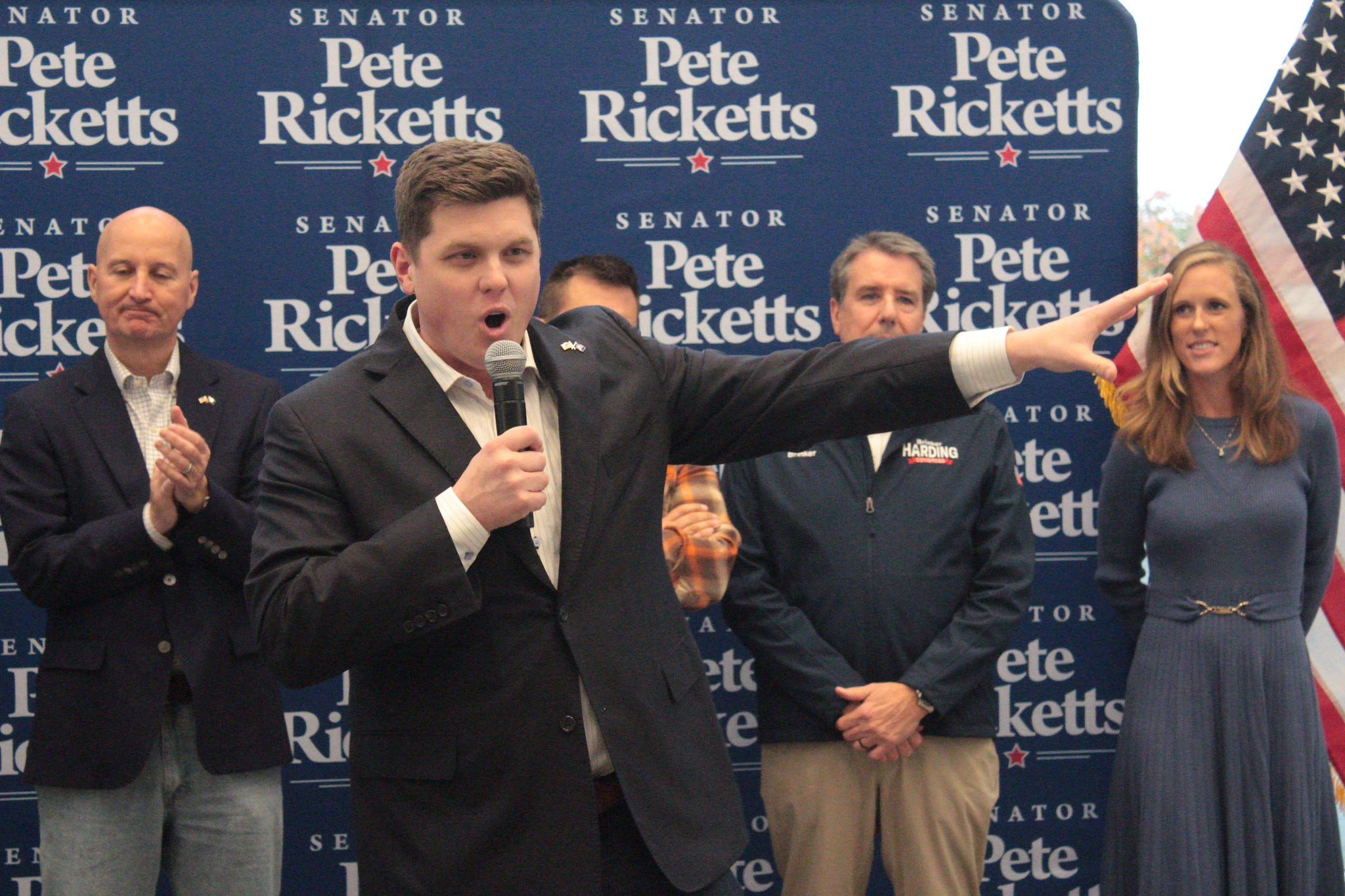
(Picture credit Matt Johnson)
LINCOLN — A giant blue wave rolled across the country last night, leaving GOP candidates like Brinker Harding in Nebraska’s 2nd District and county-level candidates like Sheriff Aaron Hanson and County Attorney Don Kleine in its wake. In the statewide races, however, rural counties proved to be the bulwark for candidates like Attorney General Mike Hilgers, State Auditor Mike Foley, State Treasurer Joey Spellerberg, and Sen. Pete Ricketts.
While the polls appeared tight late into Election Night, candidates looked to western Nebraska for the turning point.
“A lot of our Republican voters are in our more rural counties,” Ricketts said on Tuesday night. “And those counties, some of them, haven’t reported all the numbers, so we’ve got to get those in.”
The divide between urban and rural counties was clear. The strongest Republican turnout came consistently from sparsely populated western and north-central counties, while the weakest came from Douglas, Lancaster, and Sarpy counties.
For example, Ricketts received just 36% in Douglas County and 38% in Lancaster but over 80% in counties like Grant, Hayes, McPherson, and Keya Paha. Results for Gov. Jim Pillen were nearly identical.
Of the statewide candidates, Foley received more votes, and won by a wider margin, than any other candidate, winning largely even in urban counties like Douglas (64%) and Lancaster (70%).
“I had kind of a nominal opponent, but still people have to fill out the little oval next to your name, and I’m very grateful that they did,” Foley said at a post-election rally in Lincoln on Wednesday.
Foley was particularly grateful that the online gambling petitions, Initiatives 440 and 441, were defeated.
“People saw this and saw the lies that were being perpetrated on them as a false promise of property tax reductions and so forth,” Foley said. “So just thrilled that those were both defeated.”
The measures showed the same urban-rural split as other statewide races, with urban, eastern counties like Douglas and Sarpy showing the most support and smaller western Sandhills counties showing the most opposition.
The divide was even starker in Hilgers’ race. He earned over 90% of the vote in counties like McPherson (95%), Grant (94%), and Hayes (93%) but fell below 50% in counties like Douglas (40%) and Lancaster (44%).
In the end, Hilgers came out 12 points ahead statewide.
“I had a four-year track record, told the voters exactly what I was going to do four years ago, and followed through,” Hilgers said at Wednesday’s event. “I mean, a 12-point win is pretty significant in this environment, so I’m pretty thrilled.”
Spellerberg had nearly identical results in many of the same counties as Hilgers. Appointed state treasurer in November 2025, he thanked voters at the rally for electing him for the first time.
“I thank the voters for their trust in me as their state treasurer, and I don’t take it for granted,” Spellerberg said. “And looking forward to strengthening our financial future, helping our state grow.”
At the rally, Ricketts tied the statewide victories to the growing prominence of democratic socialists in the Democratic Party, and he described Nebraska as a bulwark against it.
“We don’t need these false promises of socialism,” Ricketts said. “They want to get rid of the presidency, the Senate, the Supreme Court … Nebraska is the firewall against this rising socialism.”
— Matt Johnson is a freelance reporter with The Plains Sentinel.
— John Gage is the executive editor of The Plains Sentinel.