

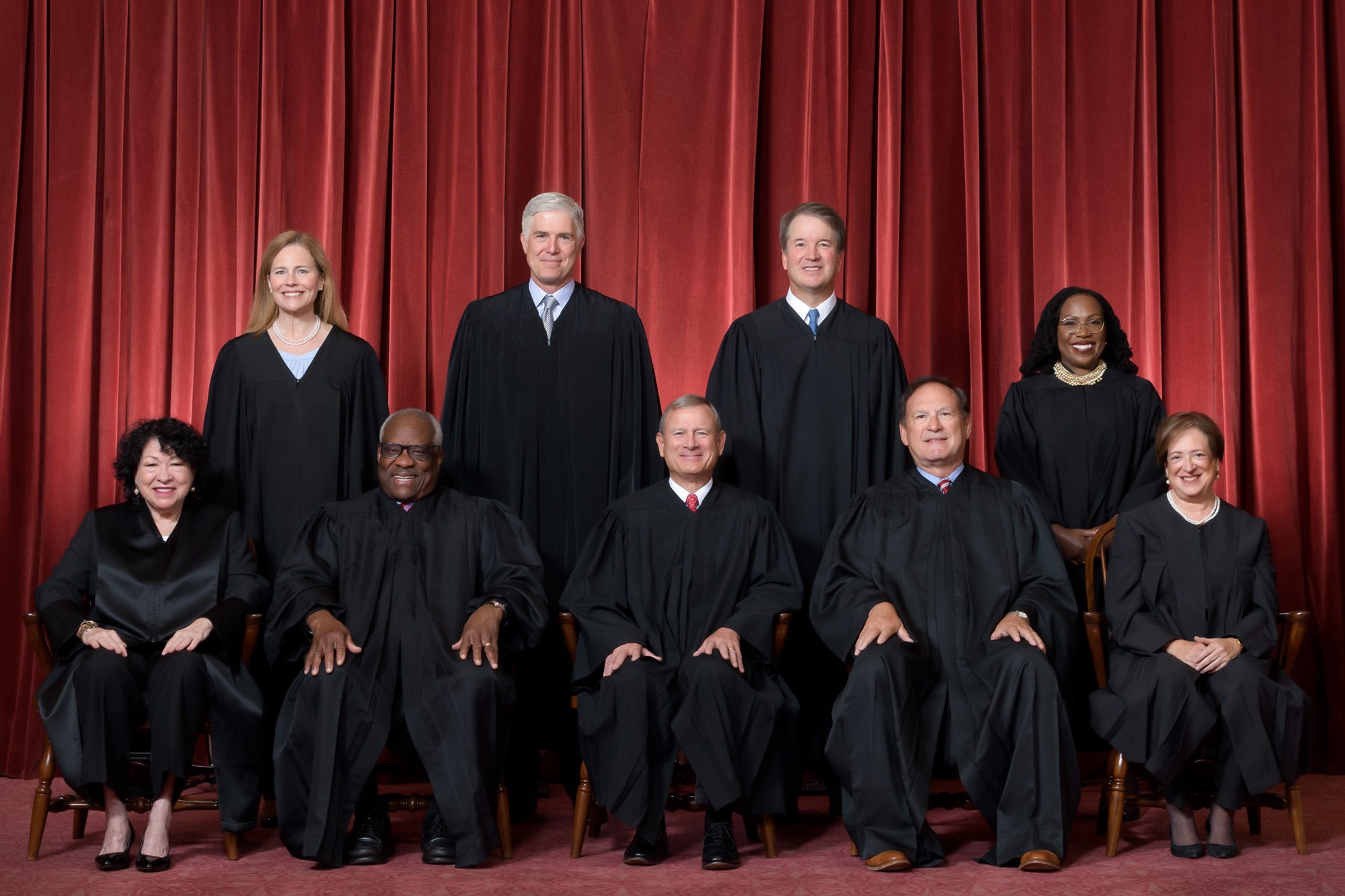
(Picture credit U.S. Supreme Court)
The U.S. Supreme Court agreed on Monday to hear a lawsuit from the state of Nebraska alleging that Colorado is violating a 1923 compact governing the South Platte River. Last summer, Attorney General Mike Hilgers filed a lawsuit that claimed Colorado had “not honored its commitments and has, in several ways, actively breached the Compact.”
In May, the Trump administration encouraged the Supreme Court to take up the issue. “A claim that one State has deprived another of water to which it is entitled under an interstate compact is a quintessential case for this Court’s original jurisdiction,” Solicitor General D. John Sauer said. “And because Nebraska’s challenge is purely factual, that claim is best addressed by a special master in the first instance.”
Nebraska has accused Colorado of allowing thousands of junior groundwater wells that have deprived Nebraska of more than one million acre-feet of water since the original signing of the compact.
Hilgers praised the court’s decision on Monday, calling it “huge news for Nebraska.” “We now get the opportunity to vindicate our water rights in front of the highest court in the land,” Hilgers said. “A very significant step for the future of our state.”
Nebraska has long sought to protect water coming into the state from the South Platte River and has set aside funding for the creation of a canal in western Nebraska. Governor Jim Pillen said the state is “determined to preserve and protect every drop of water to which it is entitled.”
“I have been a strong champion of the Perkins County Canal project from my first day as Governor. In my first budget I added significant extra funding to expand its capacity to benefit western Nebraska farmers and producers, and am glad to see this progress on the legal front,” Pillen said in response to the court news.
Colorado has previously said the Supreme Court should not take up the case.
“Nebraska’s claimed violations rely on speculative and premature allegations. To the extent any legal issues arise in the future, there are alternative forums to resolve them. The Supreme Court need not take a case that would put the court and the parties on a long, time-intensive, and expensive path that might well, in the end, put the States right back where they were before Nebraska filed their proposed complaint,” Colorado Attorney General Phil Weiser said in response to the original lawsuit. “Even if the court decides to take up part or all of Nebraska’s case, I’m confident we will win on the merits. Both the facts and the law are on our side.”
— John Gage is the Executive Editor of The Plains Sentinel.