

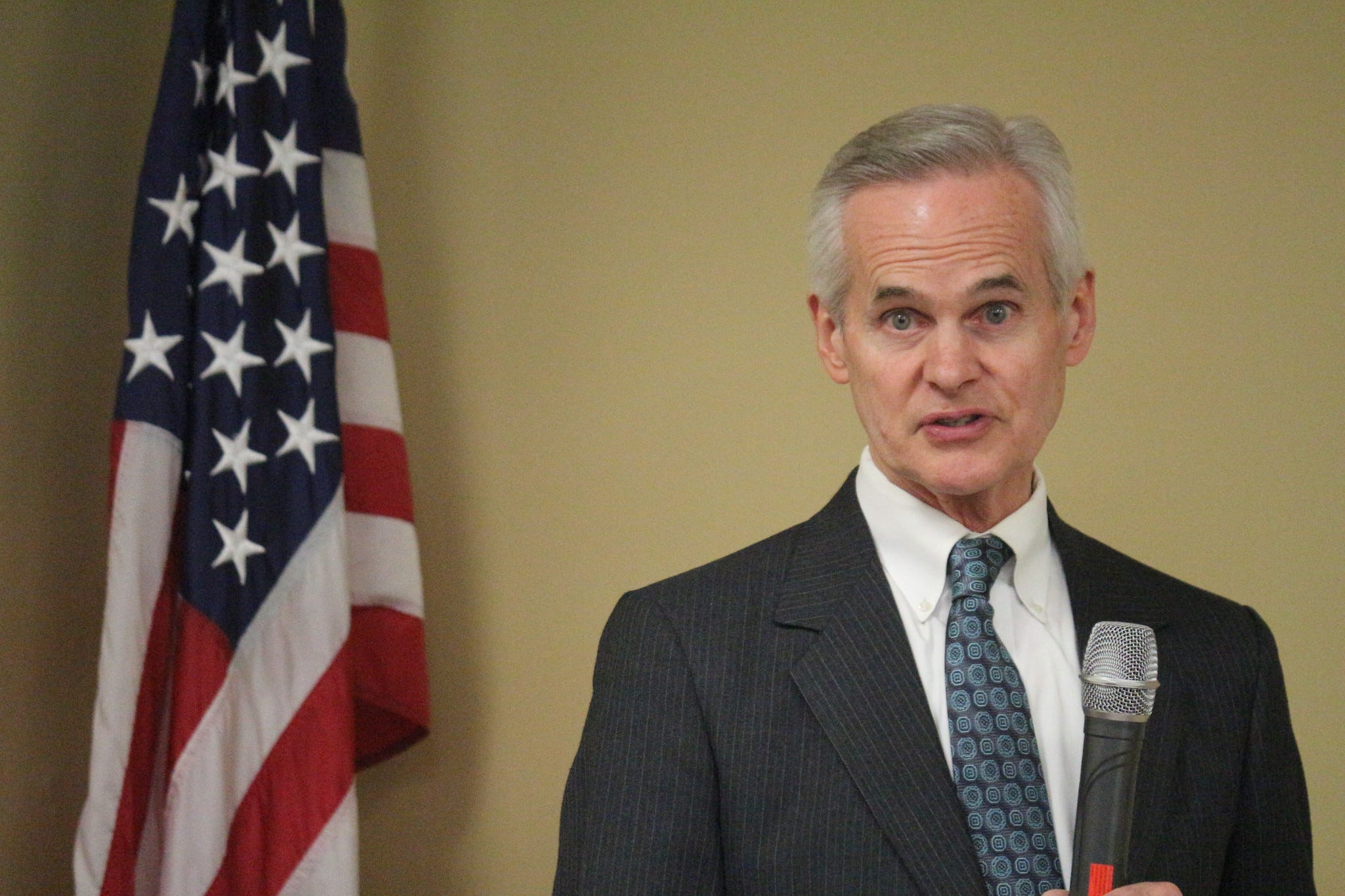
(Picture credit Matt Johnson)
The Office of State Auditor Mike Foley announced Monday morning that it had identified multiple questionable processes in the state’s Aging and Disability Waiver Program, which gives in-home care to the disabled and elderly as overseen by the Disability and Aging Division of the Nebraska Department of Health and Human Services (DHHS).
The AD Waiver Program has grown 700% in the past decade to total $464 million, assisting Nebraska’s aging population with the help of nearly 2,000 service providers. With the program’s massive expansion within what is already Nebraska’s largest agency, Foley’s office completed a 34-page report identifying suspicious billing practices from numerous registered providers.
“I have never been shy about criticizing DHHS for program mismanagement,” Foley said. “DHHS must be able to account for every dollar spent on this program.”
The first concern had to do with Electronic Visit Verification system, or EVV. Providers are required to log in via smartphone while providing services to a patient. Foley’s office found the EVV system was highly vulnerable to misuse, with come providers splitting consecutive hours across two different days.
In addition, the EVV system allowed providers to edit their logged and billable hours even after it had verified the hours worked. Foley’s office found that one agency used this end-around to add 434.5 billable hours in one month. The same agency among multiple others was also found to have billed for caregivers providing more than 24 hours of service in a single day.
Other caregivers had clocked into the AD Waiver system away from patient’s homes. In a test of 22 providers, 15 had billed and were paid for performing DHHS services while simultaneously working elsewhere. Some providers also billed for more hours of care than patients were authorized to receive — including one provider billing for 47 hours of care in a 24-hour period.
Foley did note that DHHS is actively repairing its safeguards to catch and prevent such billing activities from providers.
“Hopefully, those controls will prove sufficient to prevent further deceptive billing and the resulting theft of public funds,” he said. “A major challenge in controlling surging costs is eradicating fraudulent billing by unscrupulous providers who exploit the program’s current administrative weaknesses.”
A spokesperson for DHHS told The Plains Sentinel that “DHHS has implemented needed measures to better prevent improper billing by providers.”
Foley’s office also identified two suspicious behaviors in the agency/independent provider distinction. The standard hourly rate for an independent provider is $15, while agencies are permitted to bill at slightly higher hourly rates.
In the first case, Foley’s office found that certain independent providers likely took advantage of the agency pay increase, as it discovered four listed “agencies” consisting of an owner and a sole employee — both being the same person — with each “agency” serving only a single participant. Such “agencies” were paid nearly double the standard hourly rate for independent service providers, were all compensated in excess of $180,000 in calendar year 2025.
In perhaps the most outstanding case of suspicious billing, DHHS allowed a participant’s guardians to negotiate wages for service providers. Despite the standard rate for independent providers, DHHS eventually agreed to compensate the four agreed-upon providers $23.50, $28.45, $54.02, and $57.69 per hour.
It turned out that the first two providers were the participant’s mother and brother.
“We cannot afford to continue paying for services that were never rendered or allowing unethical providers to line their pockets with ill-gotten taxpayer money” Foley said. “The people receiving assistance through the AD Waiver program deserve our full support, and honest service providers are entitled to fair compensation.”
— Lewis Thune is a writing fellow with The Plains Sentinel.
Simply fixing the system is not adequate. The ill-gotten gains should be recovered, resulting in restitution of taxpayer funds. It shouldn't stop there. Employees that were scamming the system should be fired and prosecuted. When a bank robber is caught, justice isn't served by simply giving the money back to the bank. No difference here.