

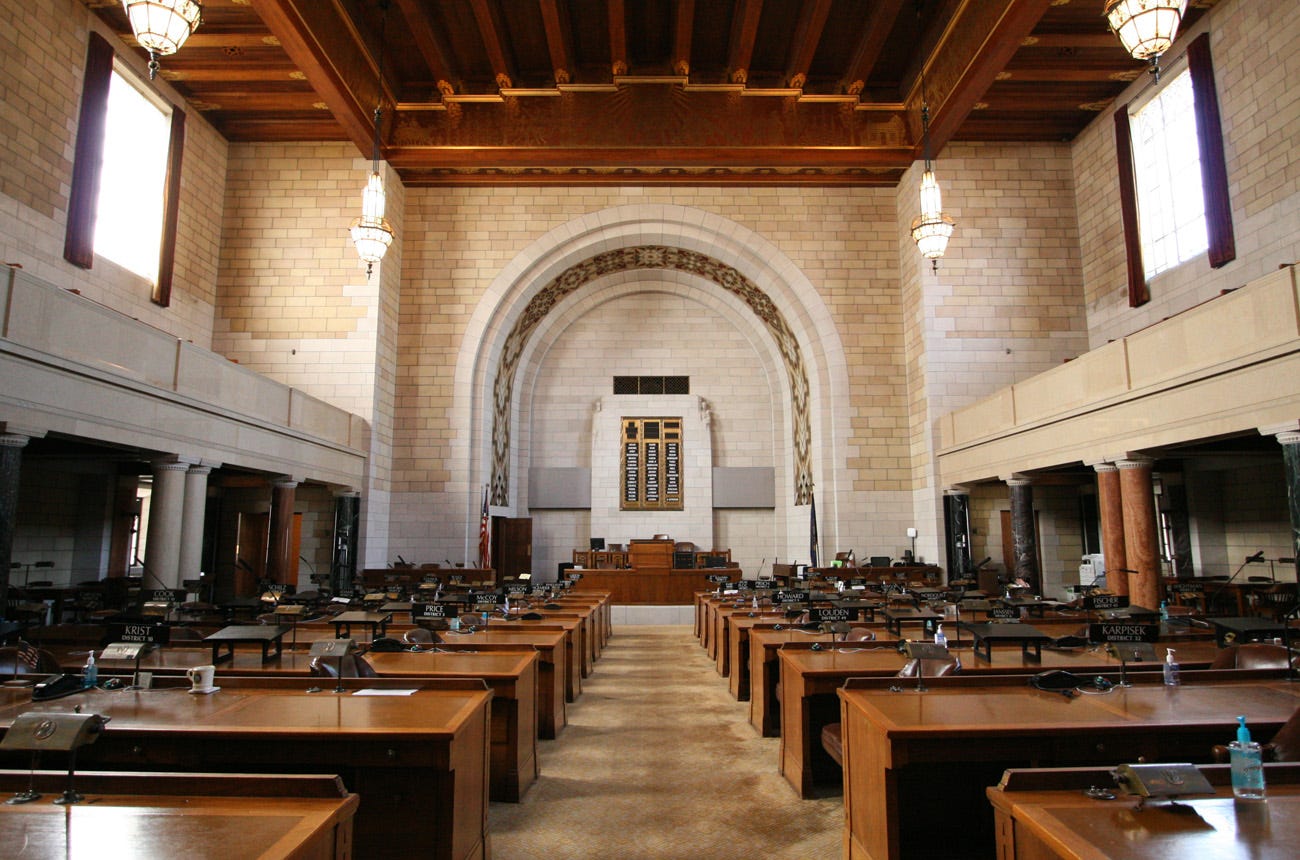
(Photo credit Nebraska Legislature)
OMAHA — Law enforcement and state lawmakers are looking into statutory changes to allow judges stricter options in cases of accused criminals claiming mental illness.
Douglas County Sheriff Aaron Hanson discussed potential changes at an event in Omaha this week in the wake of two high-profile cases wherein a man accused of shooting a police officer was acquitted on account of insanity, and a cognitively disabled man, who admitted to law enforcement he chased two minors through an Omaha park and tried to have sex with them, saw his charges dropped.
The sheriff said it’s often the law, not the judges, that is most at fault for violent offenders being set free.
“The majority of the judges in Douglas County are A+,” he said. “In my opinion, I’d say 90%.”
When asked by The Plains Sentinel, he said that in cases of mental illness and criminality, judges’ hands are often tied.
“For example, we’ve got one state statute that says we must use the least restrictive amount of care and court orders when it comes to someone who is either under the purview of the board of mental health, or even someone who has been found not guilty by reason of insanity,” he said.
But the alternative is not necessarily prison.
“I don’t advocate for mentally ill people going into prison or jail as opposed to a mental health institution, but you can see why the powers that be would take that path of least resistance,” he said.
Judges Lenient on Violent Suspects
Last week, Judge Stephanie Shearer dismissed charges of child abuse in a case involving Zachary Vinton, a mentally ill man who allegedly tried to have sex with two young girls in an Omaha park.
Shearer claimed there was not enough evidence to convict Vinton, despite Vinton admitting to authorities that he tried to rape the two minors, according to court documents.
“It is absolutely not against the law to have sexual thoughts or to think about having sex with someone,” Shearer said. “The court does not believe that reaches the level of probable cause of knowingly and intentionally placing these individuals in a situation that endangered their physical or mental health.”
The Vinton case received public backlash following his initial release, which resulted in a Gretna elementary school telling parents their children would need to use a buddy system to avoid any future attack.
The news drew attention from the likes of Larry the Cable Guy and former reality TV star Adrianne Curry, who weighed in and criticized the judge for “coddling” criminals.
Douglas County Attorney Don Kleine responded to the latest news that Vinton’s charges were being dropped, by filing a petition last week with the court trying to get the case taken up again. According to the petition, Vinton had a 2024 behavioral assessment that found he had a high risk score for likelihood of “predatory violence.”
In a second case last week, Douglas County Court Judge Shelly Stratman ruled that Shedrick Mills, who allegedly shot an Omaha police officer, was “not responsible by reason of insanity.”
Stratman ordered that Mills be kept at the Lincoln Regional Center for an inpatient evaluation. The center was given 90 days to complete the evaluation and recommend a “detailed treatment plan” for the court.
Under the law cited by Stratman, the court will hold Mills under “the least restrictive treatment conditions consistent with the safety of the public.” The same standard Nebraska authorities have criticized for allowing violent defendants back onto the streets.
Gap in Criminal Justice System
Hanson recounted the story of a Douglas County repeat offender as an example of how Nebraska’s current criminal justice system is breaking down.
“He went on a tear a couple years ago… booked into jail for terroristic threats, use of weapon to commit a felony, burglary, and he was found not guilty by reason if insanity. And so, therefore, he had to go to Lincoln Regional Center.”
Hanson said Lincoln Regional Center discharged him after around 6 months, which he suggested probably had something to do with their limited capacity of 250 beds.
“This judge said, ‘you know what? I’m going to do something different. I’m going to give the Sheriff’s Office supervisory responsibility over this person.’”
The assigned investigator found the mental health group responsible for the man had not properly vetted his living condition, and that he had relapsed into methamphetamine usage, leading to the judge ordering his recommitment to Lincoln Regional Center.
“You’re starting to see that missing piece between acute inpatient care and community-based services,” he said. “There is very little to no case management, and that’s really the part we’re going to have to solve.”
In response to a question from The Plains Sentinel, he also indicated that it might include some additional tax burden.
“What if that guy was living next to your grandkid? Or you, right? But we also have to come to terms with the fact that that’s not going to be free.”
Legislative Proposal in the Works
Hanson first called for a change in Nebraska’s law following a violent stabbing of a child by a mentally ill woman in a Walmart parking lot in Omaha this spring that went viral nationally.
Guzman had a history of violence including an incident where she attempted to light her father and his house on fire before entering a Catholic church and vandalizing it. She was later found “not responsible by reason of insanity.”
Now-retired District Court Judge Leigh Ann Retelsdorf, who let Guzman off, blamed the same law as Hanson for why Guzman walked free.
When asked about what statutory changes were being discussed, Hanson indicated he was in ongoing talks with State Senator Kathleen Kauth of Omaha, in addition to Kleine and mental health practitioners.
“I think we’ve identified, unfortunately, because of tragic situations, some loopholes that exist in state law that need to be filled.”
Kauth spoke with The Plains Sentinel, saying that legislation was still in the early stages of being drafted.
“I put together a group of sheriffs, county attorneys, clerks, mental health providers, a group of people to say ‘ok where is this breaking down?’”
She says the current question is how to ensure a statutory change doesn’t simply shift responsibility.
“We’re waiting for our drafts to come down so we have a starting point where we’re all looking at the same thing,” she said. “I need to have everything in writing so we can sit down and say, ‘We’re looking specifically at this language, how will a change in this language impact things?’ We want to make sure that we’re not, you know, squeezing in one area and blowing the balloon in the other. We don’t want to transfer problems, we want to actually address them.”
When asked whether she agreed with Sheriff Hanson that the problem was primarily statutory and not a matter of judicial mishandling, she signaled that it would become clear once the state afforded judges clearer options.
“We need to give them the ability to do more, because they’re the ones in the courtroom seeing the case – and if they feel constrained by it for certain reasons, we need to make it very clear what they can do,” she said. “The expectation is upholding people’s civil rights but also making sure the community is kept safe.”
“It’s a pretty hard line to walk when you’re dealing with a mentally ill person. Some people believe they’re not responsible for any of their choices and should just be left alone, but those choices are impacting everyone around them. We have to have guidelines for that.”
Kauth added that the process could take a while to bring together a final piece of legislation.
“I just want to make sure people understand that we’re at the very beginning of the process. There’s a lot of talking that has to happen before we actually have a bill ready to go,” she said. “It’s going to be a long, hard fight.”
— Lewis Thune is a writing fellow with The Plains Sentinel.
This is probably the most frustrating Plains Sentinel article I've read. Outrageous and violent behaviors don't always equate to mental illness, but it seems to be the trump card played in court rooms today. A man attempts to sexually assault young girls, and a judge says it's not a crime to have sexual thoughts, even though he admitted he wanted to rape them. That judge is basically saying it's not a crime to attempt to commit a crime; it's only a crime if you are successful. So, the attempted rapist would have had to actually rape the girls in order to be found guilty. Well done judge. I am so impressed by your empathy. I'm sure you're confident he won't try again, but then again, there's no harm in trying.
I can picture it now in the Legislature. A lot of ideas and some solutions and some not making it out of committee. Those that do make it out of committee being tossed about and fought over. Then if something does make it to vote on the floor, and it passes, here come the lawsuits from the left. This is something that could go on for years, not months. Meanwhile, violent criminals just keep getting released by playing the mental illness card, gaming the system.