

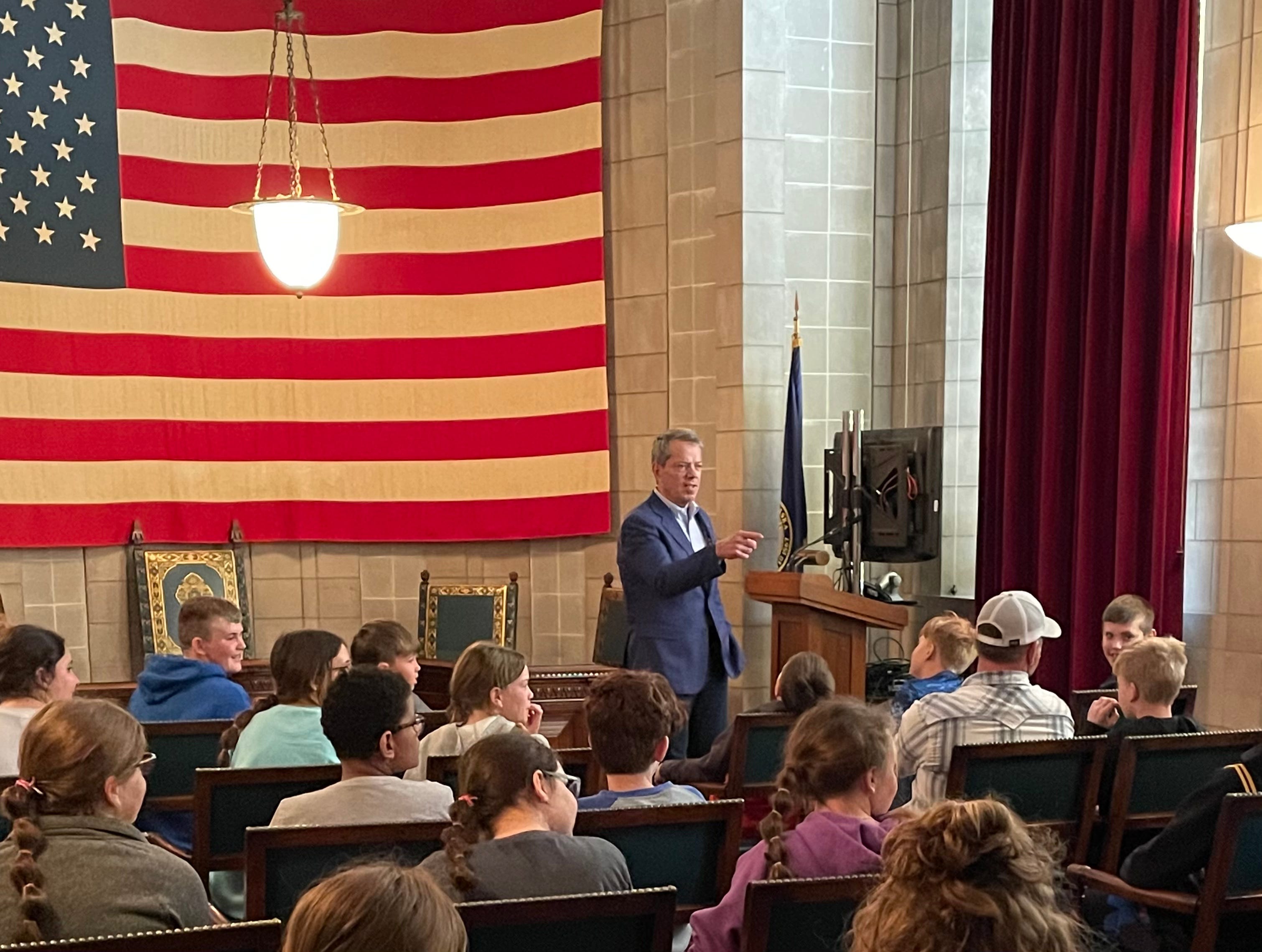
OMAHA – Governor Jim Pillen called for state senators to push forward legislation to address early childhood literacy, saying the state’s reading proficiency numbers were “concerning.”
“Reading is a building block that shapes the rest of a kid’s education. Right now, only 28% of Nebraska fourth graders are reading at or above the proficient level,” Pillen said Thursday. “That’s not good enough.”
“Those numbers tell us something important: the status quo isn’t working, and we have to do more to help struggling readers catch up,” he added.
Pillen’s comments come as the Legislature debates LB1050, a bill introduced by Education Chair Dave Murman.
“Change is needed, and it’s needed quickly,” Murman said Thursday during debate over the measure. He noted that the National Assessment of Educational Progress shows only 28% of Nebraska fourth graders meet a proficient level of reading.
Murman said the declining literacy scores were concerning to him. “Is this current path working? Should we be satisfied with being fortieth in the nation?”
The bill would replicate efforts made in Mississippi to improve early childhood literacy by allowing schools to hold back children who struggled to read. Since passing the measure, Mississippi has gone from 49th in fourth-grade reading comprehension in 2013 to ninth by 2024.
State Senator Danielle Conrad said Thursday during debate over the bill that she had a “significant amount of concern over the proposal,” but it was a “starting place for dialogue and discussion about how to achieve those [literacy] goals.”
Conrad said she was worried that the bill did not provide enough flexibility for kids who could not hit all the reading “metrics.” She provided the example of her child, who she said has high reading comprehension but reads slowly.
Pillen said the bill will result in some kids being held back, but that the measure will set up Nebraska students for success in the long-run.
“Does this mean a small number of students might not be promoted to fourth grade if they’re not ready readers?” Pillen said in a recent Omaha World-Herald op-ed. “Yes. And as a parent and grandparent, I don’t want students to feel embarrassed or discouraged. And the purpose of this policy isn’t punitive. It works alongside other literacy reforms Nebraska recently has adopted and the ones we’re poised to adopt this year to create a framework for success for our students and families.”
— John Gage is the Executive Editor of The Plains Sentinel.
With the amount of money that is being taken from us in the name of education 28% shows what a complete and utter failure government education is. Would any of us accept a box of even fries that was 28% full? Would any of us keep going to a place that charged an exorbitant amount for a box of fries that was only 28% full? Would any of us demand and force us to continue supporting this place? Would any of us be against a place that served a full box of fries for less? No we would not.
So a box of fries results in outrage, but not sub par education? Just the changing from a cup to a bag results in outrage, because the perception is you are not getting as many.
https://www.the-sun.com/money/16102187/five-guys-fries-paper-bag-change-portions/ A particularly scalding comment read: “Portions are also smaller now, don’t try to claim they’re the same.”
Its time to scrap the public education model. The money government takes should follow the student, private, home where ever. The government education system has failed us for decades, no amount of money will fix it. Competition will fix it in a year or two if not months. We have to start asking why the people that support government schools want failure to continue? Why do they want a permanent underclass? Why do they support a system that is a obvious failure? The more well to do can pay both property tax to fund this failed system and send their child to a good school. The poor cannot, they are barely making it. Yet the education mafia and its supporters just took away $3.5 million to fund poorer children getting out of their clutches. The education mafia and government - legislators and Governor only care about the adults getting paid. They will plow even more money into this failed system and at best get a small jump in scores. Their is and never has been punishment for failure when government fails. The solution is always more money. So exactly what is the incentive to improve?