
(Picture credit Gambling with the Good Life)
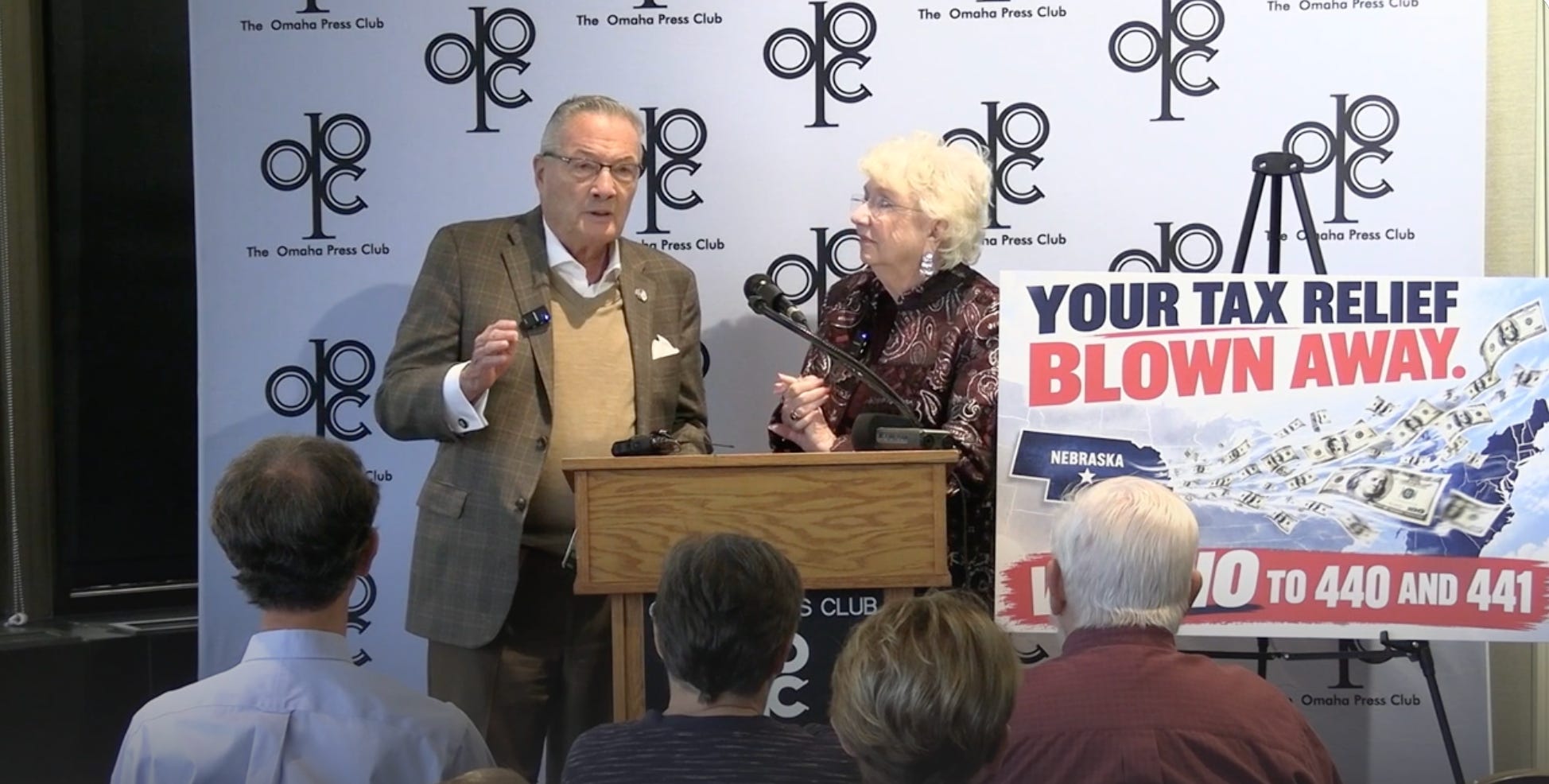
OMAHA — As Nebraskans prepare to decide whether online sports gambling will become legal in the state via ballot initiatives 440 and 441, former Omaha Mayor and NE-02 representative Hal Daub held a press conference Tuesday afternoon with an anti-gambling group in opposition to the measures.
The event, hosted by Gambling with the Good Life, welcomed press to downtown Omaha’s Press Club as Daub and the group’s executive director Pat Loontjer laid out the case against legalizing the increasingly popular online sports betting.
“We don’t protect railroads in Nebraska, in our Constitution. We don’t protect casinos or horse racing in our Constitution. Why would they want Nebraska to put this kind of gambling into our Constitution?” Daub asked.
“They know that if it’s just statutory, the dangers and damage and costs will be so terrific that the state will curtail it.”
Initiative 440 would amend the Nebraska Constitution to allow for the passage of laws legalizing internet-based sports gambling, while Initiative 441 would enact such a law and provide that sports betting apps must partner with a licensed Nebraska casino or racetrack to operate their platform.
Loontjer and Gambling with the Good Life have long been influential in opposing the expansion of gambling in Nebraska, notably winning two high-profile cases at the Nebraska Supreme Court against a 2003 keno initiative and a 2014 horseracing initiative.
While gambling has progressively expanded nonetheless, it is still concentrated on Nebraska establishments in a way smartphone-based gambling is not, Daub explained:
“We have legalized slot machine gambling in Nebraska; we have keno and lottery. And all of those produce certain amounts of revenue that are now collected by the state. Add this to it and that will cannibalize or dilute the revenue.”
“There will be no guardrails, no Nebraska interest, no Nebraska employment, and the profits will go to them. The money’s not staying in Nebraska.”
Money from new betters – those who do not already “drive to Council Bluffs” in order to sports bet – would now go to east coast business like FanDuel and DraftKings rather than the Nebraska economy.
“They’re not in Nebraska, and they’ve never had an elected representative that’s been on their side,” Loontjer said.
Furthermore, they argued, much of that money would come out of the accounts of sports betting’s primary demographic: young men.
“The statistics show that the majority of young men get addicted to this between the ages of 18 and 24 – and these are their most productive years. They’re our best and our brightest” Loontjer said.
The increase in addiction and subsequent increase in suicide would become an immense drag both societally and financially, Daub argued:
“They don’t put near the money that it will cost Nebraskans in divorce and bankruptcy, and all of the pain, the addicted young people”
Tax Relief Insignificant
An additional hangup is that initiatives 440 and 441 come with the promise of tax relief, as with the horseracing case in 2014 and Nebraska’s legalization of casino gambling in 2020. Nonetheless, Loontjer observed that six years and six casinos later, tax relief is still among the single biggest issues for Nebraska voters.
“That’s exactly what this is. It’s a farce,” she said.
Additionally, the revenue Nebraska would collect from sports gambling would come via taxation on the industry. Tax Relief Nebraska, the group which got initiatives 440 and 441 onto the ballot, estimates that sports gambling would generate $237.5 million in total tax revenue for the state of Nebraska, $166 million of which would go to the Nebraska Property Tax Credit Cash Fund.
The acknowledged catch to that figure is that it is a ten-year estimate, so actual relief would average out to $16 million per year.
“I can’t figure out from their proposals how it gets to the property tax owner. It’ll be eaten up by mill levies, by four or five thousand units of government across the state over a ten-year period that take property tax off valuation – so there won’t be anything there… the school boards in Nebraska will get that the first year,” Daub said.
“It really winds up to be less than $8 a person,” Loontjer said. “Is it worth selling our youth for this amount of money?”
That figure is even less than what was spent per signature during the petitioning effort for measures 440 and 441.
“They filed a report that said they spent about $8 million for the petition circulators” Daub said. “If there’s no business, no employee standing in the radio, television, and print commercials we’re being inundated with, where’s the money coming from?”
The most final and most resounding message from Gambling with the Good Life came courtesy of a quote which Loontjer read from Nebraska’s premier sportsman and mentor, Coach Tom Osborne, whose wife Nancy serves on the organization’s Board of Directors.
“Athletes will be facing harassment, abuse, and even physical threats, and putting sports betting on every phone will increase that pressure and expose more young people to gambling addiction. I urge everyone to vote no on 440 and 441.”
For those gambling on Nebraska’s disposition towards whether initiatives 440 and 441 will get passed by voters, prediction market Kalshi places each measure’s odds of passage above 60%.
— Lewis Thune is a College Fix writing fellow with The Plains Sentinel.