

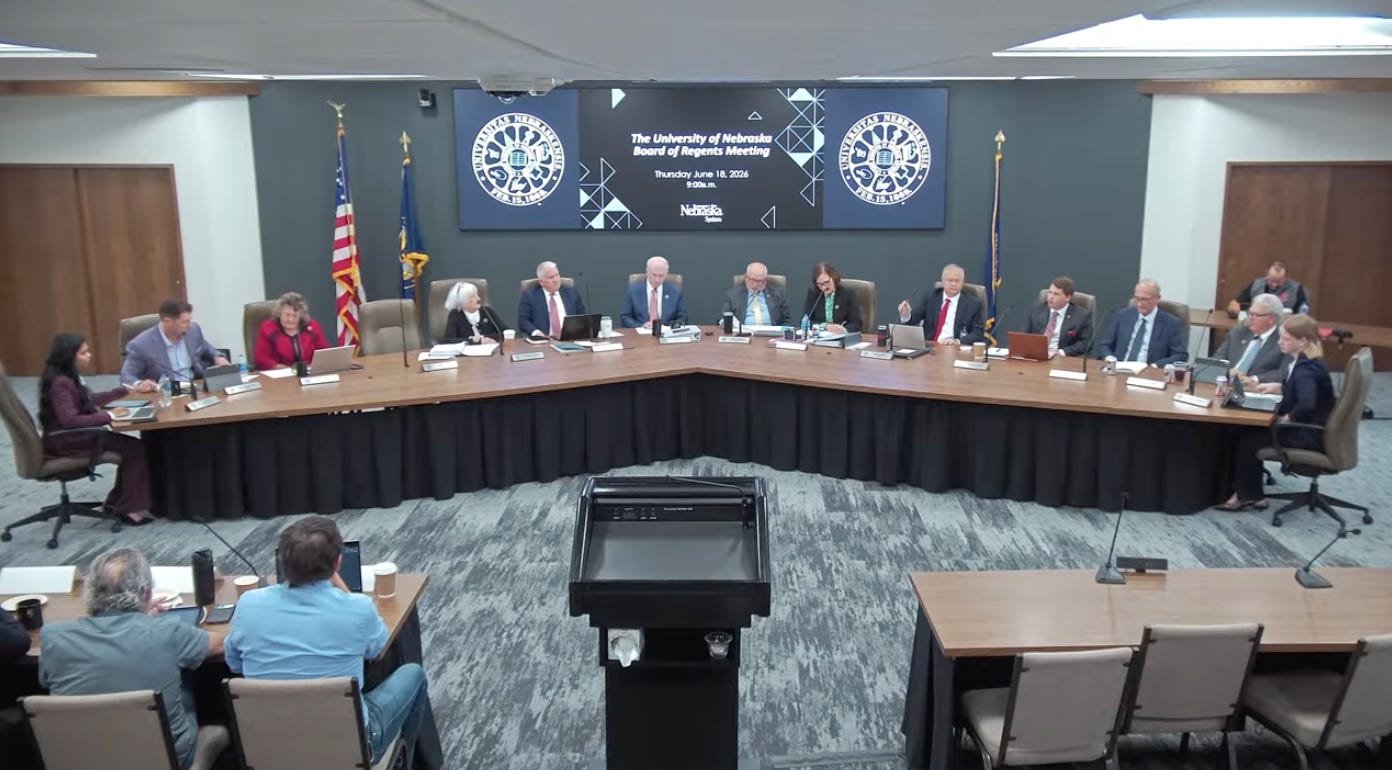
LINCOLN — The University of Nebraska Board of Regents approved the University of Nebraska’s fiscal year 2026-2027 operating budget in a 6-2 vote at their public meeting on Thursday, increasing tuition by 4.25% for students.
The Consumer Price Index-based increase accompanies a 0.62% increase in state appropriations as the University of Nebraska seeks to provide salary increases for its non-unionized staff and maintain scholarships and tuition remissions, both merit and need-based.
“Higher education is in a precarious situation,” said District 3 Regent Jim Scheer, the Board’s Vice Chair and former Speaker of the Nebraska Unicameral, “We just have to work with inflation, and that’s, you know, the black sheep of the family. No one likes it.”
Chair Paul Kenney, District 6 Regent, echoed Scheer’s observation of the present turmoil in American higher education, using fellow Big Ten schools as an example.
“This man–” he said, indicating University President Jeffrey Gold, “There’s 20 schools I believe in the Big Ten? Or 18? [He is] the fourth-longest-tenured president in the Big Ten. It’s been two years. It wasn’t easy to get to where we had to be this year.”
University of Nebraska-Lincoln Student Regent Kurt Schneider expressed optimism despite the tuition increase, recalling Nebraska’s three-year tuition freeze from 2020 through 2023.
“I think our previous years of no increase in tuition has put us in a tricky situation” he said, “with these tuition increases, we’ll continue to fund great scholarships that students really appreciate.”
Appropriations Dilemma
In addition to inflationary pressure, the tuition increase was due in part to a smaller increase in appropriations from the Nebraska Legislature, the 0.62% increase being, as noted by President Gold, far below the University’s requested increase of 3.5%.
Scheer elaborated on what that difference meant in the raw numbers.
“I’m appreciative of what we did have and that we were not reduced, but the increase on our budget was approximately $4 million from the state” Scheer said. “The tuition at 4.25 is going to generate approximately $24 million, so the students are going to be making up approximately 80% of the dollars that we will be using in addition from last year.”
District 1 Regent Timothy Clare of Lincoln cited agricultural struggles in Nebraska as a reason for the University receiving less-than-anticipated state funds. He saw the gap and the subsequent tuition spike as a challenge for the University to recommit to leadership and innovation within the state.
“Every year our budget is dependent upon a third party who sets the price for agriculture,” he said. “Let’s figure out three or four things that we can aim for that can help stabilize the state’s economy, so that when the state does suffer the $4 corn, we’re not digging ourselves into a trench.”
Beaver City’s Kathy Wilmot, whos represents District 7, voted against the budget along with District 5 Regent Robert Schafer from Beatrice. Wilmot expressed concern that the plight of farmers and ranchers in western Nebraska would continue to complicate state appropriations.
“I’m coming from an area that there is no corn. It got hailed out. We lost the beans, we lost the corn, we’ve had the fires all over Nebraska” Wilmot said, “There’s a good chance they’re going to go back and refigure taxes. That’s going to possibly affect what we’re going to get from property taxes out there, what the legislature is going to have to work with. I mean, I can’t imagine where this may end.”
With the prospect of shorthanded appropriations in future years, she emphasized the need for closer control of spending throughout the meeting. On the budget proposal, she suggested the board consider making additional cuts to forestall future tuition increases.
“I’m not saying cutting programs is easy, don’t get me wrong, but we maybe need to look at cutting back. We’ve raised tuition over the last two years 8.5%. I’m afraid we are pricing students out of their opportunity to get an education, and that’s not what I came here to do,” she said.
‘That’s Not in Our Budget’
Barbara Weitz, District 8 Regent from Omaha, indicated a different source of budgetary troubles in the Nebraska Legislature
“Not only do they not increase our budget, but they actually decrease it by the unfunded mandates that are passed. Sometimes, they’re for wonderful reasons, like the Presidential Scholars, for example, but the problem is that’s not in our budget, and we have to figure out how to cover that tuition loss,” she said.
While she thanked philanthropists and donors for helping cover that loss, she reiterated that in the absence of state mandates, those funds could have been better used.
“We don’t want our curriculum and our university driven by gifts that have to plug holes,” she said.
Clearer and better-elaborated priorities, she hopes, will help the University overcome its budgetary hurdles.
“I think our job is going to be advocating for this university in many more public ways… better relationships with our funding partners, like the unicameral, like the philanthropic community, are extremely important at this time,” she said. “We need to be putting our university mission in line with our state mission and our land grant mission.”
Despite the rise in tuition, the operating budget does ensure that the University can maintain its signature in-state scholarship programs – including the Presidential Scholars – which President Gold was quick to highlight.
“The Presidential Scholars for Nebraskans with a perfect ACT score of 36, the newly created Next Gen Scholars Program, offering full cost of attendance to all Nebraskans with an ACT score between 33 and 35,” he said, “and particularly the Nebraska Promise program, which provides access at no cost tuition to all Nebraska families that have an adjusted gross income of $65,000 or less.”
Kurt Schneider remains confident his fellow students will continue to choose the University of Nebraska, even those from outside the Cornhusker State.
“I know a lot of students from out of state, from the Chicago area, Minnesota, Wisconsin. They come here because our out-of-state tuition is cheaper than their in-state tuition,” he said. “I think there is a little bit of light at the end of this tunnel.”
— Lewis Thune is a writing fellow with The Plains Sentinel.