

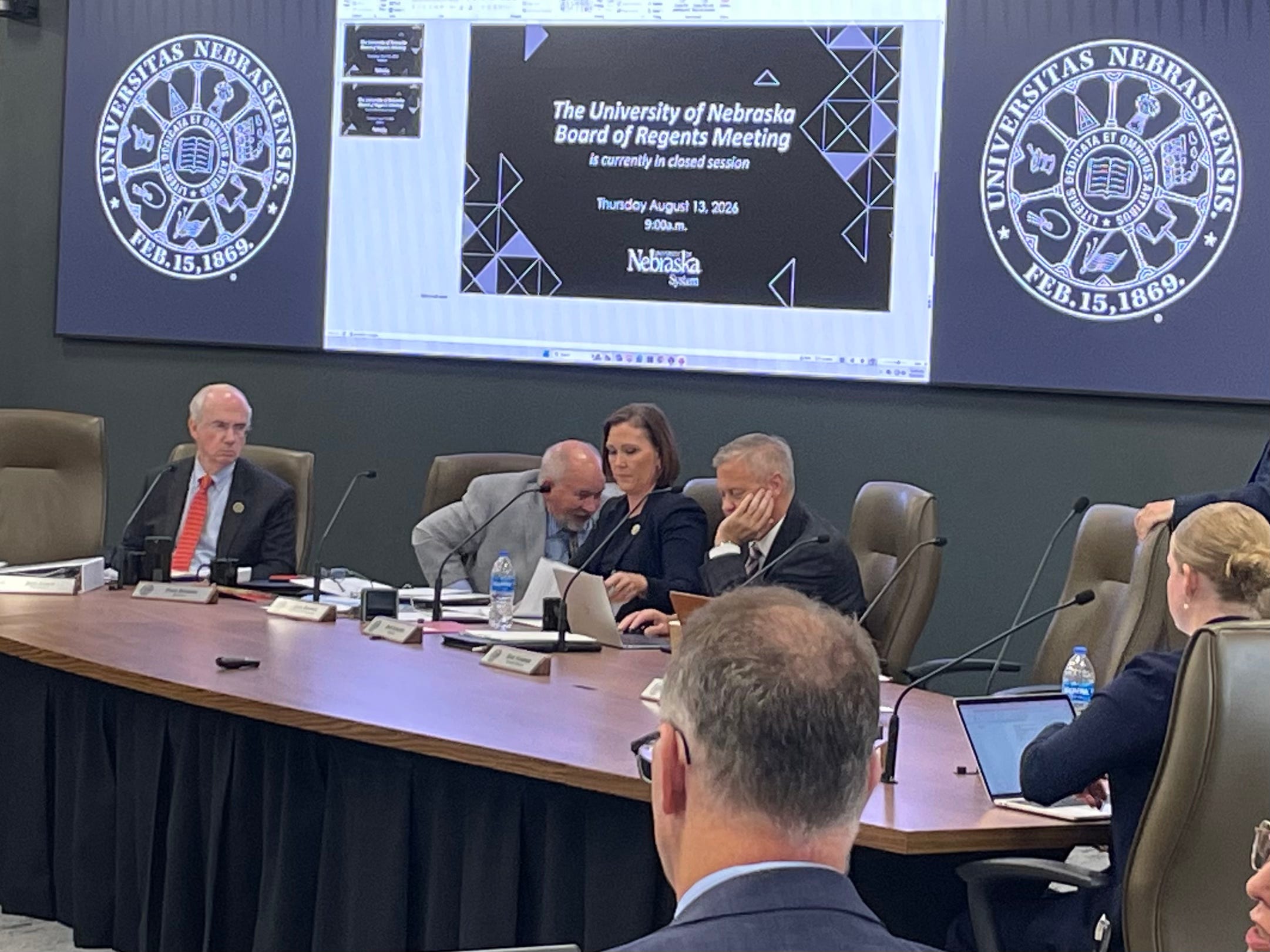
(Picture credit Lewis Thune)
The University of Nebraska Board of Regents unanimously voted to approve the university’s 2027-2029 Biennial State Operating and Capital Budget Requests, requesting a 4.25% increase to offset rising operating costs.
“The university’s budget request reflects a formulaic approach using a 2-biennium rolling average of consumer price index data,” said President Jeffrey Gold. “[It] is exactly the same methodology that was used in setting tuition for this academic year.”
In June, the board voted to increase tuition 4.25% to account for a less-than-expected increase in state appropriations. In the intervening weeks, the governor and legislature alike have been forced to reckon with a significant budget shortfall.
“Since we last met in June, our annual expenditures have been reduced yet one more time, this time, by an additional 5%.”
And the cuts are not the greatest present concern, as Gold also prominently noted that the state’s matching $1.5 million contribution to the Presidential Scholars Program – which pays full cost of attendance for Nebraska students with perfect ACT scores – is still unappropriated. While they again request that support in the 2027-2029 budget, actually receiving it will be no guarantee.
“Since its launch, we have approximately doubled the number of perfect score Nebraskans who have decided to pursue their degrees here,” Gold said.
And while no students who have accepted that scholarship will be stripped of it, Gold made clear that additional troubles with state aid could lead to in-state scholarship opportunities dwindling – those $1.5 million dollars accounting for just over 2% of the year’s in-state awarded scholarship.
“At a minimum this year, you look at Region Scholars, Nebraska Promise, Presidential Scholars, Next Gen Scholars, all the unfunded tuition mandates by the state... that will cost the university approximately $66 million this year,” he said. “We’re gonna have to make some very, very difficult decisions together as to whether some or none of these programs can be continued long-term.”
When asked by Regent Kathy Wilmot if the university had put any practical measures in place to ensure none of that money was going to illegal alien residents of Nebraska, Gold simply stated the University was fully compliant with the federal requirements as established in a June district court ruling.
Gold’s defended the request for an increase while the state sits in deficit by emphasizing the economic boon the university provides.
“For every taxpayer dollar that is appropriated each year, more than $10 is returned directly back to the state… said differently: just under $1 of every $10 of the entire economy of Nebraska — the gross domestic product — is provided by our university system, not to mention countless economic developments and impact by our alumni,” he said.
“The vitality of our state depends on the vitality of its university system.”
Regent Jim Scheer responded with frustration, saying such a message had shown to be ineffective in the ears of the state legislature.
“This legislature needs to adapt and help,” he said. “We can talk about 10 to 1 return or all the other things, but I think too often it is not understood or not believed. We provide information, we provide pamphlets, we provide booklets explaining the methodology behind it, and yet each year it seems we’re reduced more and more.”
Student Regent Aditi Rai agreed that the university could not continue to curb its budget expectations.
“It is not sustainable to keep increasing tuition, it is not sustainable to keep making cuts, it is not sustainable to rely on donors to fill every gap.”
The sole voice of optimism was Chairman Paul Kenney of District 6, who stressed that the grim outlook for the state and university together could very quickly change as harvest approaches.
“We’re gonna stay with that increase, but we don’t really know what corn is gonna do. That can change dramatically what happens,” he said. “Corn was up 20 cents yesterday, and I mean, that’s a lot of dollars if that would go on for a week or two. If you go up a dollar in corn, it changes the bottom line for the state of Nebraska.”
His stated plan is to keep the 4% increase and “see what happens.”
Wilmot of District 7, covering western Nebraska, had voted against the FY 2026-27 budget that included the 4.25% tuition hike. However, she appeared to nod at Kenney’s hopeful attitude towards corn, turning on her microphone to add:
“You better start sharing the rain, then.”
The subsequent vote to approve the budget request passed unanimously.
— Lewis Thune is a writing fellow with The Plains Sentinel.