

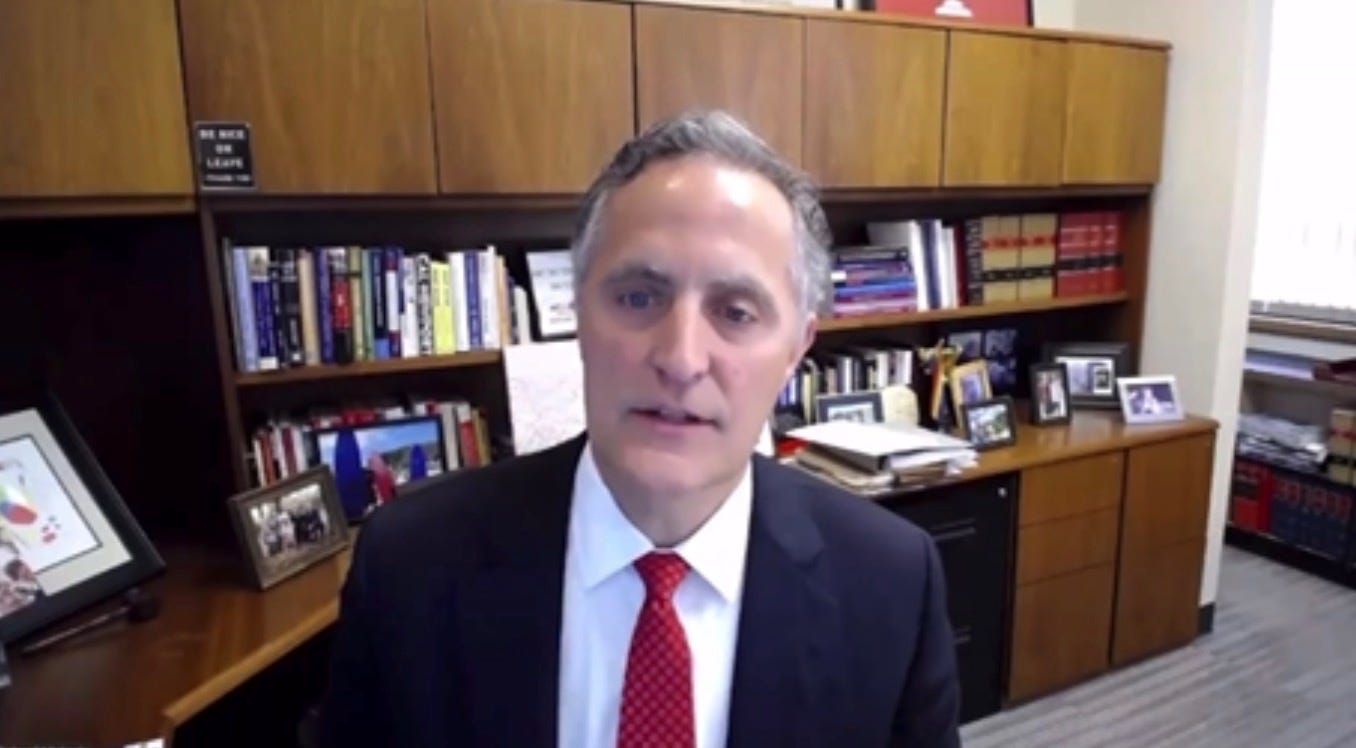
(Picture credit NACIQI)
University of Nebraska College of Law Dean Richard Moberly weighed in on Trump administration efforts to take away federal recognition from the American Bar Association (ABA) accreditation of law schools.
Last week, an advisory committee under the direction of the U.S. Department of Education, known as the National Advisory Committee on Institutional Quality (NACIQI), convened to debate whether to renew recognition of the Council of the ABA Section of Legal Education and Admissions to the Bar.
The ABA’s Council is the sole national accreditor of American law schools, and repealing its federal recognition would create a potential opening for additional national accreditors.
The ABA’s Council has come under scrutiny from conservatives in recent years over accusations that it has pushed left-wing ideology in law schools in its accreditation requirements. Critics point to the recently repealed ABA Section 206, which required “concrete actions” by law schools to promote “diversity and inclusion” among the student body, faculty and staff.
Another standard required law schools to “provide education to law students on bias, cross-cultural competency, and racism.”
The Council’s policies have caused conservatives to question the value of the ABA in accrediting law schools. Rachel Morrison, a scholar at the Ethics and Public Policy Center, argued during testimony that the government should not recognize the ABA’s monopoly in accrediting.
“The ABA serves as ‘a monopoly accreditor’ but it is not a neutral arbiter that should be privileged as the government-backed gatekeeper for legal education,” Morrison said. “While claiming to represent legal professionals, the ABA promotes progressive and partisan causes and disdains the conservative views and religious beliefs of many students and attorneys.”
Ilya Shapiro, a leading conservative legal scholar with the Manhattan Institute, agreed in his written testimony. Shapiro argued the ABA’s standards have led to “lower admissions standards” at some schools and “racial preferences.”
“Standard 303(c), for example, still compels every law school to provide education on ‘bias, cross-cultural competency, and racism.’ The Council’s own Standards Committee now concedes that this rule fails to build the intended skills, imposes a particular curricular input without measuring results, conflicts with some state laws, and creates unjustified burdens,” he added.
Opponents of taking away federal recognition from the ABA’s Council included members of the ABA’s Council, liberal advocacy groups, and law school officials, including Moberly.
In a video shared with The Plains Sentinel, Moberly defended the ABA in front of the NACIQI, asking the panel to “re-recommend” the ABA’s Council. His comments avoided the DEI controversy that had sparked the fight and instead focused on what he said were the benefits of ABA Council being given the authority to accredit law schools.
"The Council is recognized as a reliable authority on legal education,” Moberly said, arguing “portability” across state lines was necessary for law degrees. “Not just any accreditor will work. It matters that the Council consists of lawyers and experts in legal education.”
“The Council has consistently shown over the years that it understands the unique mission of legal education and the training of lawyers to not just represent clients but also to uphold and advance our American system of justice,” he added.
Moberly went on to argue that the Council did not force law schools into a “one-size-fits-all box.”
“It has created standards that have allowed for different missions while also demanding rigor and transparency.”
Moberly said as a dean he has, in the past, “chafed at some of the reporting requirements,” but said he believed the Council was “responsive” to criticism. “In my 10 years as dean, I’ve always found the Council and its staff to be professionally responsive, willing to take and act upon feedback, and thoughtful in its approach,” he said.
The ABA, ahead of the accreditation fight, repealed its “diversity and inclusion” requirement for hiring and student body composition. It is currently looking at whether to modify its “cross-cultural competency, and racism” education requirement.
Following the hearing by the NACIQI, panel members split 8-8 on whether to renew recognition for the ABA’s Council and informed the U.S. Department of Education that it could not reach a consensus on what its recommendation would be.
The split vote means the Under Secretary of Education Nicholas Kent will make the final decision.
— John Gage is the executive editor of The Plains Sentinel.