

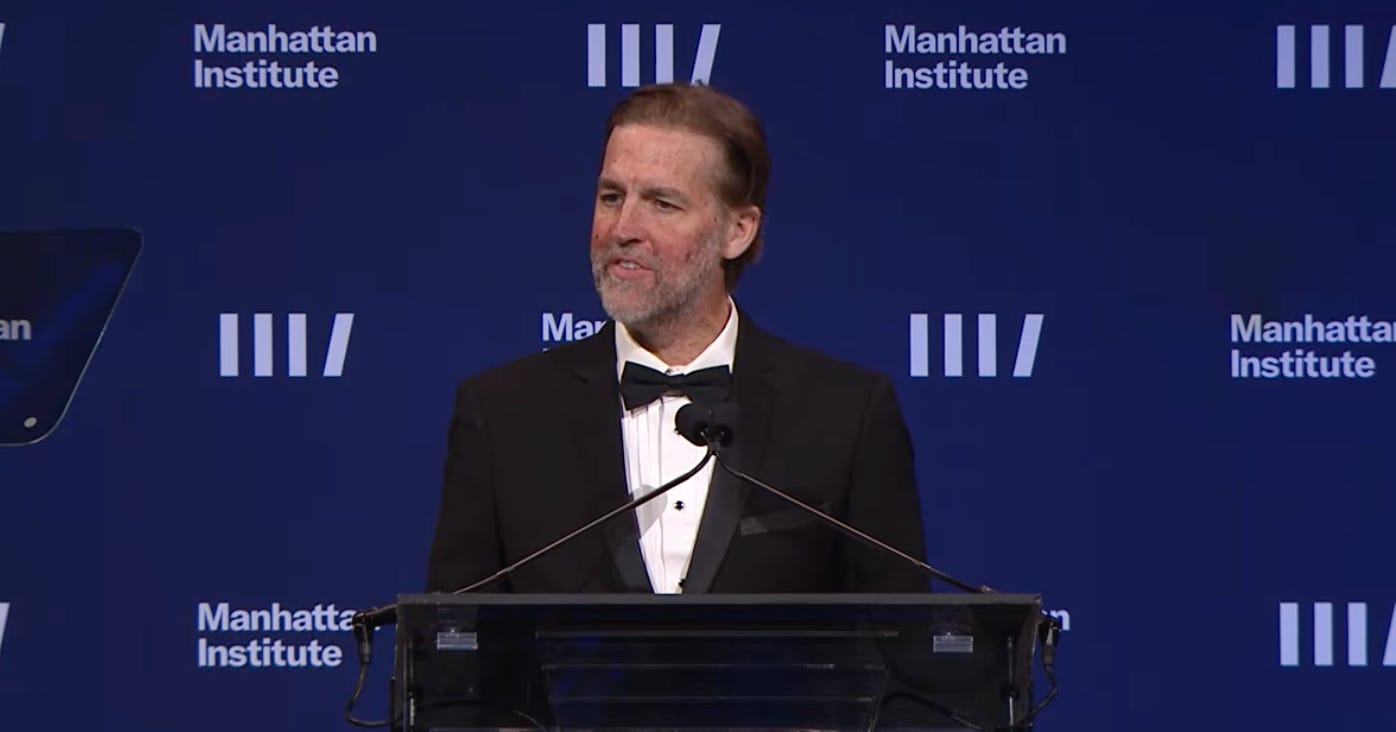
(Picture credit Manhattan Institute)
Former Nebraska Senator Ben Sasse, during his latest podcast episode of “Not Dead Yet,” reflected on declining literacy in the country as well as a loss of appreciation for poetry during an interview of Dana Goia, a poet and former chair of the National Endowment for the Arts (NEA).
Sasse said during the interview that he “wept over” a recent report from The Atlantic that the “end of reading is here” in America. “[I] went through the stages of grief and tried to say denial. It must be wrong,” he said. “It’s tragic.”
The former senator said that while universal literacy from the early Republic until now is a “unique outlier” in history, it also was a “precondition” for the “founding of this Republic.”
“If people say, ‘Oh, no big deal that you lose deferred gratification and long form deliberation and self-governance, self-control, self-restraint, self-educated to a certain degree, and you say that was kind of an accident.’ Well, is America in your parentheses as well?”
America’s Literacy Loss
According to recent data, only 28% of Nebraska fourth graders are proficient in reading, down from 37% in 2019. The drop has educational leaders grasping for strategies to reverse the decline.
With the rise of artificial intelligence, students, even at elite campuses, are skipping the reading and going straight to cheating. Princeton, this year, abolished a 133-year old honor system this year where professors would leave the classroom during exams and rely on students to report any cheating.
The loss in reading has reached adults too with a recent study showing a 40% drop in the number of adults who read for enjoyment in the past two decades.
Sasse, Goia Take Aim at Elites
Both Sasse and Goia took aim at educational elites, blaming them for leading the charge on America losing its literacy.
“What scares me, however, is when our so-called intellectuals and leaders can barely read and write,” Goia told Sasse. “[They] have no historical consciousness, know no subtlety in terms of their language. And if you don’t have subtlety in terms of language, I don’t think you have a great deal of subtlety in terms of your conceptual thinking.”
“I’m more concerned, you know, with the people that are running the great bureaucracies of the nation, of corporations, of political groups, etc. Who lack that [literacy],” Goia added.
Both Goia and Sasse said education elites are also responsible for misteaching poetry and causing students to hate the written word. Goia said during his time at the NEA, he created a program called “Poetry Out Loud,” which was a national recitation contest for students.
He said that only two states wanted to participate in the program because education leaders said: “Memorization was repressive, doing arts and competition was degrading, this contest would discriminate against minorities and foreign-born students, and finally, young people did not like poetry, so they just didn’t want to do it.”
Goia added that the educational establishment had turned off students to poetry by discouraging and looking down on popular poets like Henry Wadsworth Longfellow, the author of “Paul Revere’s Ride,” and Edgar Allan Poe.
Sasse said he believed Nebraskans liked poetry but were turned off by intellectuals who tried to make poetry a “professionalized” product for the elites.
“I think Nebraskans really actually like poetry and would like more poetry in their lives, but they do feel like there’s a professionalized bureaucratic elite that does look down on them and say, ‘The purpose of poetry is exclusion. Only we certain kinds of elite, highbrows really know. And you people, you like your verse, that rhymes. What the heck’s wrong with you, you heath?’” he said.
Both Goia and Sasse agreed the country has developed an academic elite that values “specialization” and “strategies of exclusion.”
Path Forward
Goia said parents have to take a leading role in leading the fight against literacy decline. The loss of adult reading has consequences for children, as the top two indicators of whether someone becomes a lifelong reader are whether their parents read to them as a kid and whether the kid sees their parents reading often.
“That they saw their parent read, they associated it with adult behavior,” he said. “Every family, every child that we fill with the love of language – poetry, I think is the most electrifying of the media, especially for children – every child we do will make a difference as he or she goes on in life.”
“And if we can do this with 10-15% of the population, we can change the country.”
— John Gage is the executive editor of The Plains Sentinel.
"According to recent data, only 28% of Nebraska fourth graders are proficient in reading, down from 37% in 2019." But the link goes to Voice for Children of Nebraska, which is associated with progressives. In addition. the Atlantic Monthly article has been criticized for inaccuracies.