

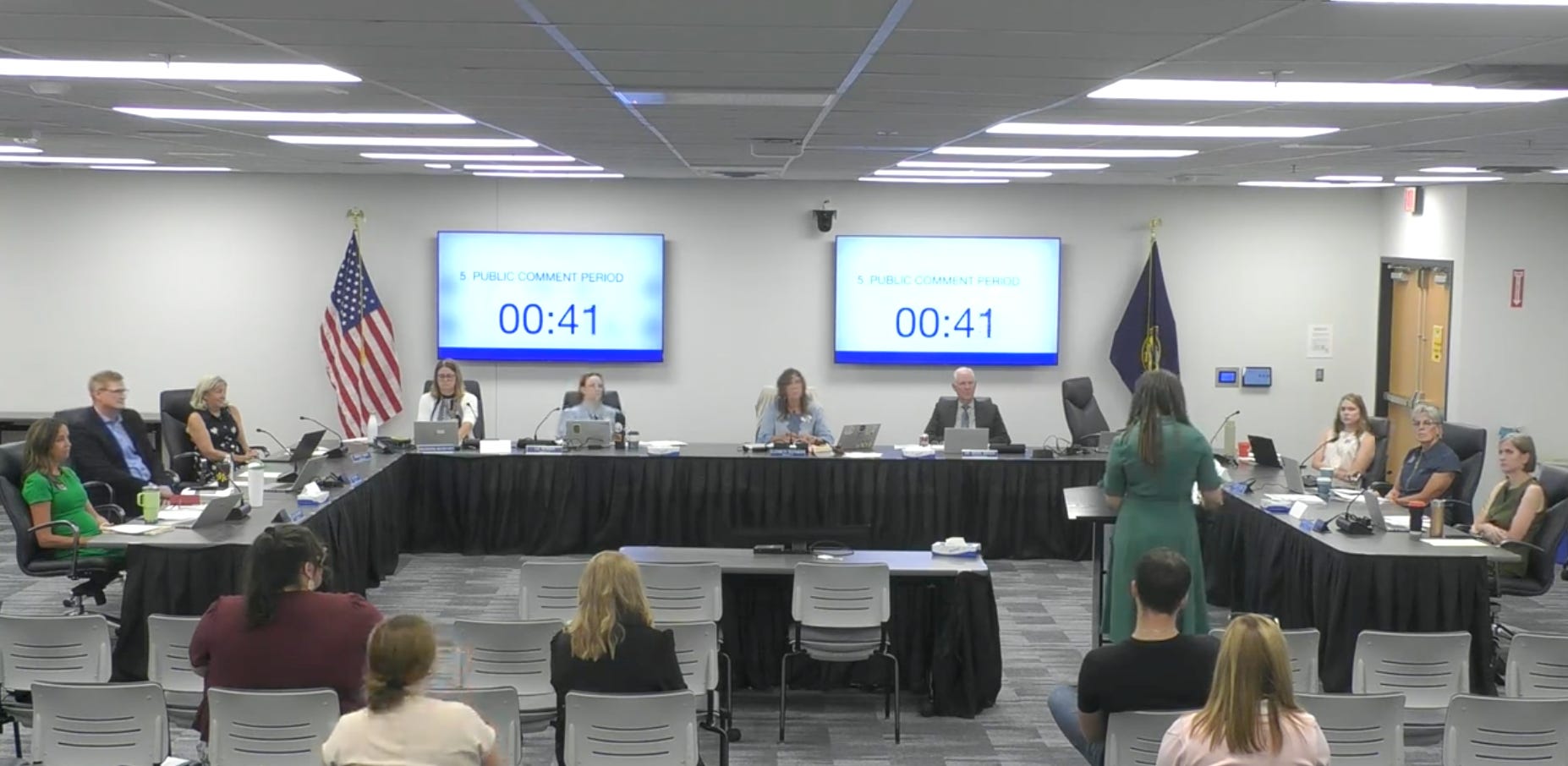
(Picture credit Lewis Thune)
The Nebraska Board of Education voted Friday to delay its decision on approving the Rule 14 approval for Identity Preparatory Academy in light of alarm over potentially radical curricula.
Identity Preparatory Academy is an all-girls middle school intended to serve the heavily black population of North Omaha. Pending Rule 14 approval, it would begin operations the following week of August 17. The school’s application for Rule 14 approval had been with the board for the preceding two months, but recent concern arose over a statement on the school website that apparently professed a commitment to the abolitionist teaching framework.
The abolitionist framework is a racial justice-based approach to education championed by Columbia University professor Bettina L. Love. Love has made numerous anti-white and anti-American comments throughout her writings.
“Whiteness cannot enter spaces focused on abolitionist teaching. Whiteness is addicted to centering itself, addicted to attention, and making everyone feel guilty for working toward its elimination,” Love wrote in one of her books.
The portion of the website in question that pushed the abolitionist framework has since been changed. Board President Elizabeth Tegtmeier summarized the ensuing problem the committee faced:
“We have a civics statute that states, ‘It is the responsibility of society to ensure that youth are given the opportunity to become competent, responsible, patriotic, and civil citizens… the youth in our state should be committed to the ideals and values of our country’s democracy and the constitutional republic established by the people.’”
A school embracing an abolitionist framework would likely fall short of that requirement.
“There’s concern that if a school is operating under an abolitionist framework, they would not be able to adhere to this statute or the spirit of the statute,” she said. “An abolitionist framework seeks to abolish the structure of American government and the things that this has been built on.”
This was to be the basis of a potentially explosive debate on the 8-person board.
School Founder Addresses Controversy
However, the morning’s fireworks were preliminarily defused when Identity founder and chief executive, Dr. DerNecia Phillips of Omaha, appeared before the board during the public comment portion of the meeting to clear the air.
“Any claim of anti-Americanism has nothing to do with me,” she said, referencing her background as a teacher, university instructor, and former military child. “I want to directly clarify our structural and educational framework.”
She went on to explain that the website’s use of “abolitionist” and related language was not in direct reference to Professor Love or “We Want to Do More Than Survive,” Love’s 2021 book on abolitionist teaching that those concerned had referred to.
“In our initial design phase, our website utilized exploratory language like ‘liberatory’ and ‘abolitionist’ to express our desire to build joyful, secure learning spaces that practically interrupted those negative pipelines,” she said.
The “pipelines” she cited were the low and declining Math and English proficiency levels in nearby North Omaha public schools.
“Through our ongoing collaborative journey alongside North Omaha families, that structure evolved and changed, and now we fully adopt an appreciative approach that’s deeply rooted in David Cooperrider’s model of appreciative education.”
In light of Dr. Phillips’ input, members initially against approving the school based on its educational framework indicated that they would like to meet with her further before voting on the matter.
“The information has changed,” Tegtmeier said, “I feel like there is a genuine earnestness to know and understand and make a qualified vote on the complete information that Dr. Phillips has.”
Considering that fact, she’d asked the initial chief opponent — Kirk Penner of District 5 — to motion for a postponement, as without further information, a yes/no vote would have likely ended 4-4. Penner did so, asking that the vote be delayed until August 11. In the intervening days, he committed to meeting with Phillips and the Identity staff.
“What we were seeing is totally different than what Dr. Phillips was saying today, so we need a little bit more time to vet the whole process,” he said. “We didn’t misinterpret ‘liberatory practices’ and ‘abolitionist education framework.’ You can’t misinterpret that, and so I want to give a second chance here, because they are saying that they’re moving away from that.”
Sherry Jones of District 6 also voiced her desire to meet with Dr. Phillips in order to settle her thoughts on the matter.
“That would be really important for me to have a vote of confidence.”
Council Members Debate Authority
Deborah Neary of Omaha had motioned to authorize the school’s approval, and took issue with Penner’s motion to postpone – chiefly because the school’s application had been under consideration for so long.
“Identity Prep has met all the legal requirement and policy standards established by this board. If any member believes now or believed over the last two months of discussions that there is some policy or guideline or regulation that they have not met, that needs to be discussed here and now, and it should have been discussed in a committee,” she said.
Additionally complicating the matter was whether the board even had the power to deliberate on it, an issue raised by Maggie Douglas of District 2 and Kristin Christiansen of Lincoln.
“The three pieces are their application, the statute that President Tegtmeier mentioned: 79-724, and Rule 14,” Christiansen said, noting the different definitions of curriculum in each piece.
“The actual materials that they’re using, the curriculum that they might purchase or give to students or use as teaching guides is beyond our purview. That is not within our scope. That’s a local school board decision.”
Neary insisted that to delay a vote on the basis of curricula thus defined would not only overstep the board’s purview, but threaten their reputation.
“Postponing this on a criteria that has nothing to do with what is legal and in policy on a school that is focused on African American children, it’s not a good look,” she said. “We as a board are saying we are going to put different criteria on this school catering to African American children than we put on any other school we have ever approved. That doesn’t sound legal. It sounds disrespectful. It sounds racist, and I can’t believe we’re even considering this.”
Jones, however, responded that the problem had to do with the educational framework, not curriculum narrowly defined:
It’s not the curriculum — I’ll say again —that is concerning to me. It’s the framework of the school. When you look into the requirements of Rule 14, it includes 79-725 and 79-724, when you read this, it talks about obedience to law, desirable citizenry, et cetera.”
Thus, she argued, the board had deliberative authority as to whether a framework qualifies.
“If you do your homework on this framework, it’s not supportive of that.”
Jones also traded barbs with Neary in response to a direct inquiry about the “disrespectful timing” of taking up the issue with less than two weeks before the school year begins rather than in the previous months of committees.
“I would encourage board members to take a look within themselves when questioning the function or dysfunction of committee and board work.”
But with board Vice President Liz Renner of Omaha voicing her support of the school, calling it “a perfect American civics lesson in action,” the board still appeared to be evenly split 4-4.
Vote to Postpone Succeeds
However, it was Renner that broke the standstill. Observing the civic spirit of Identity Prep, she expressed a willingness to postpone the vote so Penner and Jones could meet with Dr. Phillips.
“I want you to have a conversation about abolitionist teachings have a broader, better, deeper understanding of what it means,” she said. “I love discussion, I love information, and if I can get a guarantee that you are genuinely going into this open-minded to discuss with Dr. Phillips and see the school, I think you’re going to be impressed.”
“I’m going to look at it,” Penner said. “The question is the abolitionist framework, that’s the concern… that’s the discussion we’ve got to have.”
While displeased with the precedent of delaying the vote, Maggie Douglas elected to side with Renner, committing to “anything we can do to help understanding and move the school forward.”
Lisa Schonhoff of District 3 applauded the civility of the debate as Tegtmeier opened the vote. The motion to postpone succeed 6-2, with Neary and Christiansen in opposition.
Speaking with the The Plains Sentinel afterward, Tegtmeier said she was pleasantly surprised by the day’s outcome given the initial prospect of a very hostile meeting.
“Board members were able to take in not only the information we had received ahead of the meeting, but also what was presented by Dr. Phillips. And so instead of saying where we were, we were able to say ‘I want to learn more to see if I can move to a different position on this’” she said.
“Today is not a step backward, it’s a step forward. I’m encouraged, and I think we’re going to see some great collaboration between board members.”
The final vote on Identity Preparatory School’s approval will take place in a virtual public meeting Tuesday, August 11 at 1pm.
— Lewis Thune is a writing fellow with The Plains Sentinel.
Thank you for this excellent summary. The hot takes on some other news outlets do a disservice to the real debate. “Abolitionist framework” is anti-white and anti-American as laid out by its chief author Bettina Love. Dr. Phillips is clearly neither of those things. Communication will likely resolve this issue. But yes, it is the job of the State Board to ask the questions about a school that appears to be teaching anti-Americanism in direct violation of state statute. That is why we have an oversight board. What happens when a Nebraska school wants to educate kids using the “sharia framework?” Would you want the Board to say it’s not our job to question it? Kirk Penner and the other Republicans on the Board are to be commended for doing the homework and asking the hard questions. Two of the Democrats are to be commended for taking those concerns seriously, as they were intended, instead of just throwing the race card. Everyone involved wants to see this school be a blessing to the community it serves.
Given the context that the article provides, the headline is gratuitously inflammatory.