

(Photo credit the University of Nebraska at Kearney)
Nebraska lawmakers are quietly expressing their concern that the University of Nebraska at Kearney (UNK) is not taking allegations of discrimination and free speech suppression against students and faculty seriously.
A spokesperson for U.S. Senator Pete Ricketts told The Plains Sentinel that the senator sent a letter to UNK Chancellor Neal Schnoor over the free speech and discrimination concerns. The spokesperson added that the senator had initially hoped that a conversation with the chancellor would be enough, but opted to send a formal letter following the conversation.
State Sen. Dave Murman, who chairs the Legislature’s Education Committee, said he has talked to the chancellor 2 or 3 times since The Plains Sentinel's original report about discrimination against conservatives on campus. Murman said he believed that the university could be taking the internal review “more seriously.”
Murman said he was concerned for both the students and faculty, but also that potential lawsuits over discrimination claims could cost Nebraska taxpayers money. The Plains Sentinel is aware of at least two national organizations considering lawsuits against UNK over discrimination and free speech concerns.
A third organization, Foundation for Individual Rights and Expression (FIRE), told The Plains Sentinel they were “encouraged” by UNK’s public statements in support of free speech but had “concerns” about some of the processes UNK had in place that could harm free speech. Faculty have stated that UNK has an anonymous reporting system that has been used to target conservative faculty.
“We have raised concerns in the past about the proliferation of anonymous reporting systems at universities. These systems can sometimes be used to shut down speech rather than encourage it,” Graham Piro, a legal defense fellow with FIRE, said in a statement. “We encourage UNK to be mindful of the First Amendment’s protections for the expressive rights of faculty members and students who may disagree with the popular campus orthodoxy. Students also should not be unduly punished for expressing their views outside the classroom, and faculty members should also not be unduly punished for expressing their views on matters of public concern.”
State Sen. Kathleen Kauth says she plans to attend the Board of Regents meeting on June 18 where a student will speak publicly to the Board about concerns they have regarding UNK’s ideological environment.
UNK Faculty Member Goes Public
Following reporting from The Plains Sentinel, a current UNK faculty member went public with concerns about conservatives being treated unfairly on campus.
“In the current campus climate, speaking openly in favor of conservative issues can lead to becoming a pariah within the campus community,” Dr. Greg Brown, a Professor of Kinesiology & Sports Science at UNK, said in an open letter to the university published earlier this month. “It can also result in reduced opportunities for meaningful participation in leadership and committee work, which damages one’s career trajectory. While this dynamic is not unique to UNK, it is especially concerning at a publicly funded university in a conservative region of a conservative state, which should actively encourage, protect, and value a diversity of viewpoints, including dissenting ones. In practice, that ideal is not always realized.”
Brown is one of the few academics nationwide that has been willing to publicize work showing the disparity in athletic performance between biological and transgender women. His work, collaborating with colleagues across the world, was instrumental in the International Olympics Committee’s decision this year to ban biological men from competing in women’s sports in the 2028 Summer Olympics.
Brown said the public needs to demand “concrete steps” to make sure UNK administration responds to concerns from students and faculty.
“One simple, practical step is this: if you are a student, parent, alum, or taxpayer, contact someone in the UNK administration and ask what concrete steps are being taken to ensure that campus inclusivity truly includes conservatives and Christians,” he said. “Do not accept vague or dismissive answers. Ask for specific examples and plans for future actions and then follow up.”
Chancellor Has History of Pushing DEI
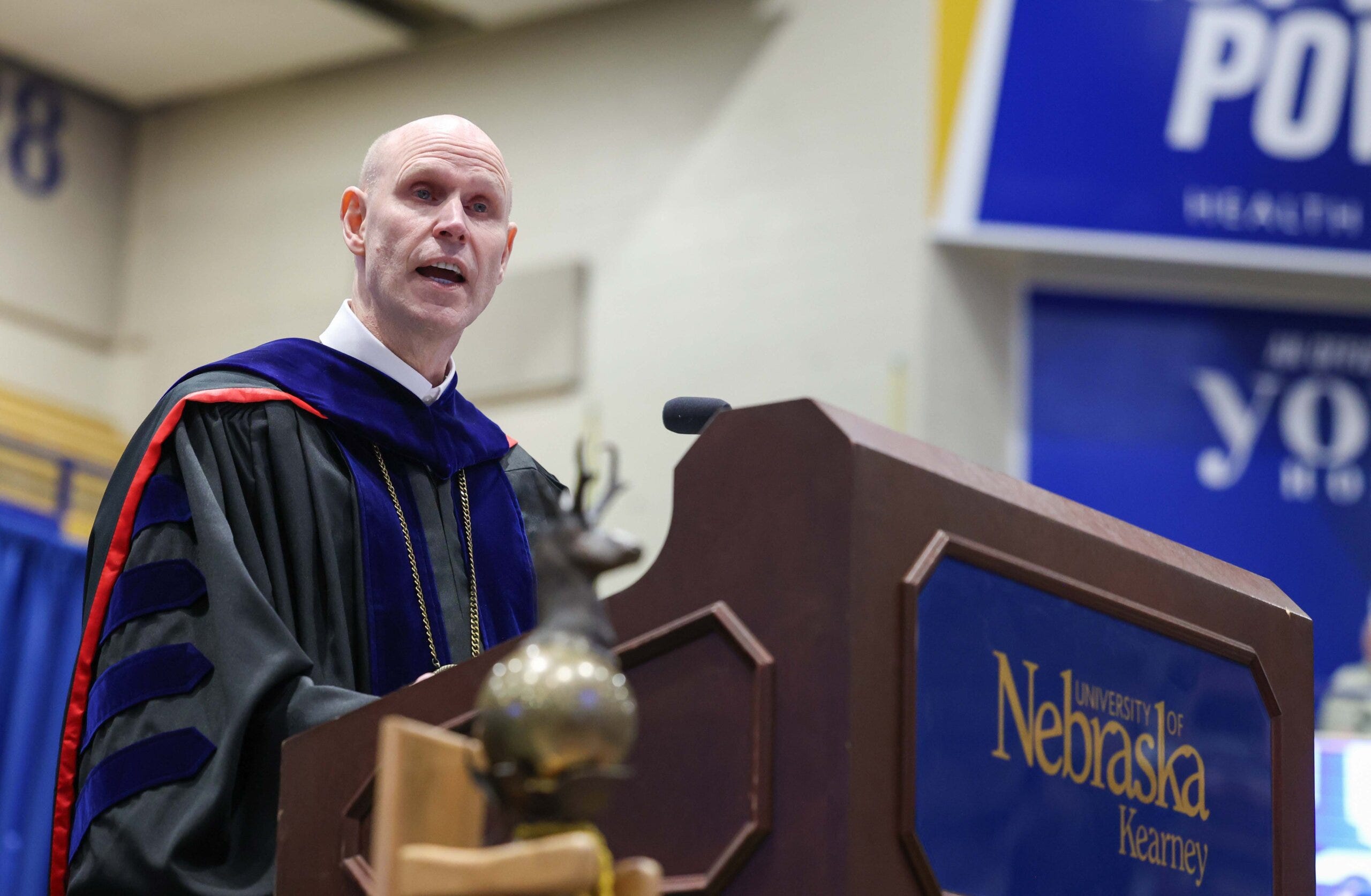
Chancellor Schnoor is the official charged with leading the “internal review” into claims made by faculty and students in conjunction with the university’s Chief Compliance Officer Alex Straatmann.
Schnoor has a long history of pushing diversity and equity initiatives. His resume with the University of Nebraska states he was key in guiding “equity initiatives” at a previous position as the chief of staff to the president at California State University-Long Beach.
An examination by The Plains Sentinel of Schnoor’s work as chief of staff shows he was a key figure in leading a “racial healing” initiative on campus following the George Floyd protests in 2020.
In 2021, Schnoor was tasked with helping lead the university’s “Institute on Truth, Racial Healing, and Transformation Campus Centers” and was put in charge of examining “policies and practices that promote or undermine racial equity, healing, and inclusion across and within divisions.”
The Institute’s goal was to develop “programming to address white fragility” and help leaders across campus “enact principles” in line with “statements supporting Black Lives Matter.”
Schnoor was also a critical part of the university’s “2030” initiative, which made it a goal to “embed equity and diversity into the fiber of the university.” The university now requires implicit bias, cultural competency, and anti-racist training for leaders of the university.
DEI & NDAs
Faculty at UNK have told The Plains Sentinel that the university has prioritized hiring new “DEI” faculty in place of professors who sought to defend traditional Western values. In one story relayed by faculty, a department attempted to hire a minority who was vastly less qualified than the other candidate, who was not a minority. When a department member pointed out the disparity in credentials, the department ended up offering both candidates the position. Both candidates declined.
In a second instance, faculty members told of another department where a minority faculty member was underperforming in their position and the university was looking to fire them. Instead of firing the professor over their performance issues, the university opted to eliminate the whole department line to avoid claims of racism.
A former member of UNK leadership told The Plains Sentinel that it’s an open secret that the university has separate pots of money to hire minority professors, and that they routinely hire and pay more for less qualified professors if they are minorities.
“Make no mistake if they have a minority candidate lined up, they’re going to get hired if they can,” the former leader said. “There’s always extra pots of money [for minority hires].”
“It was widely known that there were certain faculty who were struggling with very poor teaching evaluations, did very little research, and they were the highest paid instructors in their departments. Why? Because they were minorities.”
UNK has criticized reporting on the university for not including more on-the-record sources, and the Board of Regents chair, Paul Kenney, has called for faculty members to step forward.
Current faculty have said that UNK will almost certainly come for their jobs if they state their complaints publicly, and The Plains Sentinel is aware of multiple former faculty members who identify as conservative and have information relevant to our reporting, that have been made to sign NDAs.
Faculty say the NDAs have been used to keep former members quiet about changes or as part of buyouts, as current faculty get replaced with more “diverse” hires. The Plains Sentinel is aware of at least one professor who was forced to sign an NDA agreement in order to cover up a personnel decision that could have exposed the university to potential litigation.
The Plains Sentinel asked Kenney if the Board would allow former faculty under NDAs to step forward without repercussions. Kenney said the Board of Regents leaves those decisions to university leadership, but that he believes UNK should release former faculty from their NDAs to speak about potential discrimination.
“Sure, if they’ve got evidence to that,” he said. “You’ve got to be able to justify, than be a shadow.” Kenney also encouraged anyone under NDAs to use the anonymous whistleblower complaint hotline. UNK whistleblower complaints are reported directly to the chief compliance officer.
In a statement to The Plains Sentinel, a UNK spokesperson said, “UNK does not use nondisclosure agreements.”
‘Two People Raising Hell’
Despite concerns from lawmakers and advocacy groups, Kenney said the chief compliance officer heading the review did not seem to be finding too many issues.
“He said it was two people raising hell,” Kenney said about a recent conversation he had with Straatmann. The Plains Sentinel has spoken with over a dozen UNK members on background or on the record for our stories that have detailed instances of discrimination against conservatives. The university had previously told Kenney that reports of discrimination were only coming from anonymous sources, despite multiple people being on the record.
UNK has previously stated that they plan to release a full report after the review was complete, which a spokesperson said would take 30-45 days, starting from the first week of May.
Faculty have told The Plains Sentinel that the timeline of the university’s internal review is meant to extend well into the summer in hopes that any backlash disappears with students gone from campus.
UNK, both publicly and privately, has simultaneously dismissed specific free speech and discrimination claims as “isolated” and more general concerns from faculty and students as vague. In a statement following one of the stories from The Plains Sentinel, UNK sent out a campus-wide email stating, “we caution against broad characterizations of the campus community or academic environment based on what we understand to be isolated allegations and claims attributed to unnamed sources.”
At the time of the university’s statement, The Plains Sentinel had interviewed three current UNK students on the record over concerns about the free speech environment and treatment of conservative viewpoints on campus, with more students speaking on background.
In response to critics saying they were not taking the review seriously, a UNK spokesperson said, “The university is taking these concerns seriously, which is why Chancellor Neal Schnoor initiated a systematic review coordinated by UNK Compliance in collaboration with the University of Nebraska System.”
— John Gage is the executive editor of The Plains Sentinel.
Editor’s Note: The Plains Sentinel has opened a tip line for current and former students and faculty of the University of Nebraska to discuss their experiences and the learning environment across the university system. Send confidential tips to — plainssentinel@protonmail.com
You can always scare someone into saying whatever it is you want to hear, but that doesn't change their ideology or their actions. From everything I've read about the UNK leadership, there's a swamp there that needs to be drained.
Keep the pressure on. They wouldn’t have re-named their DEI office if they were serious about eliminating it.