

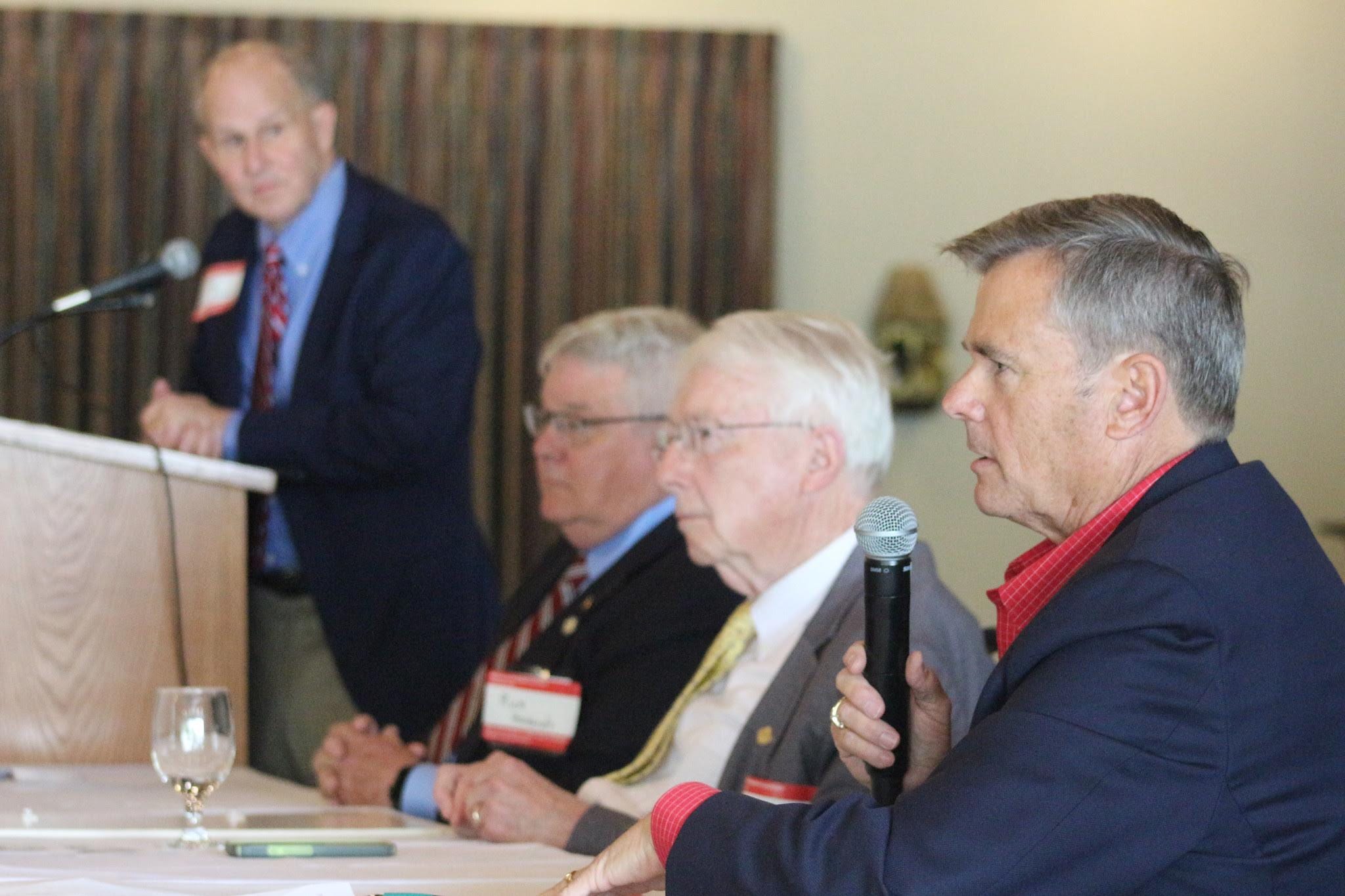
(Picture credit Matt Johnson)
OMAHA — With another legislative session concluded in the Nebraska Unicameral, state senators up for reelection are out campaigning with just days until the May 12 primary election.
Three Omaha state senators seeking reelection this year — Rick Holdcroft (LD-36), Merv Riepe (LD-12), and Brad von Gillern (LD-4) — spoke to voters this past week, making the case for why they should be reelected.
Brad von Gillern Faces Rematch with Cindy Maxwell-Ostdiek
Von Gillern highlighted the passage of LB 1165, a bill offering financial incentives for corporations, specifically aimed at keeping Union Pacific’s headquarters in Nebraska.
He also pointed to LB803, which added “truth in taxation” measures for property taxes by sending the familiar pink and blue valuation postcards two months earlier, giving taxpayers more time to respond.
“Now you’re going to get that in July — usually about two full months to contact P.J. Morgan and your school boards and other officials about their budgets and let them know you want them to hold the line and spend your dollars in a fiscally conservative way,” von Gillern said.
Von Gillern described LD-4 as a “purple district,” even though it swung for Trump by nearly 6% in 2024. In 2022, von Gillern defeated Cindy Maxwell-Ostdiek by 4.8 points to win the seat previously held by former state Sen. Robert Hilkemann, a Republican. Maxwell-Ostdiek is back for a 2026 rematch.
“In this campaign, I started earlier so that I could reach every neighbor in my district and listen to their hopes, their fears, and what they want to see from their legislator,” Maxwell-Ostdiek told The Plains Sentinel. Among these concerns are rising costs, skyrocketing property taxes, and a lack of affordable childcare and healthcare options.
Holdcroft Faces Challenger in a Deep Red District
Rick Holdcroft is running for a second term in District 36, which President Trump won by more than 23% in 2024. A retired Navy veteran, Holdcroft has focused on child protection, public safety, and agricultural tax relief, including the Newborn Safe Haven Act (LB876).
Challenging Holdcroft is Darin Tompkins, a former executive director of operations at Merck Animal Health and former first associate chair of the Sarpy County Democrats. In an interview with The Plains Sentinel, he emphasized eliminating government waste and inefficiency.
Tompkins cited double invoicing in the Department of Health and Human Services as “low-hanging fruit” and noted new state processes that increased a task from minutes and four clicks to 15 minutes and 50 clicks.
“Efficiency needs to be brought into government,” Tompkins said. “We talk about small government, but unless you make it efficient, you’re not saving costs — and you start hurting services. It’s the same thing in business.”
Holdcroft said he views Tompkins’ campaign priorities as predictable.
“I have an opponent, and he’s a Democrat, but obviously he’s running in an R-plus-20 district, so his only hope of getting elected would be to run as a Republican — and he’s just trying to do that,” Holdcroft said. “On all the major issues, such as men’s and women’s sports, he has no comment. Or on school choice.”
Like many Democrats running for office this year, Tompkins placed “affordability” front and center.
“I’ve had experiences where I’ve offered people jobs, they’ve accepted, and then looked for affordable housing and said, ‘No, thank you, I can’t afford the housing here,’” Tompkins said. “We have a problem, and we have not been fixing it.”
Holdcroft acknowledged rising living costs from his constituents but attributed them primarily to inflation, which he said the Legislature has limited power to address directly.
“The more government spending you have, the higher inflation goes — and we saw that as a result of COVID,” Holdcroft said. “After we came out of COVID, there was a huge amount of funding that went out, and it resulted in these inflationary pressures that pushed up costs. So how do you reduce that?”
Merv Riepe and a Write-In Candidate
Merv Riepe described District 12 as a “purple district.” It went for Kamala Harris by 2.3% in 2024 and has flipped between Democratic and Republican state senators over the past eight years. Riepe has earned a reputation as a “thorn in the side” of the Republican majority, breaking with his party on key votes such as State Sen. Joni Albrecht’s heartbeat bill in 2023.
This year, he faces three Democratic opponents. The candidate leading in fundraising (nearly $100,000) is Robin Richards, who ran against Riepe in 2022 and lost by a few hundred votes. Richards will not appear on the primary ballot this year after her filing fee check was returned for insufficient funds; she is now running as a write-in candidate.
Richards said she has had a friendly relationship with Riepe while serving with him on the Ralston school board, but she now has concerns about his age.
“This summer he will turn 84, which means if he gets the chance to finish a second term, he’ll be 88 when he’s done,” Richards told The Plains Sentinel. “That is an issue in my district. Many, many people have brought it up to me. They are deeply concerned that he will not make it through another four years, and then we don’t have any choice over who our representative is.”
Riepe responded directly to concerns about his age.
“Well, I was talking with Chuck Grassley this morning on the phone — he is 93 and still serving,” Riepe said. “I’d point out, first of all, that I’m knocking on doors. I walk parades. I also have not missed a day in session or a community meeting. I’ve never had surgery. I’ve never had a major illness. So my argument would be it’s a number, and quite frankly, I can do it. If I didn’t think I could, I would not put my family through it as well.”
Richards sees value in a state senator willing to break with his party and work across the aisle, citing former Sens. John McCollister and Mike McDonnell as positive examples.
“What we’ve lost right now is the institutional knowledge that senators carry when they’re just gone after eight years,” Richards said. “We need to have a little more across-the-aisle conversation about how we come back from all of these social justice issues taking up so much of our time and make Nebraska the priority again.”
GOP Senators Skeptical of Ballot Initiatives
The Legislature’s inaction this year on property taxes and changes to previously passed ballot initiatives, has triggered a number of new ballot initiatives — with a total of twelve in circulation currently. State senators over the past two sessions have fought over how to implement or change ballot initiatives including the recently passed medical marijuana initiatives that are currently being litigated in court as well as changes to the state's minimum wage.
Riepe expressed skepticism about the petition process. “If we put a petition down there that said ‘every citizen in the state of Nebraska would get a check, free and clear, for $20,000,’ everybody would sign that — but there would be nobody to pay for it,” he said.
Riepe specifically criticized the Advocates for All Nebraskans (AFAN) backed proposal to cut property taxes in half.
“One individual — who, if I mentioned his name, you would all know — said he was going to run a petition that would cut property taxes in half. Then, in the Omaha World-Herald, he said, ‘I’ll let the Legislature figure out how to pay for it.’ OK, that’s not very mature.”
Von Gillern agreed.
“I ran the numbers. If that initiative were to pass and the legislature said, ‘Okay, we’ll fix it via sales tax,’ our state sales tax rate would go to 11.5%,” von Gillern said. “Then you add in city and local taxes, plus a lot of restaurant tax. If you go out to eat in Omaha, it would be 14%. And if you’re in an entertainment district, that adds another two to three percent. So if you eat at Blackstone or at a hotel, your sales tax rate could be around 17%.”
In response, Eric Underwood said in a statement to The Plains Sentinel that Riepe and von Gillern were “attacking the judgment of their own colleagues.” Underwood pointed to bills put forward by State Sens. Loren Lippincott and Dan Lonowski that made the AFAN petitions into legislative bills.
Challengers Back Initiative Process
Both Tompkins and Maxwell-Ostdiek have made the fight over ballot initiatives a cornerstone of their campaigns. Tompkins and a PAC aligned with his campaign have sent half a dozen mailers against Holdcroft, attacking him for his votes to modify ballot initiatives that have passed.
“As a leader, you may not know what people want. But in these instances, you do,” Tompkins said. “And so we need to respect that as a representative, and you need to do the work.”
Maxwell-Ostdiek echoed a similar sentiment with regard to ballot initiatives. “I haven’t always been on the ‘winning side’ of a ballot measure, but when the voters speak, it is the job of lawmakers to listen and implement their will. That shouldn’t be controversial,” she said.
Riepe disagreed, noting that the legislature has the constitutional authority to amend ballot initiatives.
“Most of the people who sign petitions don’t feel that way,” Riepe said. “They feel, ‘I sign it, you do it. I am the second house, you work for me.’ Somebody has to be the adult in the room.”
In February, Riepe voted to alter rules on the minimum wage (passed via ballot initiative in 2022) to allow a lower rate for teenage employees.
Holdcroft chimed in on the minimum wage issue.
“The minimum wage at $15 doesn’t sound like much. That puts us number 11 in the nation for the highest minimum wage,” Holdcroft said. “Think about a company that’s coming to Nebraska, or right into the Midwest, and is looking at minimum wages. Where are they going? They’re not going to Nebraska, with the highest minimum wage in the area.”
Von Gillern spoke about an online gambling initiative he expected to pass, calling the issue “an absolute physical disaster” based on personal stories he has heard of young people ruined by gambling debts.
“It is absolutely, absolutely a physical disaster,” von Gillern said. “I know of personal stories of young men that are in college that have spent every dime of their student loans, every dime of their credit card debt. They’ve sold their vehicles. It is absolutely devastating, and it’s going to pass.”
He also added a broader critique of ballot initiatives: “It’s not uncommon for a bill to be 20, 30, 60, 80, 100 pages long. How long is a valid initiative that you all hold on? It’s 12.5 inches, about that big on your ballot, right? I don’t know how anyone thinks it could possibly write a good law off of that.”
This stance does not surprise von Gillern’s opponent. “After voters spoke on medical cannabis, earned paid sick leave, increased minimum wage, and keeping public dollars in public schools, Senator von Gillern voted to gut every measure,” Maxwell-Ostdiek said. “That is a betrayal to the voters of Nebraska and our district.”
What’s at Stake
With a 33-seat supermajority, Republicans are aiming to hold or increase their numbers, and Democrats continue to target vulnerable seats in hopes of breaking the GOP supermajority next year.
This cycle features at least half a dozen battleground seats, mostly in Omaha, where Republican and Democrat candidates will likely face off in competitive races. Nebraska Accountability and Disclosure Commission filings from last month showed Democratic candidates have raised more money in most of the competitive races as the general election approaches.
— Matt Johnson is a freelance reporter with The Plains Sentinel.
Merv Riepe disproves the old adage that wisdom comes with age. I believe most men in their 80's and not suffering from senility would want to keep males out of female bathrooms and locker rooms. Not Merv. He has no problem with it. And gender transition surgeries on minors? Merv is fine with that as well. From my perspective, Merv's age and his physical fitness are of no concern, only his moral compass.
District 4, District 18, District 12, District 36, District 14, District 48,. District 30, District 32, and District 2 and District 16. As well as 10. All being targeted by Democrats.
--