

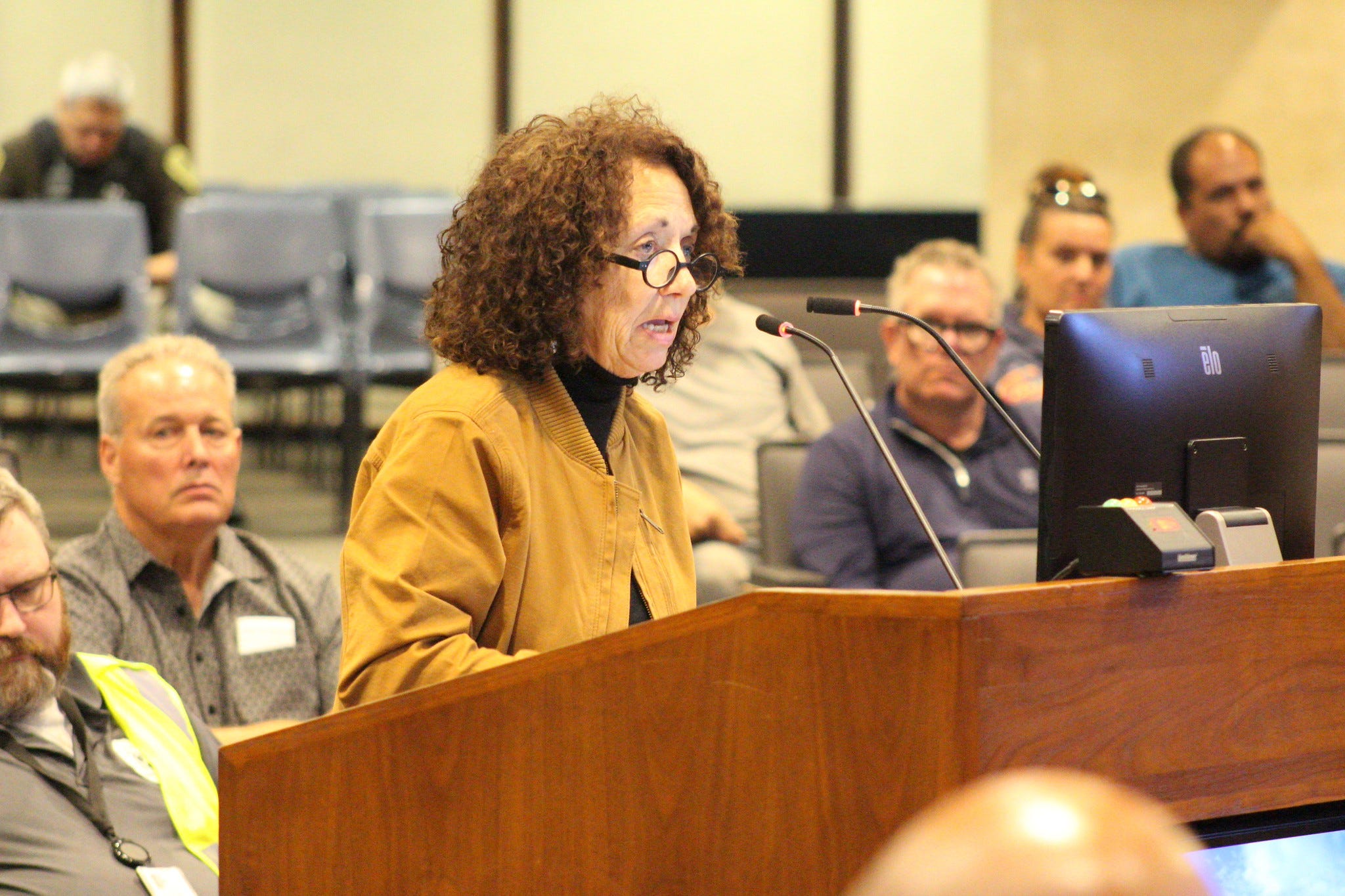
(Picture credit Matt Johnson)
LINCOLN — Thousands of Nebraska taxpayers have received pink postcards in recent weeks as subdivisions statewide hold joint public hearings before increased property tax requests may take effect.
The pink postcards and public hearings have produced outcry in Omaha, Lincoln, and across the state as citizens grapple with significant tax increases. In a year where assessed property values have climbed a statewide average of over 6%, property taxes for home and business owners will increase absent a reciprocal decrease in levies.
But far from decreasing, it appears that many levies will rise this year across the state’s many hundreds of subdivisions – schools, cities, counties, etc.
“I know that there’s more than 40 counties across the state that are having to hold these meetings,” Bud Synhorst, the national field director at Citizens for Free Enterprise, told The Plains Sentinel. “In Lancaster County it’s city and school district. In other counties, it might be the county and the school, or the county and the city.”
By Nebraska law effective until 2027, when a subdivision increases its yearly budget request by more than allowable growth percentage – a basis of 2% plus the subdivision’s real growth percentage – a joint public hearing is triggered. Next year, all counties will be required to hold these meetings, regardless of whether they propose an increase.
The county-organized hearing features the county assessor and voting members of all subdivisions with a qualifying budget increase. At the meetings, they present the details of their proposed budget increase and receive public comment.
Douglas County’s hearing included presentations from the County CFO, as well as representatives from Omaha, Bennington, and Elkhorn Public Schools.
Lancaster County’s hearing consisted of the City of Lincoln as well as Lincoln, Norris, and Waverly Public Schools.
‘You Can Afford Your Tax Increase, I Can’t.’
At the Lancaster County hearing earlier this month, responses were uniformly negative to the steep property tax increases requested by public school districts, with residents addressing representatives for well over an hour.
Most took issue with the taxing subdivisions’ inability to reduce their budgets, while many more directed their frustrations at Dan Nolte, the Lancaster County Assessor.
“We bought a town home in 2022 so we could age in place – my husband has a neurological condition,” said Donna Roller of Lincoln. “In ’22, we paid $181,000 for this townhome. And you raised it, in four years, the valuation to $90,000 more.”
While in the past three years, Lancaster property values have climbed far less than those of most Nebraska counties, they did jump an incredible 22% from 2022 to 2023 while total levies fell only 10% that year, generating a 9% increase in tax revenue.
Katrina Chambers of Lincoln said she had inherited multiple grass lots in the county without water or sewer access. Two years ago, they were assessed as residential, increasing their valuation from $9,000 to $27,000.
“I have no access to sewer, no access to water, I can’t get a curb cut, but it’s residential?” she said. “These people are complaining about 12%, 17%, 30%, I had a 200% increase in taxes on a dirt lot.”
One attendee had prepared to talk about his property’s assessed value, but diverted to express incredulity at Norris Public Schools’ 16% levy increase – the district having cited, among other reasons, the need for staff pay raises.
“Why are you having to increase over 3% for your payment of teachers and everybody else? I worked in the manufacturing sector; we never got over a 3% raise,” he said.
While Lincoln Public Schools did succeed in dropping its levy, Christopher Phillips of Lincoln pointed to LPS’s salaries for the “everybody else” that the prior speaker had mentioned. He used them as examples of reducible expenditures, asking the present LPS representative, Liz Standish, to correct him if he was wrong on the numbers.
“The superintendent, in 2025, made $330,000. Assistant superintendent made $275,000, the next assistant superintendent made $253,000,” he said. “The fourth assistant superintendent made $248,000. The fifth assistant superintendent… $221,000. The sixth assistant superintendent for Lincoln Public Schools in 2025 made $214,000.”
Multiple speakers who followed expressed total shock that the superintendent’s office was receiving upwards of $1.5 million yearly. Only a single man lauded the fact.
“I don’t mind that,” he said. “But we pay them so they can make the hard decisions. So we don’t go over what we experienced here tonight.”
Max Rice of Lincoln, a former public school teacher, put it candidly to the assembled officials.
“You can afford your tax increase, I can’t.”
Another retired LPS educator expressed her frustrations with the public budgeting process.
“I remember a few years with budgets where they would say – you know – ‘if you don’t spend it, we’re not gonna get it for next year, so spend all your money,’” she said.
“It’s pretty easy to have a mob mentality when – you know – we have all these people… what if everybody who was involved in making the budget decided that only the people whose children were in school needed to fund their education? I bet a lot of things would be cut.”
Changes Coming to the Process
While the future remains uncertain amid federal interest rates and state budgetary issues, 2027 will bring changes to the pink postcard system. While the initial postcard system has served its goal of properly alerting the public to proposed tax hikes, it’s not changed much in terms of actually averting them.
“The political subdivisions go through their budgeting process, then they have to have these meetings, and then they adopt their final budget,” Synhorst told The Plains Sentinel. He added that he was not aware of any county or school district that had lowered its property tax ask following a pink postcard meeting.
“They’ve been happening since 2022 — I haven’t seen a great deal of political subdivisions backing down from what they’ve proposed.”
Reports from meetings from Lincoln County to Otoe County reveal taxpayers across the state upset at their rising property tax bill, some saying they have seen increases of over 50% just this year.
Jon Cannon, the executive director of the Nebraska Association of County Officials, said property taxes continue to go up because the cost of local government continues to rise.
“The system that we have set up has dictated that things that are local in nature are paid for locally, and the state still does not provide as much direct aid to its local political subdivisions as most other states do,” Cannon said. “That said, the property tax credits provided by the state go a long way toward cushioning some of the increases that we have seen.”
The state has already attempted to soften the property tax blow by assuming the operating levies for community colleges. LB803, which takes effect in January 2027, aims to update the public about likely tax increases far earlier in subdivisions’ budgeting processes.
“The budgeting process in a lot of these political subdivisions started in May or June. And so it’s been going on, and you know sometimes it’s just not something that’s right in front of mind until a postcard like this shows up,” Synhorst said.
LB803 will require county officials to alert property owners to changes in value as early as June. It will further require all levying subdivisions to take part in joint public hearings, and move those hearings from mid-September to early July.
Furthermore, any subdivision that increases its property tax request from the previous year – even if it entails a decrease in levy – will require a two-thirds majority vote.
— Lewis Thune is a writing fellow with The Plains Sentinel.