

LINCOLN – With the legislative session coming quickly to a close, over a dozen Republican priority bills will likely be the casualty of a session defined by state senators working to close a budget deficit that rose to nearly $650 million.
Top conservative priorities that were given a personal priority by Republican state senators, including property tax relief measures, winner-take-all, and a bill to keep biological men out of women’s locker rooms and bathrooms, did not get scheduled for debate on the floor — leaving some Republicans frustrated with how the session developed.
Each year, the speaker of the Legislature, who is responsible for setting the agenda, tries to get to as many senators’ personal priority bills as possible, but with limited time, not all of the priority bills end up getting taken up each year.
Speaker John Arch told state senators on Tuesday that the fight over the budget “took away time we could have used to debate priority bills on General and Select File.”
GOP Amendment Attempts Fail
Two Republican senators attempted to get their priority bills attached to other measures during Tuesday’s floor debate, causing outrage from Democratic senators.
Lincoln State Senator Beau Ballard attempted to bring as an amendment to a committee package his priority bill, which would allow residents in a three-mile extraterritorial zoning jurisdiction (ETJ) to vote in Lincoln city elections. Ballard argued that residents who were being regulated by the city should be able to vote for the people responsible for regulating them.
Democratic state senators unloaded a flurry of accusations against Ballard and his bill, claiming it violated the Constitution and the Voting Rights Act. “My friend Senator Ballard has decided to throw a bomb, or a wrench, with his bill,” State Senator Danielle Conrad told Ballard, accusing him of trying to “dilute” votes in the city.
“I don’t want to hear anymore scolding of progressives over wasting time as long as Senator Ballard’s amendment is on the board,” State Senator Megan Hunt told the Legislature.
State Senator Machaela Cavanaugh filed a deluge of amendments ahead of Ballard’s to keep it from making it onto the committee package. Cavanaugh demanded Ballard withdraw his amendment to save time, saying there was only a “0.00001%” chance of state senators getting to his amendment.
He eventually withdrew his amendment.
Before the debate on the measure, Ballard told The Plains Sentinel that he had 33 votes secured to pass his amendment. When pressed on why the speaker did not take up his priority bill, Ballard said he was not given a reason. “I wish I knew. Arch didn’t want to take the time.”
After Ballard told colleagues he was pulling his amendment, State Senator Carolyn Bosn, a fellow Lincoln resident, said she wished the proposal could have been fully heard out because residents in the ETJ believed Lincoln was taking advantage of them.
“Constituents in my district tell me about stories about issues they have [with the city],” she said, adding that Lincoln officials would cause “headaches” for residents outside of the city limits and ignore them because they do not have any political power. “Nobody wants to listen because your vote doesn’t matter to them.”
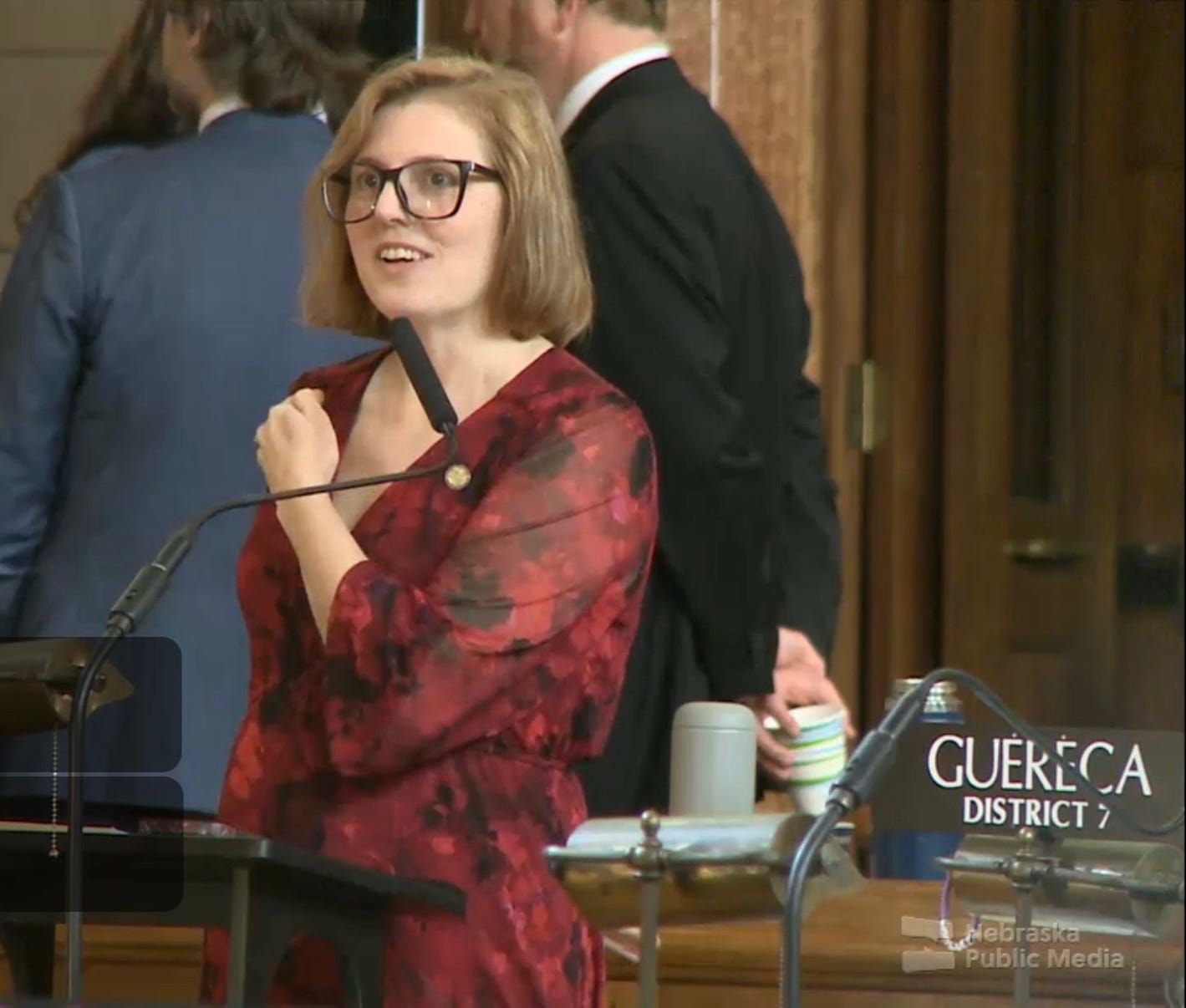
State Senator Kathleen Kauth also attempted to amend her “bathroom bill” to require government buildings to segregate locker rooms and restrooms by sex, onto State Senator Dunixi Guereca’s bill to require paid maternity leave for state employees.
After a short debate where Republican State Senator Merv Riepe reiterated his opposition to the state being “the potty patrol,” Guereca asked the chair to rule Kauth’s amendment not “Germane,” which the chair promptly did — killing the amendment.
Republicans ‘Pissed’ Over Bill Disparity
In conversations with The Plains Sentinel, multiple Republican state senators expressed frustration that over a dozen Republican priority bills did not see the floor in contrast to just a couple of Democratic priority bills.
“Everyone is pissed,” one Republican state senator told The Plains Sentinel on background. The senator described the session as “awful” for conservative priorities.
Another GOP state senator said the speaker should have selected priority bills that reflect the political makeup of the body. “If two-thirds of the body is conservative, then two-thirds of the body needs to be heard on priority bills,” the state senator said. “So that true representation of the body is being heard.”
“I feel like there’s an effort to be impartial, and sometimes it might appear to others that it’s not impartial,” the state senator added.
Priority Bills Need 33 Votes?
Arch has told state senators that they need to show him 33 votes for a bill to see the floor. State Senator Ben Hansen, the chair of the Legislature’s Executive Board, also mentioned the 33-vote threshold in a conversation with The Plains Sentinel as to why many Republican bills did not get floor time.
The 33-vote rule appears to be more of a recommendation than a hard and fast rule. For example, Democratic State Senator John Cavanaugh’s priority bill LB933, which gave immunity to doctors recommending medical marijuana, came to the floor on March 20 and received hours of debate before advancing 30-7 on the first round of debate.
Multiple state senators noted ahead of the Select File debate on the bill that it never had 33 votes to break the filibuster. The bill died on Select File Tuesday night after Cavanaugh pulled his bill, saying it did not have the support to pass in the form he wanted it to. One state senator told The Plains Sentinel that Cavanaugh was able to bypass Arch’s 33-vote rule after trading his vote on another measure with legislative leadership.
Hansen said he understands that “some senators might see it as an ideological point” that their bills did not make the floor, but that there were other considerations made on why bills did not get heard on the floor.
He added that Republican state senators were more likely to bring politically charged legislation, while Democrats tended to try to prioritize bills they thought they could get passed.
Republican State Senator Mike Moser said that Arch takes into consideration the topic, importance, and whether a bill has the votes when deciding which bills get floor time. “There’s more that goes into the process than whether you are a Republican or a Democrat,” he said.
Moser added that “if I were speaker, I would only put Republican bills up… but that’s why I wouldn’t get voted speaker.”
John Gage is the executive editor of The Plains Sentinel.
Republican State Senator Merv Riepe trivializes keeping boys out of girl's locker rooms by referring to it as a "potty patrol". Common sense should prevail, but lack of it leaves girls vulnerable to emotional trauma and sexual abuse. Are we sure the senator is Merv Riepe and not Perv Riepe?