
Editor’s Note: The Plains Sentinel has opened a tip line for current and former students and faculty of the University of Nebraska to discuss their experiences and the learning environment across the university system. Send confidential tips to plainssentinel@protonmail.com
In May, faculty at the University of Nebraska at Kearney (UNK) told The Plains Sentinel that multiple former faculty members had been forced by the university to sign non-disclosure agreements (NDAs) as the university attempted to push out unaligned faculty in favor of new “DEI” hires.
At the time, the university said in a statement that “UNK does not use nondisclosure agreements.” The Plains Sentinel promptly made a public records request for all nondisclosure agreements “between the University of Nebraska at Kearney and any former faculty member or administrator.”
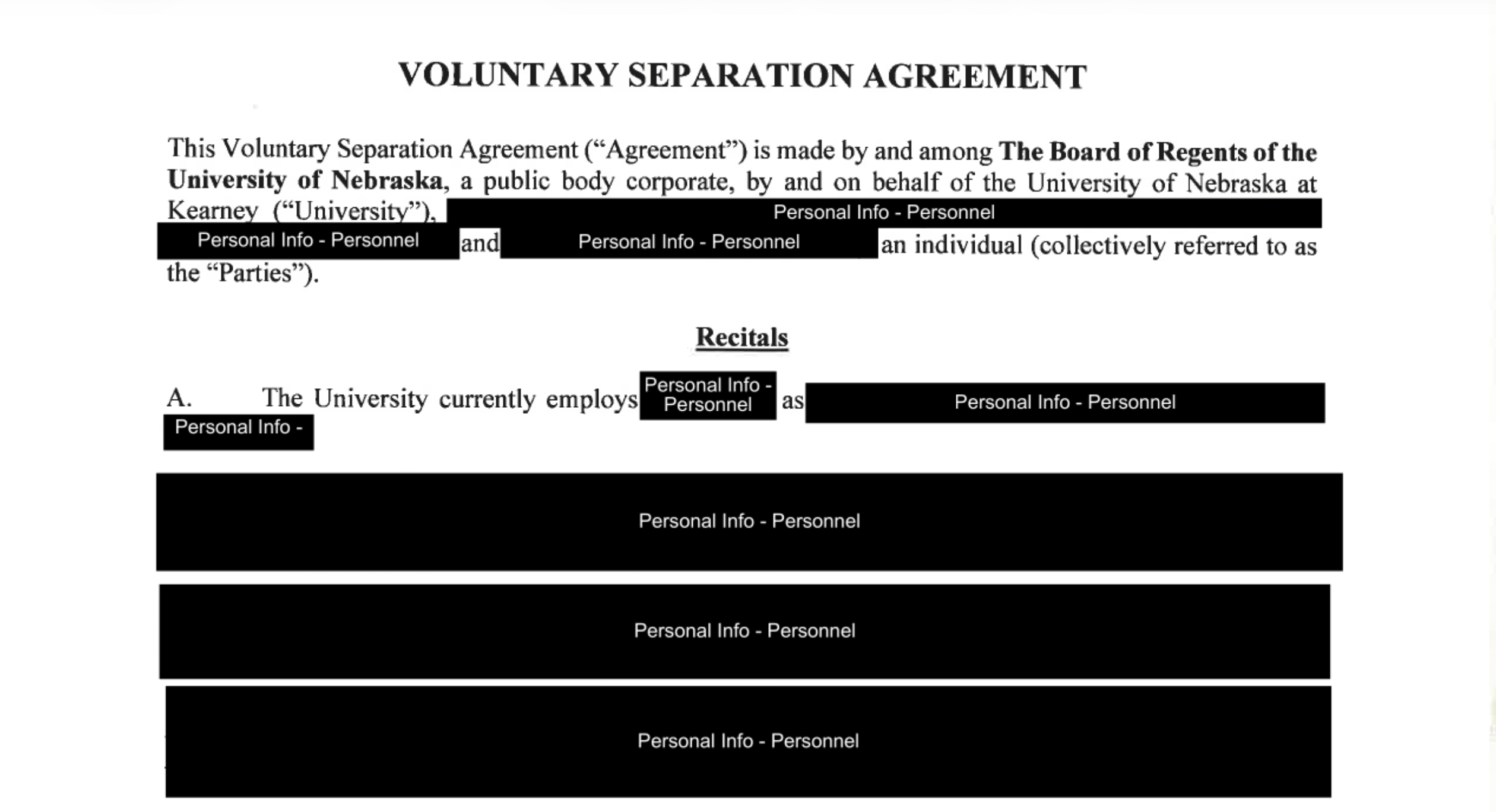
Three months later, UNK returned over a dozen voluntary retirement and separation agreements that contained non-disclosure clauses signed by former university members. The agreements show that UNK spent around one million dollars on retirement and separation contracts from September 2022 to February 2025 that included the non-disclosure clauses.
Contract Redactions
Contracts from UNK contained significant redactions, a fact that the university legal team highlighted as a reason for the delay in handing over the information. “The University has withheld through redaction personal information regarding personnel other than salary or routine directory information pursuant to the Nebraska Public Records Act,” Molly McCleery, the associate general counsel for the University of Nebraska, told The Plains Sentinel.
Contracts included both “non-disparagement” clauses and “confidentiality” clauses.
“[Redacted] shall not make, in any manner or at any time, any negative or disparaging comments or statements regarding the University of Nebraska System, its various universities including the University of Nebraska at Kearney, or any of their past or current Board of Regents, administrative officers, deans, employees, agents, students, colleges, departments, divisions, programs or services.”
The confidentiality parts of the agreement barred former faculty members from disclosing the existence of the agreement publicly. Current and former members of the university told The Plains Sentinel that while the agreements were titled either “voluntary separation agreement,” “separation agreement,” or “voluntary retirement agreement,” there was an understanding between both the university and the signers of the agreement that both parties were signing an NDA.
McCleery said that “all faculty sign a confidentiality statement,” and included a copy of the university-wide confidentiality agreement. The university-wide agreement is a standard “confidentiality statement” that bans employees from releasing confidential information such as “budget, financial, personnel, payroll or procurement information,” and differs from the dozen separation and retirement agreements that the university also handed over that included payments in exchange for silence from former faculty.
NDA Signers Speak Out
Using alternative documentation, The Plains Sentinel was able to uncover the identities of nearly all the signers of the NDAs despite retractions by the university. The Plains Sentinel reached out to multiple former faculty members, who had signed the agreements, to ask about why the university had made them sign one.
One signer told The Plains Sentinel that they believe the university is using the agreements to cover up illegal activity.
“The only possible reason you can have for doing this is they are doing illegal sh*t,” a former faculty member told The Plains Sentinel. “What would count as a legitimate reason for a public university to make a professor sign such a thing? I can’t think of anything.”
The signer added that they believe the agreements were antithetical to the spirit of a public university.
“It should be illegal for a public university to have a professor sign these things. I mean – it’s a public university. It’s run on your tax dollars. What are they trying to hide? They’ve got to be trying to hide something if they are having you sign these things.”
The Plains Sentinel spoke with faculty members, who said that many of the NDAs were signed by former members of the campus the university had wronged, silenced, and quickly shipped off campus.
Multiple signers of the NDAs told The Plains Sentinel that they want the university to lift their NDA so they can speak out. Earlier this spring, Board of Regents Chair Paul Kenney told The Plains Sentinel he believes UNK officials should waive NDAs if former faculty are aware of illegal activities the university is engaged in.
“Sure, if they’ve got evidence,” Kenney said. “You’ve got to be able to justify, than be a shadow.”
UNK Responds
The Plains Sentinel reached out to UNK to ask why they had said they did not use NDAs when their own lawyers had given over a dozen documents containing non-disclosure agreements. A spokesperson for the university said it was because the agreements were really a “Voluntary Separation Agreement” and not NDAs.
“UNK does not use nondisclosure agreements. Voluntary separation agreements conform to employment law, must be mutually agreed upon, and the confidentiality clauses pertain only to the specific, mutually agreed upon, terms of the agreement.”
Signers of the voluntary separation/retirement agreements told The Plains Sentinel it was clear to them that they had signed an NDA and that the university has made it clear that they will go after them if they break the confidentiality clause.
One signer of an agreement disagreed said the university is intentionally using the agreements to hide information from the public.
“What do these faculty members know that the administration doesn’t want the people of the state of Nebraska to know?”
— John Gage is the executive editor of The Plains Sentinel.
That's quite a leap from "UNK does not use nondisclosure agreements" to providing forced nondisclosure agreements three months later. It apparently took three months to conceal details by redacting the documents. NDA's, as well as the redacting, are used to conceal information from the public. One has to believe at the very least illegal activities are being concealed, or are criminal activities being covered up as well? When we talk about draining the swamp we usually think about Washington D.C., but it certainly looks like there's a mini-swamp in Kearney that needs to be drained.
I find it difficult for UNL to avoid being legally prosecuted for employment abuse.